
White Clover – 100 Seeds
(Trifolium repens 'Haifa')
R30.00
White Clover is a vigorous, large-leaved, early-maturing Mediterranean-type clover. It is a very versatile plant with multiple uses.
Indoor Sowing: Not Recommended.
Direct Sowing: Late Summer, Early Autumn and Spring.
Only 1 left in stock
🌿 Plant Quick Facts
Plant Info
- 🌍 Origin / Region: Central Asia, Europe, Mediterranean
- 🌸 Flower Color: Pale Pink, White
- 🦋 Pollinator Method: Attracts Bees, Attracts Butterflies, Attracts Moths
- ⓘ Plant Use: Culinary, Fodder, Medicinal, Nitrogen Fixer, Pasture Mixes, Soil Improvement
Medicinal Info
- 🌿 Medicinal Part: Flower, Leaf, Root
- 🍵 Herbal Preparation: Extract / Tincture, Infusion / Tea, Ointments/Creams, Poultice
- ⚕️ Healing System: American Traditional Medicine, European Traditional Medicine
Culinary Info
- 🍽️ Culinary Use: Beverages/Teas, Cooked greens, Garnish, Salads, Stir-frying
- 🥗 Edible Part: Flower, Leaf, Root, Seed Pods
- 😋 Flavor Profile: Bean-like, Grassy
Growth Traits
- 🌱 Life Cycle: Perennial
- 🌾 Plant Type: Perennial legume
- 🪴 Growth Habit: Mat-Forming, Prostrate
Growing Requirements
- 🌞 Sun Exposure: Full Sun, Shade
- 💧 Water Needs: Regular Water
- ☀️ Growing Conditions: Cold Tolerant, Frost Tolerant, Heat Tolerant, Moist Conditions, Not Drought Tolerant
- 🟤 Soil Preference: Clay loam, Fertile, Loam, Well-Drained
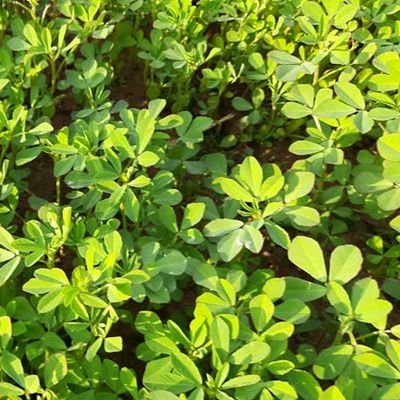
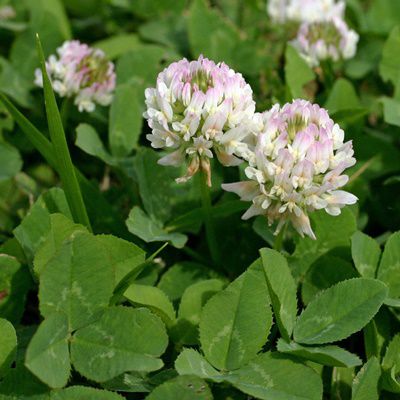
White Clover (Trifolium repens ‘Haifa’) is a vigorous, large-leaved, early-maturing Mediterranean-type clover, often selected for high forage production, rapid establishment, and strong nitrogen fixation. It is a prostrate, mat-forming perennial with creeping stems (stolons) that root at the nodes. The leaves are trifoliate (three leaflets), smooth, and often marked with a light or dark “V”. The plant produces white or pale pink, globe-shaped flowers in dense clusters on long stalks.
General Use:
- Pasture & Forage: Widely used in mixes with grasses (ryegrass, fescue) for grazing sheep, cattle, and horses.
- Cover Crop: Used to improve soil quality and nitrogen levels.
- Lawns: Useful for nitrogen fixation and covering bare soil.
Culinary Use
- Leaves: Young leaves are best eaten raw in salads, sandwiches, or smoothies. Older leaves should be boiled for 5–10 minutes to improve digestibility and reduce bitterness.
- Flowers: The white or pinkish blossoms have a sweet, mild flavor and can be eaten raw, used as a garnish, or dried to make tea.
- Roots: While edible, roots are generally consumed only in survival situations and should be boiled to remove bitterness.
- Seed Pods: Can be dried and ground into a nutritious flour.
Medicinal and Nutritional Uses:
- Respiratory & Fever Support: Infusions of flowers and leaves are used to treat coughs, colds, fever, and bronchial issues.
- Anti-inflammatory & Pain Relief: Used to treat rheumatic pain and gout.
- Skin Care: Applied in salves for wounds, burns, and sores due to antiseptic properties.
- Nutritional Content: Rich in vitamins A, C, E, and K, as well as minerals like calcium, magnesium, and potassium.
- Women’s Health: Contains phytoestrogens (genistein), which may help with menopausal symptoms
Cautionary Notes:
- Coumarin Content: Contains coumarin, which is an anticoagulant, so it should be avoided by individuals with bleeding disorders.
- Pregnancy/Medication: Not recommended during pregnancy or for those using oral contraceptives or hormone therapy.
- Safety: Do not consume browned flowers.
Growing White Clover
Indoor Sowing: Not Recommended.
Direct Sowing: Late Summer, Early Autumn and Spring.
- Prefers well-drained, fertile, loam or clay-loam soils.
- It is highly adaptable but needs good, consistent moisture during germination.
- Prepare a fine, firm seedbed.
- Seeds should be planted shallowly, about 5–15 mm deep.
- Lightly cover seeds with soil to ensure good seed-to-soil contact.
- Keep the soil consistently moist during the germination period, which usually takes 7–10 days.
Can this plant be used for culinary purposes?
White Clover is traditionally used for culinary purposes such as beverages/teas and cooked greens.
Does this plant have medicinal uses?
Traditionally, White Clover has a history of use in various healing systems, including American Traditional Medicine and European Traditional Medicine. Seeds are sold for cultivation purposes only.
Disclaimer
Medicinal Information:
All medicinal information on this website is for educational and informational purposes only and may not be construed as medical advice. The information is not intended to replace medical advice or treatment offered by healthcare professionals.
Seeds, Plants, Plant Cuttings, Geophytes and Dried Herbs:
In some countries and provinces, certain plants are deemed as invasive and are not allowed to be planted at all, whilst some plants are allowed to be grown only in certain areas or provinces. The onus is on you as the buyer to familiarize yourself with the regulations pertaining to your location, before purchasing any of our seeds, plants, plant cuttings, geophytes or dried herbs. We will not be held liable, should you purchase any seeds, plants, plant cuttings, geophytes or dried herbs. from us which are prohibited in your country or province.
Related products