
Fruit Gardening
Pruning Fruit Trees
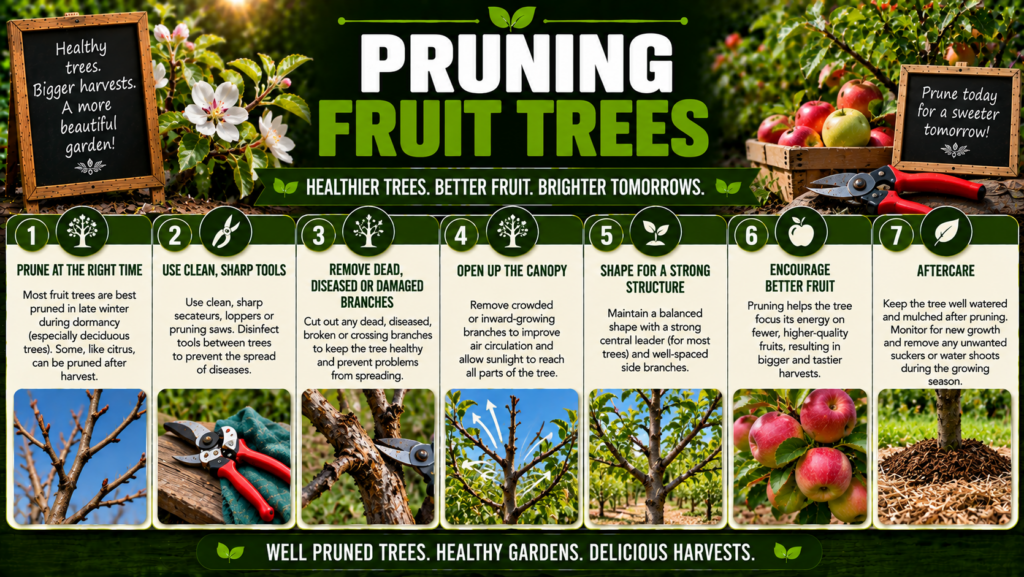
If you have recently planted a fruit tree in your garden, you may eventually find yourself wondering whether you should prune it.
For many new gardeners, pruning can seem a little intimidating. You may worry about cutting off the wrong branch or damaging the tree.
The good news is that basic fruit-tree pruning is not as complicated as it first appears.
Pruning is simply the selective removal of branches, shoots or other growth to help manage the shape, size and health of a tree.
The important thing is to understand why you are pruning, when to do it and which branches actually need to be removed.
This guide introduces the basics of pruning fruit trees so that beginners can approach the job with greater confidence.
Why Do Fruit Trees Need Pruning?
Fruit trees can often grow perfectly well without regular pruning, but selective pruning can help you manage the tree and its growth.
Depending on the type and age of the tree, pruning may help to:
- Remove dead or damaged branches
- Improve airflow through the canopy
- Allow more sunlight to reach parts of the tree
- Control the overall size and shape
- Remove crossing or rubbing branches
- Encourage productive growth
- Make harvesting easier
- Keep branches from becoming excessively crowded
Pruning is therefore not simply about making a tree look tidy.
The aim is to create a healthy, manageable structure while removing growth that is unnecessary or problematic.
When Should Fruit Trees Be Pruned?
There is no single pruning month that applies to every fruit tree.
The correct timing depends on:
- The type of fruit tree
- The age of the tree
- The climate
- Whether the tree is evergreen or deciduous
- The reason for pruning
- The tree’s flowering and fruiting habits
This is particularly important in South Africa because growing conditions differ significantly between regions.
A pruning schedule suitable for a deciduous apple tree in one part of the country may not be appropriate for an evergreen citrus tree.
Always learn the specific pruning requirements of the fruit tree you are growing.
Winter Pruning
Winter is often associated with pruning because many deciduous fruit trees lose their leaves during winter.
When the leaves have fallen, the branch structure is easier to see.
This can make it simpler to identify:
- Dead branches
- Crossing branches
- Weak growth
- Unwanted shoots
- Branches growing into the centre of the tree
However, winter pruning is not automatically correct for every fruit tree.
Some trees are better pruned at other times of the year.
Summer Pruning
Some fruit trees can benefit from selective summer pruning.
Summer pruning can be useful when the aim is to manage vigorous growth or improve light penetration.
It can also be used to remove certain unwanted shoots while the tree is actively growing.
However, excessive pruning during hot weather can place additional stress on a tree.
The amount and timing of summer pruning should therefore be appropriate for the particular fruit tree and local climate.
Evergreen Fruit Trees
Evergreen fruit trees require a slightly different approach.
Citrus trees, for example, generally retain their leaves throughout the year and do not have the same dormant winter period as deciduous fruit trees.
Routine pruning of citrus is often relatively light.
The main aim may be to remove dead, damaged or poorly positioned branches rather than drastically reducing the canopy.
This is another reason why a “one pruning method fits all” approach does not work.
Young Fruit Trees
Young fruit trees generally need structural training rather than heavy pruning.
When a tree is still developing, the aim is to encourage a strong framework of well-spaced branches.
You may need to remove:
- Weak branches
- Crossing branches
- Very low branches, depending on the desired tree shape
- Shoots growing in unsuitable directions
- Competing leaders where appropriate
Avoid removing large amounts of healthy growth simply because the tree looks untidy.
A young tree needs leaves to produce energy through photosynthesis.
Mature Fruit Trees
Mature trees may need more selective maintenance.
Over time, branches can become crowded, damaged or poorly positioned.
A mature tree may need pruning to:
- Remove dead wood
- Improve airflow
- Remove crossing branches
- Reduce overcrowding
- Manage excessive height
- Maintain a practical shape
Large mature trees can be more difficult and dangerous to prune.
If a branch is too large, too high or close to electrical lines, it is better to use a suitably qualified professional rather than attempting the work yourself.
The Three Ds of Pruning
A simple rule that beginners can remember is:
Dead – Diseased – Damaged.
These branches are often the first ones to consider removing.
Dead Branches
Dead wood provides no benefit to the tree and can become a place where pests or diseases may develop.
Diseased Branches
Branches showing signs of serious disease may need to be removed to prevent problems spreading.
However, correct identification is important because not every unusual mark or leaf symptom is a disease.
Damaged Branches
Broken or badly damaged branches can create weak points and should generally be dealt with promptly.
Remove Crossing and Rubbing Branches
Branches that grow across one another can rub together as they move in the wind.
This can damage the bark and create wounds.
Branches growing towards the centre of the canopy can also contribute to overcrowding.
When deciding which of two crossing branches to remove, consider the overall structure of the tree rather than automatically cutting the larger branch.
Look for Water Shoots
Some fruit trees produce vigorous upright shoots often called water shoots.
These shoots can grow rapidly and may contribute little to the desired structure of the tree.
Depending on the fruit tree and where the shoot is growing, it may be removed or managed as part of pruning.
Not every vigorous shoot is automatically a problem, so learn how water shoots appear on the particular species you are growing.
What Are Suckers?
Suckers are vigorous shoots that emerge from the root system or from below the graft union on grafted trees.
They can compete with the main tree for resources.
Suckers growing below a graft union are particularly important to remove because they may belong to the rootstock rather than the desired fruiting variety.
Remove suckers carefully rather than simply cutting them halfway up the shoot, as this can encourage them to regrow.
Understanding the Graft Union
Many fruit trees sold by nurseries are grafted.
A grafted tree consists of a rootstock and a selected fruiting variety joined together.
The graft union is usually visible as a swollen or slightly irregular area on the lower part of the trunk.
Growth appearing below the graft union may belong to the rootstock.
It is generally undesirable because the rootstock growth can compete with the intended variety.
When pruning young grafted fruit trees, learn where the graft union is before removing shoots.
Make Clean Cuts
Pruning cuts should be made cleanly with a sharp, suitable tool.
Avoid crushing or tearing the branch.
A damaged cut can take longer to heal and may create unnecessary injury to the tree.
For smaller branches, hand secateurs are usually sufficient.
Larger branches require appropriately sized pruning tools.
Don’t Cut Too Close to the Trunk
When removing a branch, avoid cutting flush against the trunk.
Trees have natural structures at the base of branches that help them respond to pruning wounds.
A proper pruning cut generally removes the branch while preserving the branch collar.
This allows the tree to begin its natural wound-response processes.
Don’t Leave Long Stubs
The opposite mistake is leaving a long branch stub.
A long stub may die back and can become an unnecessary source of decay.
The goal is a clean, appropriately positioned cut that respects the natural structure of the tree.
Use the Right Tools
A basic fruit-tree pruning kit may include:
- Hand secateurs
- Loppers
- A pruning saw
- Gardening gloves
- Eye protection
- Disinfectant or suitable tool-cleaning supplies
Choose a tool that is appropriate for the size of the branch.
Do not force a pair of small secateurs to cut branches that are too thick for them.
Keep Pruning Tools Clean
Cleaning your pruning tools is an important habit.
If you move from one tree to another, particularly when disease is suspected, contaminated tools can potentially spread plant pathogens.
Clean tools after use and consider disinfecting them appropriately when dealing with known or suspected diseases.
Always follow the instructions for whatever cleaning or disinfecting product you use.
Should You Seal Pruning Cuts?
Many beginners have heard that pruning wounds should be painted with a special tree wound dressing.
For most routine pruning, this is generally unnecessary.
Healthy trees have their own natural ways of responding to pruning wounds.
The more important priorities are:
- Correct pruning technique
- Sharp, clean tools
- Appropriate timing
- Avoiding unnecessary large cuts
There may be specialised situations where professional arborists use particular treatments, but ordinary garden pruning does not usually require painting every cut.
How Much Should You Remove?
One of the most important pruning rules is:
Don’t remove too much at once.
Heavy pruning can place unnecessary stress on a tree and can encourage vigorous regrowth in some species.
For beginners, it is often better to remove a small number of clearly unsuitable branches, step back and look at the tree again.
You can always make another considered cut.
You cannot easily put a branch back once it has been removed.
Pruning for Light and Airflow
A dense canopy can reduce the amount of sunlight reaching inner branches.
It can also restrict airflow.
Selective removal of overcrowded growth can help create a more open structure.
This does not mean that the tree should be stripped bare.
A healthy canopy still needs plenty of leaves to produce energy.
The goal is balance, not maximum openness.
Pruning for Easier Harvesting
Fruit trees can eventually become too large to harvest comfortably.
Pruning can help keep a tree at a manageable height and shape.
This is particularly useful in a home garden where you may want to pick fruit without needing tall ladders.
When planting a new fruit tree, also consider its mature size.
Choosing an appropriate rootstock or naturally smaller variety can reduce the amount of pruning required later.
Pruning Different Types of Fruit Trees
Different fruit trees have different growth and fruiting habits.
Apples and Pears
Apples and pears are deciduous fruit trees and are commonly pruned during their dormant period.
They benefit from developing a strong, open framework.
However, the exact pruning approach depends on the variety and whether the tree fruits on older wood or newer growth.
Peaches and Nectarines
Peaches and nectarines have different fruiting habits from apples and pears.
Pruning is particularly important for maintaining productive new growth.
Their pruning requirements should therefore be learned separately rather than applying an apple-tree pruning method to them.
Citrus
Citrus trees generally require lighter pruning.
Remove dead, damaged and badly positioned branches, along with unwanted suckers.
Avoid unnecessarily cutting away large amounts of healthy foliage.
Figs
Fig trees can become vigorous and large.
Pruning can help maintain a manageable shape and remove unwanted or overcrowded growth.
However, the timing is important because pruning at the wrong time can affect the following crop depending on the type of fig and how it produces fruit.
Plums
Plums have their own pruning requirements and timing considerations.
Some plum trees can be vulnerable to fungal diseases entering pruning wounds, so appropriate timing and good pruning technique are important.
This is another reason to check the requirements of the particular fruit tree before pruning.
Pruning Fruit Trees in Containers
Fruit trees grown in containers require special attention.
Their root systems are restricted, and excessive top growth can quickly make the plant difficult to manage.
Regular light pruning can help maintain a suitable size.
However, avoid repeatedly cutting the tree back severely.
Choose naturally compact fruit varieties or suitable dwarfing rootstocks when possible.
Common Pruning Mistakes
Pruning at the Wrong Time
Different trees have different pruning windows.
Always check the requirements of the specific species.
Removing Too Much
Heavy pruning can stress a tree and encourage vigorous regrowth.
Making Poor Cuts
Avoid crushed cuts, long stubs and cuts made flush against the trunk.
Ignoring Suckers
Suckers can quickly become vigorous and compete with the main tree.
Neglecting Tools
Dirty or blunt tools can make pruning more difficult and can contribute to poor cuts.
Pruning Without a Plan
Before cutting, look at the whole tree.
Think about its structure, airflow, sunlight and mature shape.
A Simple Beginner’s Pruning Routine
If you are unsure where to start, use this basic sequence:
Step 1: Identify the fruit tree.
Step 2: Check the appropriate pruning season.
Step 3: Inspect the entire tree before making any cuts.
Step 4: Remove dead, diseased or badly damaged branches.
Step 5: Remove obvious crossing or rubbing branches.
Step 6: Remove unwanted suckers.
Step 7: Look for overcrowded growth.
Step 8: Make only the additional cuts that are genuinely needed.
Step 9: Step back regularly and reassess the tree.
Step 10: Clean your tools when finished.
This simple process can help prevent enthusiastic beginners from removing more branches than necessary.
What If You Are Unsure About a Branch?
When in doubt, don’t rush.
Take a photograph and research the specific fruit tree and its fruiting habit.
It can also be useful to ask an experienced gardener, nursery professional or qualified arborist.
This is particularly important when dealing with a large mature tree.
Safety When Pruning
Pruning can involve sharp tools, falling branches and unstable ladders.
For small garden trees, work from a stable position and wear suitable protective equipment.
Do not attempt to prune branches near electrical lines.
For large trees or difficult branches, use a qualified professional.
The health of the tree is important, but your safety comes first.
Final Thoughts
Pruning fruit trees does not need to be frightening.
The basic principle is simple: remove what is dead, damaged, diseased, crossing, unwanted or unnecessarily overcrowded while preserving a healthy structure.
The most important thing to remember is that every fruit tree is slightly different.
Apples, peaches, figs, citrus and plums do not all grow or produce fruit in exactly the same way, so their pruning requirements can differ.
Take the time to identify your tree, learn its growth and fruiting habits and find out when it should be pruned in your particular region.
Start gently, use sharp and clean tools, and avoid removing large amounts of healthy growth simply because you think the tree needs to look tidy.
With a little practice, pruning becomes much less intimidating.
And once you understand how your fruit trees grow, a pair of secateurs and a little careful observation can go a long way towards keeping your home orchard healthy, manageable and productive.
Related Articles
Common Fruit Tree Problems
Read MoreGrowing Fruit Trees in Containers
Read More