
Herbal Medicine Guides
Historical Herbal Medicine Around the World
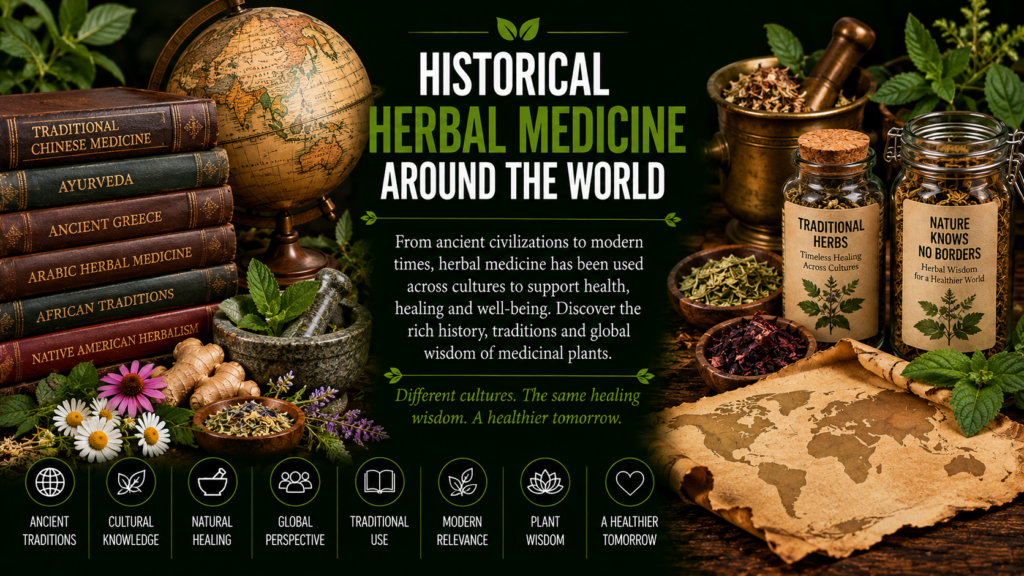
Long before modern pharmacies and manufactured medicines existed, people around the world used plants as part of their traditional approaches to health and wellbeing.
Leaves, roots, bark, flowers, seeds and fruits were gathered, prepared and passed down through generations.
Some plants were used as foods, others as teas or preparations, while particular plants were reserved for specific traditional practices.
Although modern medicine has changed enormously, many of these traditional plant practices remain part of cultural heritage today.
The history of herbal medicine is therefore not the story of one single system.
It is a collection of knowledge developed by many different communities, often independently, over thousands of years.
For someone beginning to explore herbal medicine, learning about this history provides useful context. It also helps us understand why the same plant may have different traditional uses in different parts of the world.
What Is Herbal Medicine?
Herbal medicine generally refers to the use of plants or plant-derived preparations as part of traditional or complementary approaches to health.
Historically, people used many different parts of plants, including:
- Leaves
- Flowers
- Roots
- Bark
- Seeds
- Fruits
- Resins
- Bulbs
- Whole plants
Plants could be prepared in different ways depending on the tradition and intended use.
Common preparations included:
- Infusions
- Decoctions
- Poultices
- Tinctures
- Oils
- Powders
- Syrups
The terminology and methods varied considerably between cultures.
Why Did People Use Plants?
For ancient communities, plants were readily available sources of food, flavouring, materials and potential remedies.
People learned through observation and experience.
Knowledge could be passed from one generation to another through:
- Oral traditions
- Healers
- Families
- Apprenticeships
- Written texts
- Religious institutions
- Community practices
Over time, some plants became closely associated with particular traditional uses.
Herbal Medicine in Ancient Egypt
Ancient Egypt has one of the oldest documented traditions of medicinal plant use.
Egyptian medical knowledge was recorded in several papyri.
One of the best known is the Ebers Papyrus, dating to around the second millennium BCE.
It contains numerous medical recipes and references to plants and other substances.
Plants such as garlic, onions, aloe and various aromatic herbs were part of Egyptian life and appear in historical sources relating to health and medicine.
Egyptians also used plants and resins in religious ceremonies, cosmetics and preservation practices.
This makes it important to remember that a plant mentioned in an ancient document was not necessarily being used in exactly the same way we might understand herbal medicine today.
Herbal Traditions in Ancient Mesopotamia
Some of the earliest written evidence of medicinal plant use comes from Mesopotamia.
Clay tablets from ancient Mesopotamian civilisations contain information about plants and other substances used in medical practices.
These records demonstrate that people were documenting observations about illness and treatments thousands of years ago.
Plants were prepared in various forms and used alongside other substances.
The written records provide an important historical window into how ancient communities understood health.
Traditional Chinese Medicine
Traditional Chinese medicine has a long and highly developed history.
Chinese herbal traditions include a large number of plants and other natural materials.
Traditional Chinese herbal practice developed its own terminology, theories and methods of preparation.
One historically important text is the Huangdi Neijing, which discusses traditional approaches to health and the body.
Another influential work is the Shennong Bencao Jing, a traditional materia medica associated with early Chinese herbal knowledge.
Over centuries, Chinese herbal knowledge was expanded, organised and recorded in numerous texts.
Traditional Chinese Herbal Preparations
Traditional Chinese herbal practice can involve a wide range of preparations.
These may include:
- Decoctions
- Powders
- Pills
- Extracts
- Dried herbs
The preparation method depends on the particular plant and traditional practice.
Some plants used in traditional Chinese medicine have also become subjects of modern scientific research.
However, traditional use and modern clinical evidence are not the same thing.
A plant’s historical use does not automatically establish that it is effective or safe for a particular medical condition.
Ayurveda in India
India has one of the world’s oldest continuously developed traditional medical systems.
Ayurveda developed over many centuries and includes extensive knowledge of medicinal plants.
Historical Ayurvedic texts such as the Charaka Samhita and Sushruta Samhita contain descriptions of health, disease, diet, plants and traditional treatments.
Plants such as turmeric, ginger, holy basil and neem have long histories of use within Indian traditions.
Turmeric in Traditional Practice
Turmeric is particularly well known in South Asian traditions.
Its bright yellow rhizome has been used as a spice, food ingredient and traditional preparation for centuries.
Turmeric’s active compound curcumin has also attracted considerable modern scientific interest.
However, research into an isolated compound or extract should not automatically be interpreted as proof that traditional turmeric preparations treat a particular illness.
The historical and scientific perspectives are related but not identical.
Herbal Medicine in Ancient Greece
Plants played an important role in the medical traditions of ancient Greece.
The physician Hippocrates is often associated with the development of early systematic approaches to medicine.
Greek medical writers described numerous plants and natural substances.
Later, Dioscorides, a Greek physician and pharmacologist living during the first century CE, produced De Materia Medica.
This influential work described hundreds of medicinal substances, including many plants.
It became an important reference throughout Europe and the Mediterranean for centuries.
Dioscorides and Herbal Knowledge
De Materia Medica was copied, translated and adapted over many centuries.
Its influence extended well beyond the ancient world.
The work helped preserve and spread information about plants, although its descriptions reflected the medical understanding of its time.
Historical herbal texts therefore need to be read in their historical context.
They are valuable records of traditional knowledge, but they are not modern clinical textbooks.
Herbal Medicine in Ancient Rome
Roman medicine inherited and expanded upon many Greek medical traditions.
Plants and plant preparations were commonly used.
Roman writers recorded information about medicinal herbs, foods and preparations.
The Roman naturalist Pliny the Elder included extensive descriptions of plants and their uses in his work Naturalis Historia.
This contributed to the preservation of botanical and medicinal knowledge from the ancient Mediterranean world.
Medieval European Herbal Medicine
After the decline of the Western Roman Empire, herbal knowledge continued through different communities and institutions.
Monasteries became important centres for preserving and cultivating plants.
Monastic gardens often contained medicinal herbs as well as plants used for cooking.
Herbal knowledge also continued through local traditions and folk practices.
Plants such as:
- Chamomile
- Sage
- Lavender
- Yarrow
- Thyme
- Fennel
became associated with various traditional uses across Europe.
Medieval Herbals
Illustrated herbals became important sources of botanical and medicinal information.
These books described plants, their appearances and traditional uses.
Some combined information inherited from ancient Greek and Roman sources with local European knowledge.
Over time, printing made botanical and herbal information more widely available.
Herbal Medicine in the Islamic Golden Age
During the medieval period, scholars working across the Islamic world played an important role in preserving, translating and developing medical knowledge.
Arabic and Persian medical scholars studied earlier Greek, Roman and other traditions while also adding their own observations.
The physician Ibn Sina, known in Europe as Avicenna, wrote The Canon of Medicine.
This became an influential medical text in both the Islamic world and medieval Europe.
Plant-based medicines were an important part of the medical traditions described in such works.
African Herbal Traditions
Africa has an enormous diversity of plant species and a long history of traditional plant use.
Different communities developed their own knowledge of local plants and their traditional applications.
There is no single “African herbal medicine” system.
Traditions differ substantially between regions, cultures and communities.
Traditional healers and community knowledge holders have historically played important roles in passing plant knowledge from one generation to the next.
Traditional Herbal Knowledge in Southern Africa
Southern Africa has a particularly rich history of traditional plant use.
Indigenous communities have long used locally available plants as food, materials and traditional remedies.
Plants such as:
- Aloe species
- Artemisia species
- Rooibos
- Buchu
- African wormwood
- Wild rosemary and other aromatic plants
have histories of traditional use in southern African communities.
The specific uses, preparations and cultural meanings differ between communities.
This diversity is important and should not be reduced to a single set of “African remedies”.
Traditional Knowledge and Oral History
Much traditional herbal knowledge was never written down.
Instead, it was passed verbally from parents, grandparents, healers and other experienced community members.
This means that historical records do not always provide a complete picture.
A lack of written evidence does not necessarily mean that a particular community did not have extensive knowledge of medicinal plants.
Oral traditions have played an important role in preserving knowledge across generations.
Indigenous Herbal Traditions Around the World
Traditional plant knowledge is not limited to Africa, Europe or Asia.
Indigenous communities across the Americas, Australia and the Pacific developed detailed knowledge of their local plant environments.
Plants could be used for:
- Food
- Medicine
- Fibre
- Building materials
- Dyes
- Ceremonial purposes
- Fragrance
In many cultures, knowledge of plants was closely connected with the seasons, landscape and community traditions.
Native American Plant Knowledge
Indigenous peoples of North America developed extensive knowledge of local plants.
Different nations and communities used different plants and preparation methods.
Plants such as willow, echinacea and yarrow have become particularly well known outside their original cultural contexts.
However, it is important to recognise that Indigenous knowledge is diverse and should not be treated as one single system.
Traditional use also does not automatically mean that modern evidence supports every historical claim associated with a plant.
Traditional Plant Knowledge in Australia
Aboriginal Australian communities have developed extensive knowledge of native plants over thousands of years.
Plants were used for food, materials and traditional health practices.
The Australian environment contains many plants that are found nowhere else in the world.
Knowledge of these plants was traditionally connected to local landscapes, seasons and cultural practices.
Much of this knowledge remains culturally significant today.
Herbal Medicine and the Trade in Plants
Plants have travelled across the world for thousands of years.
Trade routes allowed herbs, spices and medicinal plants to move between regions.
A plant originally found in one part of the world could eventually become established in the traditional practices of another.
Ginger, cinnamon, black pepper and many aromatic plants are examples of botanical materials that travelled widely through trade.
This movement of plants also meant that medical knowledge could be exchanged between cultures.
How Herbal Knowledge Changed Over Time
Traditional herbal medicine was never completely static.
People experimented, observed results, adopted useful practices and sometimes abandoned others.
New plants became available through trade.
Different cultures exchanged ideas.
Written texts were copied and translated.
Later, botanical classification helped people distinguish between plant species more accurately.
Eventually, modern chemistry and pharmacology began examining the substances contained within medicinal plants.
From Traditional Remedies to Modern Medicines
An important part of modern pharmaceutical history is the discovery of useful compounds from plants.
Scientists have isolated and studied naturally occurring substances from plants and other organisms.
Some have become important medicines.
For example, quinine was historically derived from Cinchona bark and played an important role in the treatment of malaria.
Digoxin-related cardiac glycosides are associated with foxglove plants and have a long history in medicine.
Salicylic acid and related compounds helped lead to the development of modern aspirin.
These examples demonstrate that plants can contain biologically active substances.
They also demonstrate why careful research and standardisation are important.
Traditional Use vs Scientific Evidence
This distinction is especially important for anyone beginning to explore herbal medicine.
A plant may have been used traditionally for hundreds or even thousands of years.
That tells us something important about historical and cultural use.
It does not automatically prove that the plant is effective for a particular medical condition.
Modern research may support some traditional uses, may find limited evidence for others or may raise safety concerns.
The evidence needs to be considered separately from the history.
Why Plant Identification Matters
Historical herbal texts often used common names rather than modern scientific names.
This can create confusion.
The same common name may refer to different plants in different regions.
Likewise, the same plant may have several common names.
Modern botanical identification helps reduce this confusion.
When discussing medicinal plants, using the scientific name where possible is particularly helpful.
Traditional Preparations
Historical herbal medicine used many different preparation methods.
Infusions
Plant material was steeped in hot water.
This is similar to making a traditional herbal tea.
Decoctions
Harder plant materials such as roots or bark were simmered in water.
Poultices
Plant material was prepared and applied externally.
Oils
Plant material could be infused into oil for external use.
Tinctures
Plant material was extracted using alcohol or another suitable solvent.
Different cultures developed their own preparation methods and terminology.
Why Preparation Matters
The way a plant is prepared can change the substances extracted from it.
An infusion, decoction, tincture and essential oil are not chemically identical.
They can therefore have different properties and different safety considerations.
This is one reason why you should never assume that information about one preparation automatically applies to another.
Herbal Medicine in the Modern World
Today, traditional herbal medicine continues to be practised in many parts of the world.
Some people use herbal products alongside conventional healthcare.
Others use them as part of cultural or traditional practices.
At the same time, scientists continue to investigate medicinal plants and their compounds.
Modern research can help us understand:
- Which compounds are present
- How they act in the body
- Whether traditional claims are supported
- Potential side effects
- Possible interactions with medicines
- Appropriate preparation and dosage
This research is an important bridge between traditional knowledge and modern scientific understanding.
Respecting Traditional Knowledge
When discussing traditional herbal medicine, cultural context matters.
Traditional plant knowledge belongs to communities and cultures that have developed and maintained it.
It should not simply be treated as a collection of recipes available for anyone to commercialise.
There are important conversations around traditional knowledge, intellectual property, cultural heritage and benefit sharing.
Learning about herbal history should therefore involve respect for the people and communities who preserved that knowledge.
Herbal Medicine and Modern Safety
Natural does not automatically mean harmless.
Plants contain biologically active chemicals.
Some can interact with medicines, affect certain medical conditions or cause adverse reactions.
Some plants are toxic if incorrectly identified or prepared.
For this reason, beginners should be cautious about using historical herbal recipes as practical medical instructions.
Historical information is valuable, but it should not replace modern safety information or professional medical advice.
Why Historical Herbal Medicine Still Matters
The history of herbal medicine helps us understand several things.
It shows how closely humans have interacted with plants throughout history.
It demonstrates the importance of observation and traditional knowledge.
It helps explain why certain herbs remain culturally significant.
It also provides a starting point for modern scientific research.
Perhaps most importantly, it reminds us that our understanding of plants has developed over thousands of years and continues to develop today.
A Beginner’s Way to Explore Herbal History
If you are new to herbal medicine, you don’t need to learn everything at once.
Start with a few plants that interest you.
For each plant, look at:
- Its scientific name
- Where it naturally occurs
- Traditional uses
- Cultures associated with those uses
- Historical preparations
- Modern research
- Known safety concerns
- Possible medicine interactions
This approach helps separate historical information from modern medical evidence.
Final Thoughts
Herbal medicine has a remarkably long and diverse history.
From ancient Egypt and Mesopotamia to China, India, Europe, Africa, the Americas and Australia, people have developed their own relationships with the plants around them.
Some knowledge was recorded in ancient texts.
Much more was passed down through oral traditions and community practice.
Over time, plants travelled along trade routes, traditions influenced one another and botanical knowledge became increasingly detailed.
Modern science has added another layer by examining the chemical compounds found in plants and investigating their potential effects.
For anyone beginning to explore herbal medicine, understanding this history is valuable.
It teaches us to appreciate traditional knowledge without automatically assuming that every historical claim has been scientifically proven.
It also encourages a healthy respect for the plants themselves.
Learn the plant. Learn its history. Learn how it has traditionally been used. And then learn what modern evidence says about it.
That combination of historical knowledge, cultural respect and modern scientific understanding provides a much more responsible foundation for exploring the fascinating world of herbal medicine.
Related Articles
What Are Herbal Actions?
Read MoreCommon Herbal Safety Terms Every Beginner Should Know
Read MoreShelf Life of Different Herbal Preparations
Read More