
Herbal Medicine Guides, Herbal Preparations
Shelf Life of Different Herbal Preparations
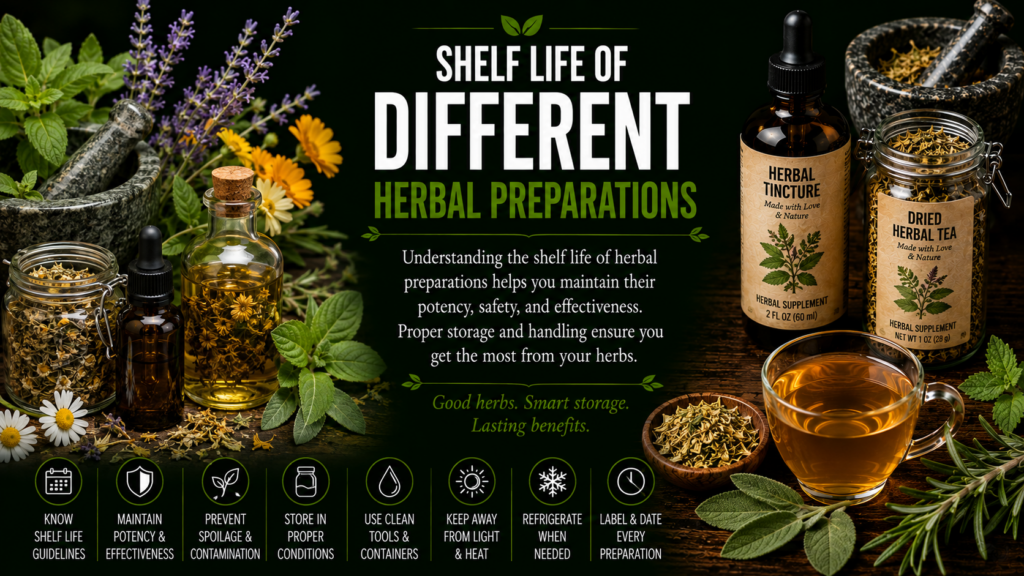
If you are beginning to explore herbal medicine, you may eventually find yourself with a collection of dried herbs, herbal teas, tinctures, infused oils or homemade salves.
Then comes an important question:
How long do they actually last?
Unfortunately, there is no single answer.
Different herbal preparations have very different shelf lives. A properly dried herb can remain useful for considerably longer than a fresh herbal tea, while an oil infusion has different storage considerations again.
The way an herb is prepared, how much moisture it contains, the ingredients used, how it is stored and whether it has been exposed to contamination can all affect how long it remains suitable for use.
For beginners, the safest approach is to learn the basic differences between preparations rather than relying on one universal expiry period.
What Does “Shelf Life” Mean?
Shelf life refers to the period during which a product is expected to remain suitable for its intended use when stored under the recommended conditions.
For herbal products, shelf life can involve more than simply asking whether something has “gone bad”.
Over time, herbs and herbal preparations can lose colour, aroma, flavour and some of their active constituents.
A product may therefore become less useful even before there are obvious signs of spoilage.
For commercial herbal products, the manufacturer’s expiry or best-before information should be followed.
Homemade preparations are more complicated because there may not be a laboratory-tested shelf life.
Why Do Herbal Preparations Have Different Shelf Lives?
The biggest reason is moisture.
Moisture can encourage the growth of microorganisms such as bacteria and mould.
Fresh plant material contains a considerable amount of water. Once an herb is properly dried, much of that moisture has been removed, making it considerably easier to store.
This is why a dried herb can generally be stored for much longer than a freshly prepared herbal tea.
Other factors include:
- Temperature
- Light
- Air exposure
- Humidity
- Preparation method
- Ingredients
- Container
- Hygiene
- Contamination
- Whether preservatives are present
Fresh Herbs
Fresh herbs generally have a relatively short storage life.
Once harvested, fresh leaves and flowers continue to change. They can wilt, lose aroma and eventually deteriorate.
If you are using fresh herbs for culinary or traditional herbal purposes, use them promptly and store them appropriately.
Do not assume that placing fresh herbs in a container automatically makes them suitable for long-term storage.
Fresh plant material can also introduce moisture into preparations, which can shorten their shelf life.
Dried Herbs
Properly dried herbs are among the easiest herbal materials to store.
Good drying removes enough moisture to make the material much less favourable for microbial growth.
However, dried does not mean indestructible.
Over time, dried herbs can lose:
- Aroma
- Colour
- Flavour
- Volatile oils
- Some other plant constituents
For this reason, older dried herbs may still look perfectly normal while being considerably less aromatic or useful than fresh, well-stored material.
How to Store Dried Herbs
Store dried herbs in:
- Clean, dry containers
- A cool location
- A dark cupboard
- An area with low humidity
Keep containers tightly closed and avoid repeatedly opening them unnecessarily.
Glass jars with secure lids can be useful storage containers, provided they are clean and completely dry before use.
How Long Do Dried Herbs Last?
There is no single guaranteed shelf life for every dried herb.
As a practical guide, many dried herbs are best used while they still retain their characteristic colour and aroma rather than being kept indefinitely.
A commonly used household guideline is around one to two years for many dried herbs, although some herbs may retain quality for shorter or longer periods depending on how they were dried and stored.
This should not be treated as a universal expiry date.
If a dried herb has been exposed to moisture, developed mould, smells unusual or shows signs of contamination, discard it regardless of its age.
Herbal Infusions and Teas
An infusion is commonly made by steeping herbs in hot water.
Once water has been added, the storage situation changes considerably.
A freshly prepared herbal tea is generally intended to be consumed reasonably soon after preparation rather than stored for long periods.
If you are not going to drink it immediately, refrigeration can slow deterioration, but refrigeration does not make a homemade herbal tea safe indefinitely.
As a general household practice, it is sensible to prepare only the amount you expect to use and discard leftover tea rather than keeping it for several days.
If a prepared infusion develops an unusual smell, appearance or taste, discard it.
Decoctions
A decoction involves simmering plant material in water.
Like an infusion, it is a water-based preparation and therefore has a much shorter storage life than a properly dried herb.
Freshly prepared decoctions are generally best used promptly.
If a decoction needs to be stored temporarily, use a clean container and refrigerate it, but do not assume refrigeration makes it suitable for long-term storage.
When in doubt, throw it out.
Tinctures
Tinctures are liquid herbal preparations traditionally made by extracting plant material into alcohol or another suitable solvent.
Because alcohol can inhibit the growth of many microorganisms, properly prepared alcohol-based tinctures can have a considerably longer storage life than water-based preparations.
However, not every tincture is the same.
Shelf life depends on factors such as:
- Alcohol concentration
- Plant material
- Preparation method
- Storage conditions
- Container
- Contamination
Commercial tinctures should be stored according to the manufacturer’s instructions and used before the stated expiry date.
Homemade tinctures do not automatically have a guaranteed shelf life simply because alcohol was used.
Herbal Glycerites
A glycerite is an herbal preparation made using glycerine as a solvent instead of alcohol.
Glycerine-based preparations can have a shorter storage life than properly prepared alcohol-based tinctures.
The exact shelf life depends on the formulation, water content, ingredients and storage conditions.
If you are making glycerites at home, it is important not to assume that they are shelf-stable simply because glycerine is present.
Herbal Oils and Infused Oils
Herbal-infused oils are made by combining plant material with a carrier oil.
Examples of carrier oils include olive, sunflower and other suitable vegetable oils.
The shelf life of an infused oil depends on the type and quality of the carrier oil, the plant material used and the amount of moisture introduced.
This last point is particularly important.
Fresh herbs contain water.
If fresh plant material is added to oil without appropriate preparation, the moisture can create conditions that encourage microbial growth.
This means that homemade herbal oils require more care than simply placing fresh leaves into a jar of oil.
If you are making infused oils at home, use a reliable preparation method and understand the risks associated with moisture.
How Long Do Herbal Oils Last?
There is no universal shelf life for homemade herbal oils.
Some preparations may remain suitable for a considerable period when made correctly and stored appropriately, while others may deteriorate much sooner.
The carrier oil itself has an expiry period and can eventually become rancid.
Signs of deterioration may include:
- An unpleasant or stale smell
- Significant changes in appearance
- Unusual cloudiness
- Mould or visible contamination
- An off smell that is different from the normal aroma
When in doubt, discard the oil.
Do not rely on taste testing to determine whether an oil is safe.
Herbal Salves
A salve is generally made by combining an infused oil with a substance such as beeswax to create a semi-solid preparation.
Because a properly prepared salve contains little or no free water, it can generally have a longer storage life than a water-based preparation.
However, the shelf life still depends on the ingredients and preparation method.
The carrier oil can become rancid over time, while contamination can occur if dirty fingers or wet utensils are introduced into the container.
Use clean, dry equipment when preparing and handling salves.
Herbal Creams and Lotions
Creams and lotions can be more complicated than salves because many contain water.
Water-based products can provide an environment in which microorganisms may grow if they are not properly preserved.
Commercial products generally contain preservatives and are manufactured under controlled conditions.
Homemade creams and lotions can be much more difficult to keep microbiologically safe.
For beginners, it is therefore important not to assume that a homemade cream will last for months simply because it looks normal.
Herbal Syrups
Herbal syrups often contain water and sweeteners such as sugar or honey.
The sugar content can help preserve some preparations, but it does not automatically make a homemade syrup shelf-stable.
Water-based homemade syrups can spoil, particularly if they are not prepared, stored and preserved appropriately.
If you make an herbal syrup at home, follow a reliable recipe from a reputable source and pay close attention to storage instructions.
When the preparation has an unusual smell, appearance, mould or other signs of spoilage, discard it.
Herbal Powders
Dried herbs can also be ground into powders.
Powdering increases the surface area of the plant material, which can affect how quickly it loses aroma and freshness.
Powders should be kept tightly sealed and protected from moisture, heat and light.
Because moisture is one of the biggest enemies of dried herbal products, always use completely dry utensils when handling powders.
Capsules and Tablets
Commercial herbal capsules and tablets should have an expiry or best-before date supplied by the manufacturer.
Store them according to the label instructions.
Do not assume that transferring capsules to another container will extend their shelf life.
If the product has passed its expiry date, follow the manufacturer’s guidance regarding disposal rather than continuing to use it simply because the capsules look normal.
Essential Oils Are Different
Essential oils are highly concentrated aromatic products and should not be confused with ordinary herbal-infused oils.
They are produced through specialised processes such as distillation or expression and can have very different safety considerations.
Essential oils can also deteriorate through exposure to heat, light and air.
If you are researching essential oils, treat them as a separate category rather than assuming that the storage rules for infused herbal oils apply to them.
Light Can Damage Herbal Preparations
Light can contribute to the deterioration of some plant compounds and oils.
This is why many herbal products are stored in dark or opaque containers.
A cool, dark cupboard is often a better storage location than a sunny windowsill.
Avoid storing herbal preparations in places exposed to strong sunlight or excessive heat.
Heat Can Affect Shelf Life
High temperatures can accelerate deterioration.
This is particularly important in South Africa, where summer temperatures can become quite high.
Avoid storing herbal products in areas that regularly become hot, such as:
- Direct sunlight
- Near a stove
- Inside a hot vehicle
- Near a heater
- In a very warm cupboard
A cool, dry storage area is generally preferable.
Moisture Is One of the Biggest Problems
Moisture can cause dried herbs to become damp and may encourage mould growth.
Always allow dried herbs to cool completely after drying before sealing them in containers.
If condensation forms inside a storage container, investigate the cause rather than simply closing the lid again.
Containers and utensils should also be completely dry before coming into contact with dried herbs.
How to Tell if an Herbal Preparation Has Spoiled
Depending on the preparation, warning signs can include:
- Visible mould
- Unexpected cloudiness
- Bubbling or fermentation
- An unusual smell
- Rancid or stale odour
- Major colour changes
- Unexpected separation
- Signs of contamination
However, the absence of visible spoilage does not guarantee that a homemade preparation is safe.
Some harmful microorganisms or deterioration may not produce obvious changes that you can see or smell.
This is one reason why homemade water-based preparations should not be stored for long periods without appropriate preservation knowledge.
The “When in Doubt, Throw It Out” Rule
If you are unsure whether an herbal preparation is still suitable, it is safer to discard it.
Trying to save a questionable herbal product is not worth the risk.
This is especially important with:
- Water-based preparations
- Homemade creams
- Fresh herb preparations
- Products containing fresh plant material
- Preparations showing signs of mould or contamination
A new batch is usually much better than taking a chance on an old one.
Labelling Your Homemade Herbal Preparations
If you make herbal preparations at home, good labelling is extremely useful.
Write down:
- Plant name
- Botanical name if known
- Plant part used
- Preparation type
- Ingredients
- Date prepared
- Storage instructions
- Any other relevant information
A label prevents the common problem of finding an unmarked jar months later and wondering what is inside.
Store Different Preparations Separately
It is also useful to keep different types of preparations organised.
For example:
Dried herbs: Cool, dry and dark storage.
Infusions and decoctions: Short-term storage, generally refrigerated if temporarily retained.
Tinctures: Stored according to the preparation and manufacturer’s or reliable preparation instructions.
Infused oils: Protected from heat and light and checked for deterioration.
Salves: Stored appropriately and protected from contamination.
Commercial products: Follow the label and expiry date.
Shelf Life Quick Reference
| Herbal Preparation | General Storage Consideration |
|---|---|
| Fresh herbs | Short storage life; use promptly |
| Dried herbs | Often months to around 1–2 years for good quality, depending on storage and herb |
| Infusions | Best used fresh; refrigerate only for short-term storage |
| Decoctions | Best used fresh; refrigerate only for short-term storage |
| Alcohol-based tinctures | Often longer-lasting, but depends on concentration and preparation |
| Glycerites | Variable; generally require more careful storage |
| Infused oils | Variable; depends on oil, plant material and moisture |
| Salves | Often longer-lasting than water-based preparations, but oils can still become rancid |
| Creams and lotions | Highly variable; water-based homemade products can spoil quickly |
| Herbal syrups | Variable; water-based preparations require careful storage |
| Powders | Store dry, cool and protected from air and light |
| Commercial capsules/tablets | Follow manufacturer’s expiry and storage instructions |
These are general guidelines rather than guaranteed expiry dates.
Quality Is More Than Shelf Life
An herbal preparation can be technically unspoiled but still have lost some of its original quality.
For example, an old dried herb may retain its original appearance but have very little aroma compared with a fresh batch.
Similarly, an oil may still look acceptable but have developed an unpleasant rancid smell.
Shelf life should therefore be thought of as both safety and quality.
Final Thoughts
Different herbal preparations have very different storage requirements.
Dried herbs can generally be stored for much longer than fresh water-based preparations, while tinctures, infused oils, salves, creams and syrups each have their own considerations.
The most important factors to remember are moisture, heat, light, air, contamination and the ingredients used.
If you make your own herbal preparations, label everything clearly, use clean and dry equipment, follow reliable preparation methods and store each product appropriately.
Most importantly, never assume that a homemade preparation is safe simply because it still looks normal.
When something smells unusual, shows signs of mould or contamination, or you are simply unsure about its condition, it is better to discard it.
Good herbal practice is not only about learning what plants can traditionally be used for. It is also about learning how to handle, prepare and store them responsibly.
Related Articles
Historical Herbal Medicine Around the World
Read MoreHerbal Tea vs Herbal Infusion
Read MoreWhat Are Herbal Actions?
Read MoreCommon Herbal Safety Terms Every Beginner Should Know
Read MoreMaking Herbal Preparations
Read More