
Herbal Preparations
Herbal Tea vs Herbal Infusion
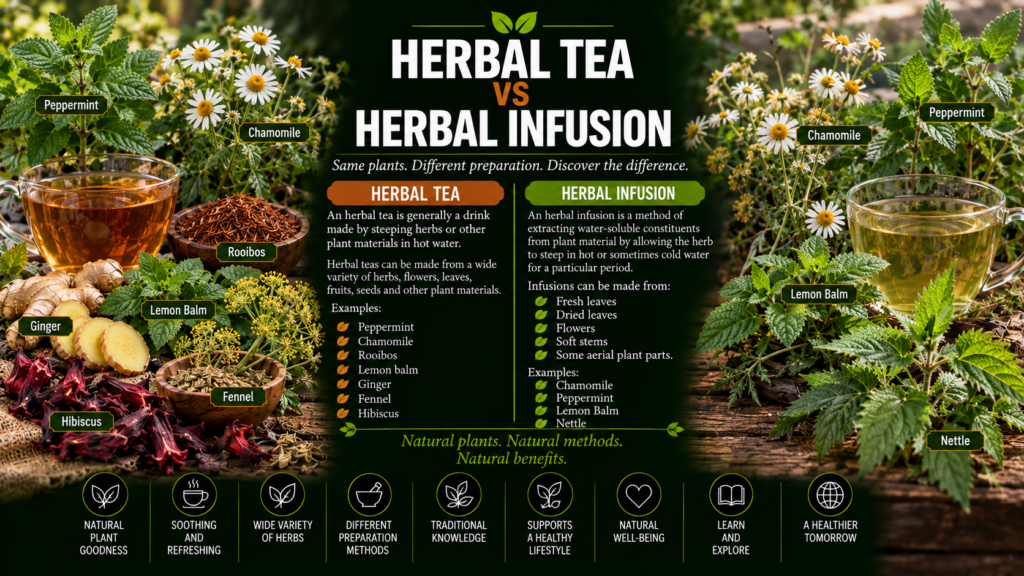
If you are new to herbal medicine, you will quickly come across words such as herbal tea, infusion, and decoction.
At first, these terms can seem interchangeable. After all, they can all involve putting herbs into water and allowing them to steep.
There is, however, a useful distinction between an everyday herbal tea and a more deliberately prepared herbal infusion.
Understanding the difference is helpful when you start learning about medicinal plants, especially when reading traditional herbal recipes or instructions.
What Is an Herbal Tea?
An herbal tea is generally a drink made by steeping herbs or other plant materials in hot water.
Unlike ordinary tea, herbal tea does not necessarily contain the leaves of the tea plant, Camellia sinensis. Herbal teas can be made from a wide variety of herbs, flowers, leaves, fruits, seeds and other plant materials.
Common examples include:
- Peppermint
- Chamomile
- Rooibos
- Lemon balm
- Ginger
- Fennel
- Hibiscus
Herbal teas are often enjoyed simply as pleasant drinks and may form part of a relaxing daily routine.
In traditional herbal practices, however, an herbal tea may also be prepared with a particular plant for its traditional properties.
What Is an Herbal Infusion?
An infusion is a method of extracting water-soluble constituents from plant material by allowing the herb to steep in hot or sometimes cold water for a particular period.
The process is similar to making tea, but the term infusion is often used when the preparation is being made more deliberately for herbal purposes.
The herb is placed in water, allowed to steep, and then strained before use.
The amount of herb, amount of water, steeping time and temperature can all affect the resulting preparation.
So, Are Herbal Tea and Herbal Infusion the Same Thing?
Sometimes they can be.
This is where the terminology can become confusing.
An herbal tea can essentially be an infusion, particularly when leaves or flowers are steeped in hot water.
The main difference is often how the term is being used.
“Herbal tea” usually describes the finished beverage and may suggest something prepared for enjoyment.
“Herbal infusion” more often describes the preparation method and may refer to a more purposeful herbal preparation.
There is no single worldwide definition that makes every herbal tea and infusion completely different.
How Is an Herbal Infusion Made?
A simple infusion generally follows these basic steps.
1. Choose the Correct Herb
First, make sure you have correctly identified the plant.
This is especially important when using herbs medicinally. Some plants have similar common names, while others can be confused with unrelated species.
When possible, learn the botanical name of the plant as well.
2. Prepare the Plant Material
Depending on the herb, you may use:
- Fresh leaves
- Dried leaves
- Flowers
- Soft stems
- Some aerial plant parts
The plant material should be clean and appropriately prepared.
Dried herbs are commonly used because they are convenient to store and measure.
3. Add Hot Water
Place the herb into a suitable container and add hot water.
For many delicate plant parts, freshly boiled water that has been allowed to cool slightly can be suitable.
The herb is then left to steep.
4. Allow It to Steep
The steeping time depends on the herb and the preparation.
There is no single steeping time that is correct for every plant.
Some everyday herbal teas may only need a few minutes, while traditional herbal infusions can be steeped for longer.
Always follow a reliable recipe or preparation method for the specific herb you are using.
5. Strain and Enjoy
Once the preparation has finished steeping, strain out the plant material.
The resulting liquid can then be enjoyed as an herbal drink.
If you are preparing an infusion for a particular traditional herbal purpose, follow the preparation instructions from a reputable herbal reference rather than simply making it stronger or steeping it for longer.
What Herbs Are Commonly Used for Infusions?
Many herbs containing delicate leaves and flowers are traditionally prepared as infusions.
Examples include:
Chamomile
Chamomile flowers are commonly steeped in hot water to make a fragrant herbal drink.
Chamomile tea is often associated with relaxation and digestive comfort in traditional herbal use.
Peppermint
Peppermint leaves make a refreshing infusion with a strong, characteristic aroma.
Peppermint has a long history of traditional use, particularly in relation to digestive comfort.
Lemon Balm
Lemon balm leaves can be infused in hot water to produce a pleasant lemon-scented herbal drink.
It has traditionally been associated with relaxation and general wellbeing.
Nettle
Nettle leaves have traditionally been prepared as teas and infusions.
Nettle is also an interesting plant for beginners because it has culinary, gardening and traditional herbal uses.
Raspberry Leaf
Raspberry leaf is traditionally used to make herbal infusions and has a long history in women’s herbal traditions.
As with all medicinal herbs, traditional use does not automatically establish that a preparation is suitable for everyone.
What Is a Decoction?
Understanding infusions becomes easier when you know about decoctions.
A decoction is another water-based herbal preparation, but instead of simply steeping the plant material, the herb is generally simmered in water.
Decoctions are traditionally used for tougher plant materials such as:
- Roots
- Bark
- Hard seeds
- Some berries
- Other dense plant parts
The additional heat and longer preparation time can help extract constituents from these tougher materials.
Infusion vs Decoction
A simple way to remember the difference is:
Infusion = steeping
Decoction = simmering
For example, delicate chamomile flowers would commonly be prepared as an infusion, while a tough root may traditionally be prepared as a decoction.
However, the correct preparation depends on the individual herb, so these should be treated as general guidelines rather than rigid rules.
Why Does the Plant Part Matter?
Different parts of the same plant can contain different constituents.
A leaf is structurally different from a root, bark or seed.
This affects how easily the constituents can be extracted into water.
Delicate plant parts such as flowers and leaves are generally more suitable for infusion, while tougher plant materials may require a decoction or another preparation method.
This is one reason herbal medicine involves more than simply choosing a plant and putting it into hot water.
Does a Longer Steeping Time Make an Infusion Better?
Not necessarily.
It can be tempting to think that leaving an herb in water for a very long time will automatically produce a stronger or better preparation.
That is not always the case.
The amount of plant material, water temperature, steeping time and chemical properties of the herb all influence the final preparation.
A longer steep can also produce a stronger flavour that may not be pleasant.
For medicinal preparations, follow a reliable preparation method rather than guessing.
Does More Herb Make a Better Tea?
Again, not necessarily.
Using a larger amount of an herb can increase the concentration of its constituents.
That does not automatically make the preparation more effective, and with some herbs it could increase the possibility of unwanted effects.
This is particularly important when moving from an ordinary food or beverage to a medicinal preparation.
Natural does not mean that unlimited amounts are safe.
Herbal Tea for Everyday Enjoyment
Many herbal teas can simply be enjoyed as part of everyday life.
A cup of rooibos, peppermint or chamomile tea can be a pleasant way to enjoy plants without treating the drink as medicine.
This distinction is useful because not every herbal drink needs to be viewed as a medicinal preparation.
Some are simply delicious beverages.
Herbal Infusions in Traditional Herbalism
In traditional herbalism, an infusion may be prepared with a particular plant for a specific traditional purpose.
The preparation may involve a particular quantity of herb, a particular volume of water and a defined steeping period.
The resulting preparation is then used according to the traditional practice associated with that herb.
When learning about these preparations, it is important to distinguish between traditional use and modern scientific evidence.
A traditional preparation can be historically important without necessarily having been proven to treat a particular medical condition.
Fresh Herbs vs Dried Herbs
Both fresh and dried herbs can be used for some infusions, but they are not identical.
Fresh herbs contain considerably more water, while dried herbs have had much of their moisture removed.
This means that the amount of fresh herb needed in a recipe may not be directly interchangeable with the amount of dried herb.
If you are following a specific recipe, use the form of the herb specified.
Can Herbal Infusions Be Stored?
Freshly prepared herbal infusions are generally best consumed soon after preparation.
Because water-based preparations can support microbial growth, they should not be treated like dried herbs that can be stored for months.
If an infusion needs to be kept temporarily, refrigeration can slow deterioration, but it does not make a homemade infusion suitable for indefinite storage.
A useful beginner’s rule is:
Make only what you expect to use and avoid keeping homemade water-based preparations for unnecessarily long periods.
If an infusion develops an unusual smell, appearance or other signs of spoilage, discard it.
What About Adding Honey?
Honey is often added to herbal teas for flavour.
There is nothing unusual about enjoying an herbal drink with a little honey, provided the ingredients are suitable for the person consuming it.
However, adding honey does not automatically turn an herbal tea into a preserved medicinal preparation.
A homemade herbal drink containing water should still be treated as a perishable preparation.
Can You Add Milk?
Some herbal drinks can be enjoyed with milk, depending on the flavour and the individual’s preferences.
However, adding milk changes the preparation and its storage requirements.
Milk is perishable, so a drink containing milk should not be left at room temperature for extended periods.
If you are preparing an herbal beverage for storage, it is generally simpler to add milk only when the drink is being consumed.
Herbal Tea Bags vs Loose Herbs
Herbal teas can be purchased in convenient tea bags or as loose dried herbs.
Tea bags are simple to use and provide a consistent amount of plant material when commercially produced.
Loose herbs allow you to see the plant material and can be useful when learning to identify different herbs.
Neither format is automatically better.
The quality of the herb, correct identification, storage and preparation all matter.
Choosing Herbs for Your Infusion
When purchasing herbs for herbal teas or infusions, consider:
- Correct plant identification
- Botanical name
- Plant part
- Quality of the dried material
- Packaging
- Storage conditions
- Supplier reputation
- Any relevant safety information
Avoid unidentified herbs sold simply by an uncertain common name.
Correct identification is particularly important when using plants medicinally.
Safety Comes First
An herbal infusion may look like an ordinary cup of tea, but that does not mean every herb is suitable for everyone.
Some herbs can interact with medicines, cause allergic reactions or be unsuitable during pregnancy or breastfeeding.
Certain plants can also be inappropriate for people with particular health conditions.
If you take prescription medicines, are pregnant or breastfeeding, or have an ongoing health condition, speak with a doctor, pharmacist or other appropriately qualified healthcare professional before using medicinal herbal preparations.
Not Every Herb Should Be Prepared as a Tea
This is an important beginner lesson.
Just because a plant can be placed in hot water does not mean that it should be consumed as an herbal tea.
Some plants contain constituents that may be unsuitable for internal use, while others require specialised preparation.
Never assume that every plant growing in your garden can safely be made into a tea.
Correct plant identification and reliable information are essential.
A Simple Comparison
| Feature | Herbal Tea | Herbal Infusion |
|---|---|---|
| Main idea | A herbal drink | A method of extracting herbs in water |
| Typical preparation | Steeping in hot water | Steeping in hot or sometimes cold water |
| Main purpose | Often everyday enjoyment | Often a more deliberate herbal preparation |
| Common plant parts | Leaves, flowers, herbs | Leaves, flowers and other suitable softer plant parts |
| Strength | Usually beverage-oriented | Can be prepared according to a specific herbal method |
| Storage | Best consumed fresh | Best consumed fresh or stored only briefly when appropriate |
| Example | Chamomile tea | Chamomile infusion |
The distinction is not absolute, and the terms are sometimes used interchangeably.
The Important Difference to Remember
For a beginner, the easiest way to understand the terminology is to think of herbal tea as the drink and infusion as the preparation method.
A cup of chamomile tea can also be a chamomile infusion.
The words describe slightly different aspects of the same preparation.
Once you understand this, herbal books and recipes become much easier to follow.
Final Thoughts
Herbal tea and herbal infusion are closely related terms, and in everyday conversation they are often used to mean much the same thing.
An herbal tea usually refers to the finished drink, while an infusion describes the process of steeping suitable plant material in water.
Understanding this distinction becomes particularly useful as you explore traditional herbal medicine and begin learning about different preparation methods.
Remember that the herb, plant part, quantity, water temperature and steeping time can all affect the final preparation.
And perhaps most importantly, don’t assume that stronger is always better.
Start with well-identified herbs, use reliable preparation instructions and treat medicinal herbal preparations with the same care you would give any other health-related product.
With a little practice, the difference between a simple herbal tea, an infusion and a decoction will become much easier to understand—and you will have a good foundation for exploring the fascinating world of herbal medicine.
Related Articles
Shelf Life of Different Herbal Preparations
Read MoreMaking Herbal Preparations
Read More