
Herbal Medicine Guides
Common Herbal Safety Terms Every Beginner Should Know
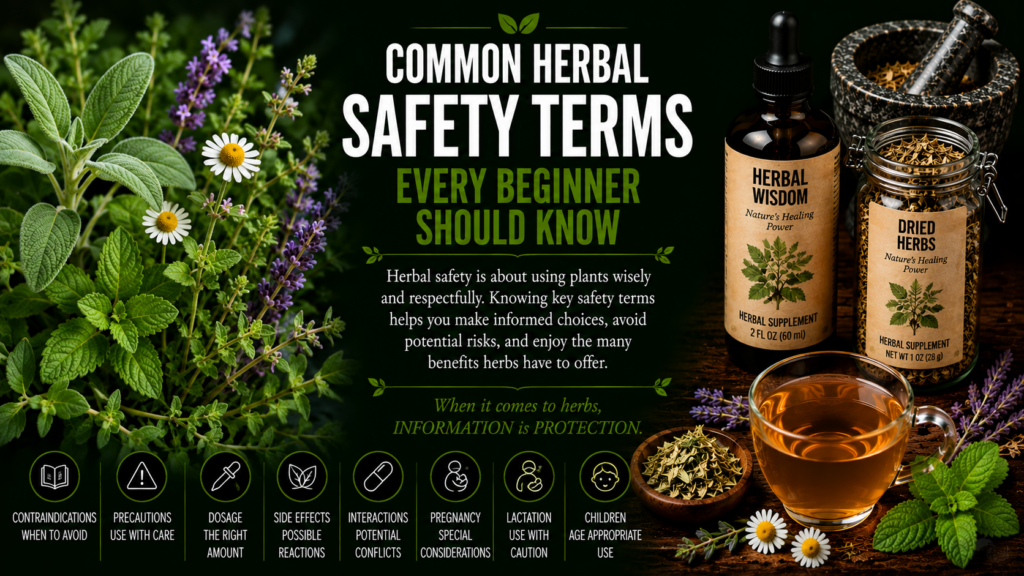
If you are beginning to explore herbal medicine, you will quickly discover that there is much more to learning about medicinal plants than simply finding out what a herb has traditionally been used for.
You will also come across words such as dosage, contraindication, interaction, side effect, allergy, topical, internal use and traditional use.
Understanding these terms is an important part of becoming a responsible herbal beginner.
Herbal products can be useful subjects of study, but they are not automatically safe simply because they come from plants. Safety depends on the particular herb, the part of the plant being used, the preparation, the amount, the person using it and other factors. Scientific evidence and safety information also vary considerably between different herbal products.
This guide explains some of the most common safety terms you are likely to encounter.
Why Herbal Safety Matters
Plants have been used traditionally for thousands of years, and many familiar medicines have also originated from compounds found in plants.
However, “natural” does not automatically mean “safe”.
Some plants can cause unwanted effects, while others can interact with medicines. Certain herbs may also be unsuitable for particular groups of people.
For example, some herbal products have not been adequately studied in children, during pregnancy or while breastfeeding. Some may also need to be avoided or discussed with a healthcare professional before surgery.
Learning basic safety terminology gives you a better foundation for researching herbs responsibly.
1. Contraindication
A contraindication is a situation in which a particular medicine, herb or treatment should not be used because it may be unsafe.
For example, a particular herb might be contraindicated during pregnancy or for someone taking a certain type of medicine.
Contraindications can be absolute or relative depending on the situation, but beginners do not need to become experts in those distinctions immediately.
The important lesson is:
Always check whether an herb is suitable for you before using it.
Do not assume that an herb is appropriate simply because it is commonly used.
2. Interaction
An interaction occurs when one substance affects another when they are used together.
In herbal medicine, you may hear about herb–drug interactions.
An herb may potentially increase the effect of a medicine, reduce its effect or alter how the body processes it. Some interactions can be serious.
This is particularly important for people taking prescription medicines.
A good habit is to tell your doctor, pharmacist or other healthcare professional about any herbal products you use or are considering using.
3. Side Effect
A side effect is an unwanted or unintended effect that can occur when using a medicine or other substance.
Side effects vary according to the herb and preparation.
They might be mild, such as digestive discomfort, or more serious in some cases.
Do not assume that an unpleasant reaction is simply something you should “push through”. If you experience a concerning reaction after using an herbal product, stop and seek appropriate professional advice.
4. Adverse Reaction
An adverse reaction is an unwanted or harmful response associated with using a substance.
You may see the term used in medical or safety information when discussing reactions to medicines or herbal products.
The terms side effect and adverse reaction are sometimes used in similar ways in everyday conversation, but safety information may distinguish between different types of unwanted effects.
As a beginner, the important thing is to take unusual or serious reactions seriously.
5. Allergy
An allergy occurs when the immune system reacts to a substance that is normally harmless to most people.
Plants and herbal products can cause allergic reactions in susceptible individuals.
An allergy can sometimes appear as:
- Itching
- Rash
- Redness
- Swelling
- Sneezing
- Breathing difficulties
A severe allergic reaction can be an emergency.
If someone develops serious difficulty breathing, swelling of the face or throat, or other signs of a severe allergic reaction, seek emergency medical care immediately.
6. Dosage
Dosage refers to the amount of a substance taken at one time or over a specified period.
The appropriate amount of an herbal product can depend on many factors, including:
- The particular herb
- The plant part
- The preparation
- The concentration
- The person’s age
- Other medicines being used
- Individual health circumstances
This is why it is not safe to assume that the dosage for one herbal preparation applies to another.
A cup of a mild herbal infusion and a concentrated extract are not necessarily equivalent.
7. Dose
The word dose refers to the amount taken on a particular occasion.
You may see dose and dosage used almost interchangeably, although technically dosage can refer more broadly to how much is taken and how often.
When reading herbal information, pay attention to the exact preparation being discussed.
8. Internal Use
Internal use means that an herbal product is taken into the body, such as by drinking a tea or swallowing a capsule.
Examples include:
- Herbal teas
- Infusions
- Decoctions
- Capsules
- Tablets
- Tinctures
An herb intended for topical use should not automatically be assumed to be safe for internal use.
The preparation and route of administration matter.
9. Topical Use
Topical use means applying a product to the outside of the body, usually the skin.
Examples include:
- Creams
- Salves
- Ointments
- Oils
- Compresses
Topical does not automatically mean risk-free.
Some plants can irritate the skin or cause allergic reactions, and some substances can be absorbed through the skin.
Always follow the instructions for the particular preparation.
10. Tincture
A tincture is a concentrated herbal preparation made by extracting plant constituents into a liquid, traditionally using alcohol or another suitable solvent.
Tinctures can vary considerably in strength and composition.
This is important because a tincture should not be treated as equivalent to a cup of herbal tea made from the same plant.
The concentration and preparation method can be very different.
11. Infusion
An infusion is generally made by steeping plant material in hot or boiling water for a period of time.
Herbal teas are commonly prepared in this way.
Leaves and flowers are often suitable for infusion, although the appropriate preparation depends on the particular plant.
An infusion is not automatically safe simply because it is a tea. The identity of the plant and the amount used still matter.
12. Decoction
A decoction is a preparation in which plant material is simmered in water.
This method is traditionally used for tougher plant materials such as certain roots, bark or seeds.
Like an infusion, a decoction can vary in strength depending on the plant material and preparation method.
13. Extract
An extract is a preparation in which particular constituents are removed from plant material using a solvent or another extraction method.
Extracts can be considerably more concentrated than the original plant material.
This is why you should never assume that a capsule, extract or concentrated liquid has the same strength as a traditional tea made from the plant.
14. Concentration
Concentration refers to how much of a substance is present in a particular amount of a preparation.
Two products made from the same herb may have very different concentrations.
For example, a highly concentrated extract can contain substantially more of certain plant constituents than a simple infusion.
When reading herbal information, always pay attention to whether the source is discussing the whole herb, a tea, an extract or another preparation.
15. Traditional Use
Traditional use means that a plant or preparation has a history of being used in a particular way within a traditional medical or cultural practice.
Traditional use can be valuable historical information.
However, it should not automatically be interpreted as proof that the herb has been scientifically demonstrated to treat a particular condition.
Scientific evidence varies widely between herbs and uses.
A good herbal reference should ideally make it clear whether a statement refers to traditional use, laboratory research, animal research or human clinical studies.
16. Evidence
When herbal information refers to evidence, it means the information available from research or other reliable sources supporting a particular claim.
Not all evidence is equally strong.
For example, laboratory research involving isolated cells is different from a well-designed clinical trial involving people.
You may therefore see phrases such as:
- Traditional evidence
- Preliminary evidence
- Limited evidence
- Human clinical evidence
- Stronger evidence
Learning to recognise these distinctions can help you avoid taking exaggerated herbal claims at face value.
17. Clinical Trial
A clinical trial is a research study involving people.
Clinical trials can help researchers investigate whether a treatment is effective and whether it has unwanted effects.
When reading about an herb, it is useful to know whether claims about its use come from human studies or from laboratory or animal research.
A result observed in a laboratory does not automatically mean that the same result will occur in people.
18. Standardised Extract
You may encounter the term standardised extract on herbal product labels.
This generally refers to an extract produced to contain a specified amount or range of particular constituents.
Standardisation can make products more consistent in terms of certain measured compounds, but it does not automatically mean that the product is safe or effective for every person.
It is still important to consider the herb, preparation, dose and available evidence.
19. Botanical Name
A botanical name is the scientific name used to identify a particular plant.
This is particularly important in herbal medicine because common names can be confusing.
Different plants can sometimes share similar common names, while one plant may have several common names.
When researching a medicinal herb, checking the botanical name can help make sure you are reading about the correct species.
20. Plant Part
The phrase plant part refers to the specific part of the plant being used.
This might be:
- Root
- Leaf
- Flower
- Fruit
- Seed
- Bark
- Rhizome
- Whole herb
Different parts of the same plant can contain different constituents and may have different traditional uses or safety considerations.
Never assume that because one part of a plant is traditionally used, every part of that plant is suitable for use.
21. External Use
External use generally means using a preparation on the outside of the body rather than taking it internally.
The term is often used on traditional herbal preparations and product labels.
As with topical use, external application does not guarantee that a preparation is suitable for everyone.
22. Quality
Quality refers to characteristics such as the identity, purity, consistency and appropriate manufacture of an herbal product.
Herbal products can vary, and products available commercially may not always be identical to preparations studied in research.
For this reason, it is sensible to choose products from reputable sources and read labels carefully.
Where possible, look for clear information about the plant species, plant part, preparation and amount.
23. Contamination
Contamination occurs when an unwanted substance is present in an herbal product.
Possible contaminants can include microorganisms, chemicals, heavy metals or other unwanted substances.
Quality control is therefore an important part of herbal product safety.
A product being labelled “herbal” does not guarantee that it is free from contamination.
24. Pregnancy and Breastfeeding
You may come across warnings such as “not recommended during pregnancy” or “insufficient safety information during breastfeeding”.
These warnings should be taken seriously.
Many herbal products have not been adequately studied in pregnancy or breastfeeding, and some herbs may have specific risks.
If you are pregnant, planning a pregnancy or breastfeeding, it is particularly important to discuss herbal products with an appropriate healthcare professional rather than relying on general internet advice.
25. Children
Children should not automatically be given an herbal preparation simply because an adult uses it.
Many herbal supplements have not been adequately studied in children, and children may respond differently to substances than adults.
Parents and caregivers should seek appropriate professional advice before giving medicinal herbal products to children.
26. Surgery
Some herbal products may affect bleeding, blood pressure, heart rate or the way anaesthetic medicines work.
This means that herbal supplements can be relevant when someone is preparing for surgery. Current guidance recommends telling healthcare providers about all supplements being taken, and some healthcare providers may advise stopping certain products before planned surgery.
Never assume that an herbal supplement is irrelevant simply because it is natural.
27. “Natural” Does Not Mean “Safe”
This is perhaps the most important phrase for a beginner to remember.
Plants contain biologically active substances. Some can be useful, while others can cause unwanted effects.
Herbal products can also interact with medicines or be unsuitable for people with particular health circumstances.
Instead of asking only:
“Is this herb natural?”
ask:
“What plant is this, what preparation am I considering, what evidence exists, and is it appropriate for me?”
That is a much safer way to approach herbal learning.
A Simple Herbal Safety Checklist
Before using an unfamiliar medicinal herb or herbal product, consider the following:
- Do I know the correct botanical name?
- Do I know which part of the plant is being used?
- Do I know whether it is intended for internal or external use?
- What type of preparation is it?
- How concentrated is the preparation?
- What is known about its safety?
- Could it interact with medicines?
- Are there warnings for pregnancy or breastfeeding?
- Is it suitable for the intended age group?
- Am I using it for traditional purposes or relying on a scientifically established claim?
- Is the product from a reputable source?
- Would a doctor, pharmacist or other qualified healthcare professional need to be consulted first?
You do not need to memorise all these questions.
The more you read about herbs, however, the more naturally they will become part of your research routine.
Where Should a Beginner Start?
If you are new to herbal medicine, begin with reliable sources and learn about one plant at a time.
Do not rely on a single social media post or an anonymous website for information about a medicinal plant.
Look for information that clearly distinguishes traditional use from scientific evidence and provides appropriate safety information.
It is also useful to keep a personal herbal reference notebook containing:
Plant | Botanical name | Plant part | Preparation | Traditional use | Evidence | Safety notes
This can become a valuable learning resource as your knowledge develops.
Final Thoughts
Herbal medicine has a fascinating history, and learning about medicinal plants can open the door to a much deeper appreciation of the plants growing around us.
But responsible herbal learning begins with understanding safety.
Terms such as contraindication, interaction, dosage, side effect, allergy, internal use, topical use, traditional use and evidence may seem complicated at first. Once you understand them, however, herbal information becomes much easier to interpret.
Most importantly, never assume that a plant is safe simply because it is natural.
Learn to identify the plant correctly, understand how it is prepared, look at the available evidence and pay attention to safety information.
The goal is not to be afraid of medicinal plants. It is to approach them with curiosity, respect and good information.
Related Articles
Historical Herbal Medicine Around the World
Read MoreWhat Are Herbal Actions?
Read MoreShelf Life of Different Herbal Preparations
Read More