
Plants by Health Benefit
Herbs Traditionally Used for Women’s Health
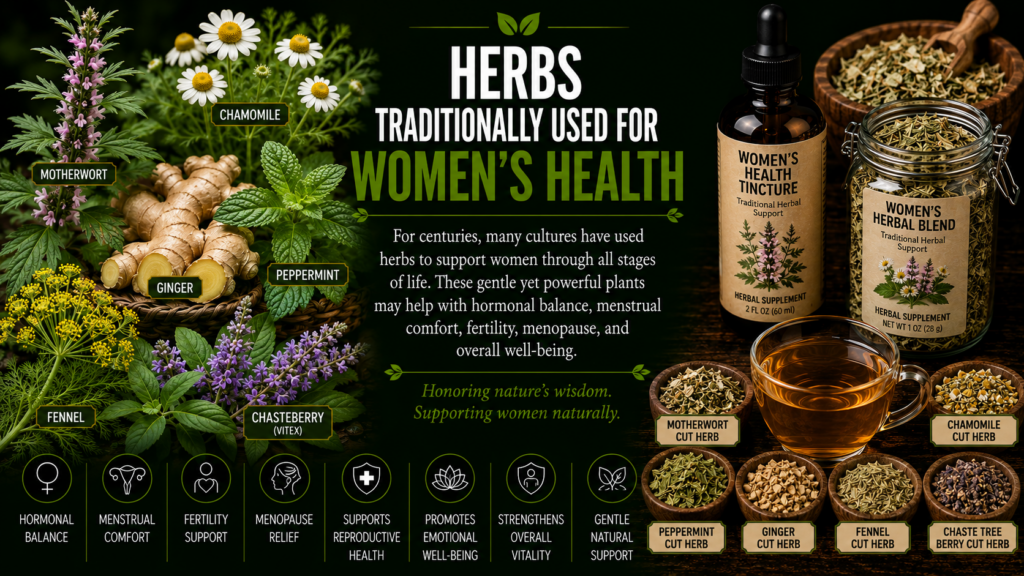
Plants have played an important role in traditional healing practices around the world for thousands of years. Women in many cultures have traditionally used herbs as part of everyday wellbeing and during different stages of life.
Today, interest in traditional women’s herbal medicine remains strong. You may come across herbs described in books, gardens and herbal traditions as being associated with menstrual wellbeing, digestive comfort, menopause or general health.
However, it is important to approach this subject carefully.
An herb’s traditional use does not automatically mean that modern research has proven it to be effective for a particular health condition. Evidence varies considerably between plants and their different uses, and some herbs can interact with medicines or may not be suitable for everyone.
This article looks at these plants from an educational and traditional perspective, rather than presenting them as treatments or cures.
What Is Women’s Herbal Medicine?
Women’s herbal medicine is not a single system of medicine.
Different cultures have developed their own traditions surrounding plants and women’s health. Herbal practices have been recorded in European, African, Asian, Middle Eastern and Indigenous traditions, among many others.
The herbs used and the ways they were prepared varied considerably.
Traditional herbal knowledge might include plants associated with:
- Menstrual wellbeing
- Digestive comfort
- General relaxation
- Menopausal changes
- Everyday nourishment
- Skin care
- Traditional pregnancy practices
- Postpartum traditions
It is important to remember that historical use tells us what people traditionally did. It does not necessarily tell us whether a particular herb has been proven to be effective or safe by modern research.
Why Is Women’s Health a Special Area of Herbalism?
Women experience several stages of life that can involve significant physiological changes.
These may include:
- Puberty
- Menstruation
- Pregnancy
- Breastfeeding
- Perimenopause
- Menopause
- Post-menopause
Traditional herbal systems developed different approaches to supporting women during these stages.
However, some of these stages—particularly pregnancy and breastfeeding—require additional caution because the safety of many herbs has not been adequately established.
For this reason, an herb that is traditionally used by adults should not automatically be assumed to be appropriate during pregnancy or breastfeeding.
Raspberry Leaf
Red raspberry leaf is one of the herbs commonly associated with traditional women’s herbal practices.
It has a long history of use in herbal traditions, particularly in connection with pregnancy and women’s reproductive health.
However, historical popularity should not be confused with proof of effectiveness.
If you are pregnant or considering using raspberry leaf during pregnancy, it is particularly important to obtain advice from an appropriately qualified healthcare professional rather than relying on traditional use alone.
This is a good example of why herbal traditions and modern safety evidence need to be considered separately.
Ginger
Ginger is a familiar culinary herb and spice that has also been used traditionally for digestive discomfort and nausea.
It has been studied in relation to nausea and vomiting, including during pregnancy, although the evidence around safety and appropriate use during pregnancy needs to be considered carefully.
Ginger is a useful example when learning about herbal medicine because a familiar food plant can also have a long history of traditional medicinal use.
As with any medicinal herbal product, concentrated supplements should not automatically be treated as equivalent to the amounts normally used in food.
Chamomile
Chamomile is traditionally associated with relaxation and digestive comfort and has been used in many cultures for generations.
It is also widely enjoyed as a herbal tea.
Some people use chamomile as part of a relaxing evening routine, while traditional herbal practices have associated it with digestive and soothing properties.
However, chamomile is not suitable for everyone. Allergic reactions can occur, particularly in people who are sensitive to plants in the daisy family, and potential interactions with medicines have also been reported.
Peppermint
Peppermint is another familiar herb with a long history of traditional use.
It is commonly associated with digestive comfort and is often enjoyed as a tea after meals.
Peppermint is not exclusively a women’s herb, but it can form part of general wellbeing practices during different stages of life.
The important lesson is that an herb does not need to be specifically labelled a “women’s herb” to be relevant to women’s everyday herbal traditions.
Fennel
Fennel has a long history of culinary and traditional herbal use.
It has traditionally been associated with digestive comfort and has also appeared in various women’s herbal traditions.
Because fennel contains biologically active plant compounds, however, traditional use does not mean that concentrated preparations are appropriate for everyone.
Different preparations can also vary significantly in strength.
Chasteberry
Chasteberry, also known as Vitex agnus-castus, is one of the herbs most commonly associated with traditional and modern herbal discussions about women’s health.
It has been studied in relation to premenstrual symptoms and other women’s health concerns.
Some research suggests that chasteberry may help with certain PMS symptoms, although evidence varies and more research is needed to establish its effectiveness for different uses.
It is also not automatically suitable for everyone. Safety considerations can include pregnancy, breastfeeding and certain hormone-sensitive conditions.
Motherwort
Motherwort (Leonurus cardiaca) has a long history in traditional European herbalism and is particularly interesting when studying herbs associated with women’s health.
Its common name reflects its historical connection with motherhood and women’s herbal traditions. Traditional herbal practices have associated motherwort with menstrual and reproductive wellbeing, as well as with nervous or emotional support.
Motherwort is also an excellent example of why it is important to distinguish traditional use from modern clinical evidence.
The European Medicines Agency has recognised certain motherwort preparations on the basis of their long-standing traditional use. Its assessment concerns preparations made from the flowering parts of Leonurus cardiaca and recognises traditional use for relieving symptoms associated with nervous tension and certain nervous heart complaints after serious conditions have been excluded by a doctor. The EMA also states that motherwort medicines should only be used by adults.
Motherwort should not be used during pregnancy. The EMA specifically lists pregnancy as a contraindication for the motherwort preparations covered by its assessment.
This makes motherwort a good reminder that even a plant with a long history of traditional use needs to be researched carefully before medicinal use.
When researching motherwort, use its botanical name, Leonurus cardiaca, to make sure you are looking at the correct plant.
Black Cohosh
Black cohosh is a North American plant that is particularly well known for its association with menopause.
It has been studied for symptoms such as hot flushes and other menopausal concerns.
Research findings have been mixed. Some studies suggest possible benefits from certain black cohosh preparations, while other research has not found consistent evidence of benefit.
There are also safety considerations. Rare cases of liver damage have been reported in people using commercial black cohosh products, although it is not always clear whether black cohosh itself was responsible.
This is another useful reminder that a plant’s popularity does not remove the need for careful research.
Red Clover
Red clover is another herb frequently mentioned in discussions about menopause.
It contains substances known as isoflavones, which are a type of phytoestrogen.
Red clover products have been studied for menopausal symptoms, but evidence regarding their effectiveness is not conclusive.
Because substances with hormone-like activity may not be appropriate for everyone, people with particular health circumstances or those taking medicines should seek professional advice before using concentrated red clover products.
Dong Quai
Dong quai, also known as Angelica sinensis, has a long history in traditional Chinese medicine and is sometimes described as a women’s herb.
It has traditionally been associated with menstrual and reproductive health.
However, traditional use should not be confused with established effectiveness.
Dong quai is also an example of why it is important to identify the exact plant and preparation being discussed. Common names can sometimes be confusing, while different preparations may have different properties.
St John’s Wort
St John’s wort is sometimes mentioned in relation to mood changes associated with menopause and other aspects of women’s wellbeing.
However, it is particularly important to be cautious with this herb because it can interact with numerous medicines.
The interactions can be significant, including with some antidepressants and other commonly used medicines.
It may also not be suitable during pregnancy or breastfeeding.
This makes St John’s wort a good example of an herb that should not be treated as a simple “natural remedy”.
Fenugreek
Fenugreek has been used traditionally in food and herbal practices in several cultures.
It has sometimes been promoted for supporting milk production during breastfeeding.
However, research into whether fenugreek actually increases milk production has produced mixed results, and safety information for larger-than-food amounts during breastfeeding is limited.
Fenugreek is also an important safety example because larger medicinal amounts are not considered appropriate during pregnancy.
Herbs and Menstrual Health
Traditional herbal practices have included many plants associated with menstrual wellbeing.
Some herbs have historically been described as:
- Relaxing
- Antispasmodic
- Digestive
- Warming
- Traditionally supportive of normal menstrual cycles
However, menstrual symptoms can have many different causes.
Severe pain, unusually heavy bleeding, persistent changes in menstrual cycles or other concerning symptoms should not simply be assumed to be a normal problem that requires an herbal remedy.
Sometimes the most important step is finding out what is causing the symptom.
Herbs and Menopause
Menopause is another area where herbal products are widely discussed.
Plants and natural products commonly mentioned include:
- Black cohosh
- Red clover
- Soy
- St John’s wort
- Dong quai
- Ginseng
Some of these have been studied, but current evidence does not establish that herbal products consistently relieve menopausal symptoms, and some can have side effects or interact with medicines.
If menopause symptoms are troublesome, it is worth discussing the available options with a doctor, nurse or pharmacist rather than relying solely on herbal supplements.
Herbs During Pregnancy Need Special Care
Pregnancy is not a time to experiment with unfamiliar medicinal herbs.
Although some herbs may have been used traditionally during pregnancy, the safety of many herbal products has not been adequately studied.
Some plants may also have effects that could be harmful during pregnancy.
Anyone who is pregnant or considering using a medicinal herbal product during pregnancy should discuss it with an appropriate healthcare professional rather than assuming that “natural” means safe.
This is particularly important with concentrated extracts, tinctures and supplements, which may provide much larger amounts of plant constituents than normal food use.
Herbs and Breastfeeding
The same caution applies during breastfeeding.
Some herbal products have not been adequately studied in breastfeeding women or nursing infants.
Even if an herb has a long history of traditional use, that does not necessarily mean that its safety during breastfeeding has been established.
If you are breastfeeding and considering a medicinal herbal product, discuss it with an appropriate healthcare professional.
What About Herbal Teas?
Herbal teas can be a gentle way to explore culinary herbs and traditional herbal practices, but “tea” does not automatically mean “safe for everyone”.
The plant must still be correctly identified, and some herbs can have unwanted effects or interact with medicines.
A mild culinary tea made from a familiar herb is also not necessarily equivalent to a concentrated medicinal extract made from the same plant.
The preparation matters.
Food, Tea and Concentrated Extracts Are Not the Same
This is an important concept for anyone beginning to explore herbal medicine.
There can be a substantial difference between:
Using an herb as food
and
Taking a concentrated herbal extract.
A herb used in normal culinary quantities may have a very different effect from a concentrated capsule, tincture or extract.
This is one reason you should never assume that a medicinal preparation is safe simply because the plant is commonly eaten.
Botanical Names Matter
When researching medicinal plants, learn to recognise their botanical names.
For example:
- Chasteberry – Vitex agnus-castus
- Motherwort – Leonurus cardiaca
- Black cohosh – Actaea racemosa
- Dong quai – Angelica sinensis
Botanical names help distinguish plants that may have similar or confusing common names.
This is particularly important when buying dried herbs or plants for medicinal study.
What Does “Women’s Health” Actually Mean?
It is worth remembering that women’s health is not limited to reproductive health.
It can include many areas of wellbeing, including:
- Nutrition
- Bone health
- Heart health
- Sleep
- Emotional wellbeing
- Digestive health
- Physical activity
- Menstrual health
- Pregnancy
- Menopause
- Healthy ageing
Herbal medicine may form part of some people’s cultural or personal wellbeing practices, but it should not replace appropriate medical care.
How to Research a Women’s Health Herb Responsibly
If you come across an herb described as being useful for women, take a few minutes to investigate it properly.
Ask:
- What is the correct botanical name?
- Which part of the plant is traditionally used?
- What is the traditional use?
- Is there scientific research supporting the claim?
- What preparation was studied?
- Are there known side effects?
- Can it interact with medicines?
- Is it suitable during pregnancy or breastfeeding?
- Are there warnings for particular health circumstances?
- Is the product from a reputable source?
These questions can help you separate useful information from exaggerated herbal claims.
Traditional Knowledge Deserves Respect
Traditional herbal knowledge represents generations of observation and cultural practice.
It is worth learning about and preserving.
At the same time, traditional knowledge and scientific research answer different questions.
Traditional knowledge can tell us how a plant has been used historically.
Scientific research can help investigate whether a particular use appears effective and what risks may be involved.
The two perspectives can be discussed together without treating them as identical.
Natural Does Not Mean Risk-Free
This is perhaps the most important message in any beginner’s herbal education.
A plant can be natural and still contain powerful compounds.
Herbs can cause side effects, allergies and interactions with medicines. Some may also be unsuitable during pregnancy, breastfeeding or for people with particular health circumstances.
If you take prescription medicines or have an ongoing health concern, it is sensible to speak with a doctor or pharmacist before starting a medicinal herbal product.
A Beginner’s Women’s Herbal Reference List
For someone beginning to explore the subject, the following plants are useful to research from a traditional-use perspective:
| Herb | Traditionally associated with |
|---|---|
| Raspberry leaf | Traditional women’s herbal practices |
| Ginger | Digestive comfort and nausea |
| Chamomile | Relaxation and digestive comfort |
| Peppermint | Digestive comfort |
| Fennel | Digestive and traditional women’s herbal practices |
| Chasteberry | Premenstrual symptoms |
| Motherwort | Traditional women’s and menstrual herbal practices |
| Black cohosh | Menopause |
| Red clover | Menopause |
| Dong quai | Traditional menstrual and reproductive herbal practices |
| St John’s wort | Mood and some menopausal discussions |
| Fenugreek | Traditional breastfeeding practices |
This table is intended as a starting point for learning, not as a recommendation to use these herbs medicinally.
Final Thoughts
Women have used plants as part of traditional health practices for generations, and the subject of women’s herbal medicine is both fascinating and extensive.
Herbs such as ginger, chamomile, peppermint, chasteberry, motherwort, black cohosh and red clover have all appeared in traditional or modern discussions of women’s wellbeing, but their evidence, preparation methods and safety profiles are not the same.
The best way to explore this subject is with curiosity and a healthy respect for the plants themselves.
Learn the botanical names, understand the traditional history, look at modern evidence and always check safety information before considering medicinal use.
Most importantly, herbal medicine should complement responsible healthcare rather than replace it.
The more you learn, the more you will discover that the world of medicinal plants is not simply about finding a plant for a particular symptom. It is about understanding the plant, its history, its preparation, its traditional role and—just as importantly—its limitations.
Related Articles
Herbs Traditionally Used for Immune Support
Read MoreHerbs Traditionally Used for Respiratory Health
Read More