
Plants by Health Benefit
Herbs Traditionally Used for Immune Support
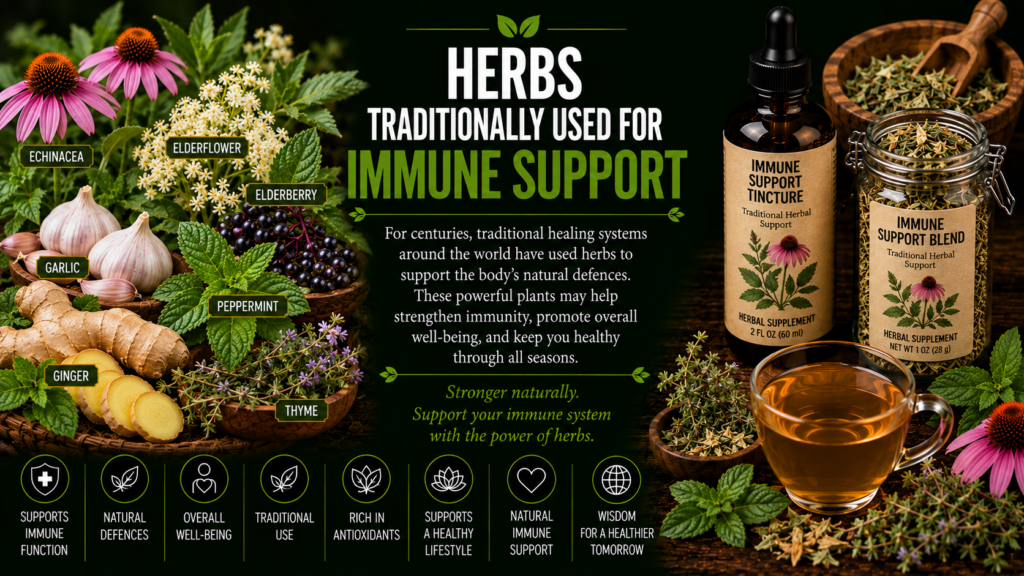
The immune system is one of the body’s most important defence systems. It helps the body respond to bacteria, viruses and other substances that can cause illness.
Long before modern medicine developed, people around the world used plants as part of traditional approaches to health and wellbeing. Some of these herbs became particularly associated with seasonal illnesses, respiratory complaints and what we might today describe as supporting the body’s natural defences.
Today, you will find many herbal products marketed for “immune support”. Some are sold as teas, tinctures, capsules, syrups or dried herbs.
But there is an important distinction to make.
An herb being traditionally used for immune support does not automatically mean that modern research has proven that it prevents illness or strengthens the immune system.
Some herbs have been studied more extensively than others, and research results can vary depending on the plant species, plant part, preparation and amount used.
This article introduces some herbs traditionally associated with immune support and looks at them from an educational and traditional perspective.
What Does “Immune Support” Actually Mean?
The phrase “immune support” is used very widely.
It can refer to general practices intended to support normal immune function, rather than treating a particular illness.
Your immune system is a complex network involving cells, tissues, organs and biological processes throughout the body. It does not work like a simple switch that can be turned “up” by taking one particular herb.
A healthy lifestyle remains an important part of supporting normal immune function.
This includes:
- Eating a varied, nutritious diet
- Getting enough sleep
- Staying physically active
- Managing stress
- Maintaining good hygiene
- Drinking enough fluids
- Following appropriate vaccination recommendations
- Seeking medical care when necessary
Herbal products may be part of some people’s traditional or personal health practices, but they should not replace these basic measures.
Why Are Herbs Associated With Immune Support?
Many herbs have been used traditionally during times when people experienced coughs, colds, seasonal illnesses or general feelings of being unwell.
Over generations, certain plants became associated with helping the body cope with these common health concerns.
Modern research has investigated some of these plants, but the results are not always straightforward.
For example, NCCIH notes that research into immune-related supplements is often limited or inconsistent, and that products containing different plant species or preparations may produce different results.
This is why it is better to learn about individual herbs rather than assuming that every plant labelled an “immune booster” works in the same way.
Echinacea
Echinacea is probably one of the best-known herbs associated with immune support.
Several species are used in herbal products, including:
- Echinacea purpurea
- Echinacea angustifolia
- Echinacea pallida
Echinacea has a long history of medicinal use among Indigenous peoples of North America and later became part of European and North American herbal traditions.
Today, echinacea products are commonly promoted for colds and other respiratory infections.
Research has produced mixed results. Some studies suggest that certain echinacea preparations may slightly reduce the chance of developing a cold or may have some effect on cold symptoms, while other studies have not found a clear benefit.
Another important point is that “echinacea” does not describe one identical product. Different species, plant parts and preparations can have different properties.
Some people can also experience allergic reactions to echinacea, particularly those who are sensitive to plants in the daisy family.
Elderberry
Elderberry, particularly the European elder or black elder (Sambucus nigra), has a long history in traditional medicine.
Elderberries have traditionally been used for seasonal respiratory complaints, including colds and flu.
Some preliminary research suggests that elderberry preparations may help relieve symptoms of colds or influenza, but the evidence is still limited and more high-quality research is needed.
There is also an important safety point with elderberry.
Raw or unripe elderberries, as well as the leaves and stems, contain substances that can be toxic. Proper preparation is therefore essential.
This is a good example of why you should never assume that every part of a medicinal plant is safe simply because one part of the plant is traditionally used.
Garlic
Garlic, or Allium sativum, is probably one of the easiest medicinal plants to recognise because it is already a familiar kitchen ingredient.
Garlic has been used as both food and traditional medicine for thousands of years.
It is sometimes promoted as an immune-supporting herb, particularly during the colder months.
However, research specifically investigating garlic for immune function and prevention of colds remains limited. NCCIH notes that only a small number of studies have investigated this area, with insufficient evidence to draw firm conclusions.
Garlic is generally considered safe in normal food amounts for most people.
Concentrated garlic supplements are a different matter. They can increase bleeding risk and may interact with medicines such as anticoagulants.
This is another useful reminder that using an herb as food and taking it as a concentrated supplement are not necessarily the same thing.
Astragalus
Astragalus (Astragalus membranaceus) has a long history in traditional Chinese medicine.
Its root has traditionally been used in combination with other herbs and is sometimes described as an adaptogenic herb.
Astragalus is now frequently promoted for immune support and resistance to illness.
Research into astragalus is continuing, but there is currently not enough reliable scientific evidence to establish whether it is useful for particular health conditions.
Astragalus may also interact with medicines that suppress the immune system and may not be suitable for people with certain autoimmune conditions. There is limited information about its safety during pregnancy and breastfeeding.
For beginners, astragalus is therefore best viewed as an interesting traditional medicinal plant to research rather than as a guaranteed immune booster.
Ginger
Ginger is another familiar kitchen ingredient that has a long history of traditional medicinal use.
It is commonly associated with digestive comfort and nausea and has also been used traditionally during respiratory complaints.
Ginger is not usually considered a direct “immune booster”, but it is often included in traditional wellness preparations because of its warming flavour and long history of use.
Fresh ginger can be used in cooking and drinks, while dried ginger is also commonly available.
As with garlic, there is an important difference between ordinary culinary use and concentrated medicinal preparations.
Turmeric
Turmeric (Curcuma longa) is another familiar South African kitchen cupboard ingredient, particularly in households that enjoy Indian-inspired cooking.
Turmeric has a long history of use in traditional Indian and South Asian practices.
It is sometimes promoted for immune health because of its plant compounds, particularly curcuminoids.
However, research into turmeric and curcumin covers many different health areas, and evidence for particular uses varies.
Turmeric used as a culinary spice is quite different from a concentrated curcumin supplement.
This is worth remembering when reading claims about herbal products.
South African Geranium
One particularly interesting plant for South African readers is South African geranium (Pelargonium sidoides).
The roots of this plant have a history of traditional use in southern Africa.
Today, preparations made from Pelargonium sidoides root are used in some countries for respiratory complaints, including symptoms associated with colds.
Research has suggested that certain preparations may help with some respiratory symptoms, although the quality of the evidence varies.
This plant is especially interesting from a local herbal perspective because it connects modern herbal products with traditional southern African plant knowledge.
As always, the exact preparation matters.
Elderflower
Elderflower comes from the flowers of the elder plant and has a long history of traditional use.
It is sometimes used in herbal teas and traditional preparations associated with seasonal wellbeing.
It is important not to confuse elderflower with raw elderberries or other parts of the elder plant.
Different parts of a plant can contain different constituents and may have different safety considerations.
If using elder products, make sure the plant material has been correctly identified and appropriately prepared.
Sage
Sage (Salvia officinalis) is another familiar culinary herb with a long history of traditional use.
It has traditionally been used for a variety of purposes, including mouth and throat preparations.
Sage is sometimes included in herbal discussions relating to seasonal respiratory wellbeing.
However, concentrated sage preparations require more caution than ordinary culinary use. Sage contains compounds such as thujone, and high-dose or long-term use may not be safe.
This is another example of why the form and amount of an herb matter.
Thyme
Thyme is a familiar culinary herb that has also been used traditionally in herbal preparations.
It has historically been associated with respiratory and throat comfort.
Thyme can be enjoyed as a culinary herb or used in traditional herbal preparations, depending on the product.
However, concentrated preparations should not automatically be considered equivalent to the small quantities normally used in cooking.
Rosemary
Rosemary is another South African garden favourite with culinary and traditional herbal uses.
It has historically been used in various traditional preparations and is particularly valued for its aromatic qualities.
Rosemary is not a proven treatment for infections, but it is an interesting example of how herbs used regularly in the kitchen can also have a long history of traditional medicinal use.
Why Plant Identification Matters
When learning about medicinal herbs, correct identification is extremely important.
Many plants have several common names, and some common names are used for completely different plants in different regions.
Whenever possible, learn the botanical name.
For example:
- Echinacea – Echinacea purpurea
- Garlic – Allium sativum
- Elderberry – Sambucus nigra
- Astragalus – Astragalus membranaceus
- South African geranium – Pelargonium sidoides
- Turmeric – Curcuma longa
- Ginger – Zingiber officinale
- Sage – Salvia officinalis
- Thyme – Thymus vulgaris
- Rosemary – Salvia rosmarinus
Botanical names make it much easier to research the correct plant and avoid confusion.
Herbal Tea vs Medicinal Preparation
An important distinction for beginners is the difference between an ordinary herbal tea and a concentrated medicinal preparation.
A cup of ginger or thyme tea prepared for enjoyment is not necessarily equivalent to a concentrated herbal extract.
The concentration, preparation method and amount of plant material can be very different.
This is why you should not assume that increasing the amount of herb will make an herbal preparation more effective.
With some plants, it could instead increase the risk of unwanted effects.
Can Herbs Prevent You From Getting Sick?
This is one of the most common questions surrounding immune-support herbs.
It is important to be cautious about claims that a particular herb will prevent you from catching a cold, flu or another infection.
Research into herbs such as echinacea, elderberry and garlic has produced mixed or limited evidence, and no herbal product should be treated as a guaranteed way of preventing illness.
Good everyday health practices remain important.
Herbs Are Not a Replacement for Medical Care
An herbal tea can be comforting when you are feeling under the weather, but it should not replace appropriate medical care.
Seek medical attention when symptoms are severe, unusual, persistent or getting worse.
This is particularly important for young children, older adults, pregnant people and anyone with a chronic health condition or weakened immune system.
Herbs can also interact with medicines, so always consider the whole picture rather than looking at a plant in isolation.
Natural Does Not Mean Risk-Free
This is one of the most important lessons for anyone beginning to explore herbal medicine.
A plant can be completely natural and still contain powerful biologically active compounds.
Herbal products can cause:
- Allergic reactions
- Digestive upset
- Medicine interactions
- Side effects
- Problems when taken in excessive amounts
NCCIH advises that herbal products should be considered individually because safety varies considerably between products and people.
Pregnancy and Breastfeeding
Extra caution is needed during pregnancy and breastfeeding.
The safety of many medicinal herbs has not been adequately studied during these periods.
Even herbs that are commonly used by adults may not necessarily be suitable during pregnancy or breastfeeding.
Some herbs may also interact with medicines or have effects that are inappropriate during pregnancy.
If you are pregnant or breastfeeding, speak with an appropriately qualified healthcare professional before using medicinal herbal products.
Children and Herbal Products
Children should not automatically be given herbal supplements simply because the product is labelled natural.
Children can respond differently to medicines and herbal products than adults.
For example, NCCIH notes that evidence and safety information for echinacea in children are limited, and allergic reactions are a concern.
Parents and caregivers should therefore obtain appropriate professional advice before giving medicinal herbal products to children.
A Beginner’s Immune-Support Herb Reference
The following table provides a simple starting point for learning about herbs traditionally associated with immune or seasonal respiratory support.
| Herb | Traditional or commonly discussed association |
|---|---|
| Echinacea | Colds and seasonal respiratory wellbeing |
| Elderberry | Colds and flu traditions |
| Garlic | General health and traditional immune support |
| Astragalus | Traditional immune and vitality practices |
| Ginger | Digestive comfort and general wellbeing |
| Turmeric | Traditional general health and wellbeing |
| South African geranium | Traditional respiratory use |
| Elderflower | Seasonal herbal traditions |
| Sage | Traditional throat and mouth preparations |
| Thyme | Traditional respiratory and throat use |
| Rosemary | Traditional general wellbeing |
This table is intended as a learning reference, not a list of treatments or recommendations.
How to Choose an Herbal Product Responsibly
If you decide to explore herbal products, take some time to investigate the product before using it.
Look for:
- The correct botanical name
- The plant part used
- The amount of herb or extract
- Preparation method
- Manufacturer or supplier information
- Appropriate storage instructions
- Expiry or best-before information
- Safety warnings
- Known medicine interactions
Be particularly cautious of products making dramatic claims such as “boosts immunity instantly”, “prevents all infections” or “replaces medicine”.
Strong health claims deserve strong evidence.
Traditional Use and Scientific Research Are Different
Traditional herbal knowledge is valuable and provides an important record of how plants have been used by different communities.
Scientific research asks different questions.
Traditional use can tell us:
How has this plant been used historically?
Scientific research can investigate:
Does a particular preparation appear to have a measurable effect, and what are its potential risks?
These two sources of knowledge can complement one another, but they should not be treated as interchangeable.
Building a Healthy Immune-Support Routine
Instead of relying on a single herb, think about overall health.
A sensible everyday routine includes:
- Eating a varied diet
- Including plenty of vegetables and fruit
- Getting enough sleep
- Staying active
- Drinking enough water
- Managing stress
- Practising good hygiene
- Avoiding unnecessary use of medicines or supplements
- Getting appropriate medical care
Herbal teas can be enjoyable additions to a healthy lifestyle, but they are only one small part of the bigger picture.
Final Thoughts
Herbs have been used traditionally for generations, and many plants have become associated with supporting health during seasonal illnesses.
Echinacea, elderberry, garlic, astragalus, ginger, turmeric, South African geranium, sage and thyme are just some of the plants you may encounter when beginning to explore this area of herbal medicine.
Some have been researched more extensively than others, and the evidence is often mixed. The exact plant species, plant part and preparation can also make a significant difference.
For beginners, the most useful approach is to stay curious without believing every health claim you read.
Learn the botanical names, understand the traditional uses, check the available evidence and pay attention to safety information.
Most importantly, remember that supporting general wellbeing is not the same thing as treating or preventing disease.
Herbal medicine is a fascinating subject because it combines traditional knowledge, botany, history and modern scientific research. The more you learn, the better equipped you will be to appreciate medicinal plants while also respecting their limitations.
Related Articles
Herbs Traditionally Used for Women’s Health
Read MoreHerbs Traditionally Used for Respiratory Health
Read More