
Plants by Health Benefit
Herbs Traditionally Used for Respiratory Health
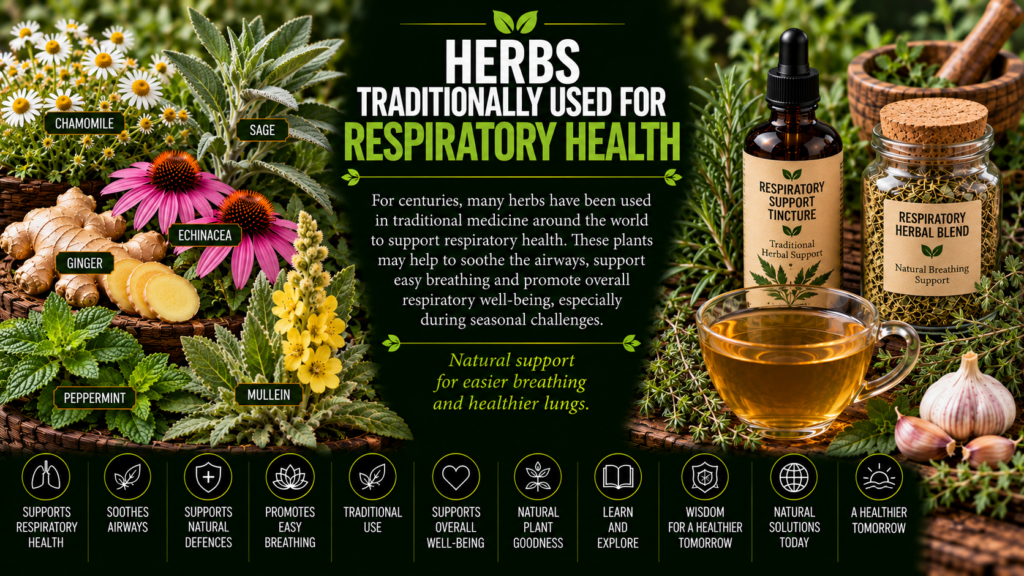
Respiratory illnesses such as colds, coughs, sore throats and seasonal flu have been part of human life for thousands of years. Long before modern pharmacies existed, people around the world used plants, teas, syrups, steam preparations and other traditional remedies to help soothe respiratory symptoms.
Today we have access to effective medical treatments for many respiratory infections, but that does not mean traditional herbal knowledge has become irrelevant. Many medicinal plants continue to be researched for their effects on coughs, sore throats, inflammation and other respiratory symptoms.
The important thing is to understand the difference between traditional use, laboratory research and proven clinical treatment.
Some herbs have interesting research behind them, while others are supported mainly by traditional use. A plant showing antiviral activity in a laboratory, for example, does not automatically mean that drinking a tea made from that plant will cure a viral infection.
This article looks at a selection of herbs and medicinal plants that have traditionally been used for respiratory health, while keeping the evidence and safety considerations in perspective.
What Is a Respiratory Infection?
A respiratory infection affects part of the respiratory system, which includes the nose, sinuses, throat and lungs.
Respiratory infections can be caused by different types of microorganisms, including viruses and bacteria.
Common examples include:
- The common cold
- Influenza
- Viral sore throats
- Sinus infections
- Bronchitis
- Some forms of pneumonia
- Other upper and lower respiratory tract infections
Not every cough or sore throat has the same cause, which is why treating every respiratory illness in exactly the same way is not appropriate.
Viral and Bacterial Infections Are Different
One of the most important things to understand is that antibiotics do not treat viral infections.
Antibiotics work against certain bacterial infections, but they do not work against viruses such as those that cause colds and influenza. The World Health Organization also states that antibiotics do not prevent or treat COVID-19 because COVID-19 is caused by a virus.
That does not mean antibiotics are never appropriate for someone with a respiratory illness. A healthcare professional may prescribe them when a bacterial infection is suspected or confirmed.
Likewise, herbs should not automatically be considered substitutes for antibiotics or other appropriate medical treatment.
Can Herbs Help With Respiratory Symptoms?
Some herbs have traditionally been used to soothe symptoms such as:
- Coughing
- Sore throat
- Nasal congestion
- Chest discomfort
- Excess mucus
- Fever associated with minor illnesses
- General cold and flu symptoms
Research has also investigated a number of herbs for respiratory infections.
However, the evidence is not the same for every plant.
An important distinction is that traditional use does not equal clinical proof.
For example, laboratory studies may show that a plant extract affects a virus, but this does not necessarily demonstrate that the whole plant, prepared as a tea, will treat that infection in humans.
This distinction is particularly important when discussing serious infections.
African Wormwood
It has a long history of traditional use for respiratory complaints, including colds, coughs and other conditions affecting the respiratory tract.
The plant is also known by several local names, including umhlonyane and lengana.
African wormwood is particularly interesting from a South African herbal medicine perspective because it is part of our own regional medicinal plant heritage.
It is important, however, not to confuse traditional use with proof that Artemisia afra can cure an infection.
Liquorice Root
Liquorice (Glycyrrhiza glabra) has a long history of traditional use for coughs and respiratory complaints.
The root contains glycyrrhizin and other compounds that have attracted considerable scientific interest.
Laboratory research has investigated liquorice compounds for antiviral activity, but laboratory findings should not be interpreted as proof that liquorice root can treat a respiratory virus in humans.
Liquorice also deserves particular attention from a safety perspective. Large amounts or prolonged use of glycyrrhizin-containing liquorice can cause serious problems, including effects on blood pressure, potassium levels and heart rhythm. People with hypertension or heart or kidney problems should be particularly cautious.
Bay Leaf
Bay (Laurus nobilis) has traditionally been used as both a culinary herb and a medicinal plant.
Bay leaves contain aromatic plant compounds and have traditionally been included in preparations intended to support respiratory comfort.
In everyday use, bay leaf is perhaps most familiar in soups, stews and other cooked dishes.
Its traditional medicinal use is interesting, but there is not enough clinical evidence to describe bay leaf as a treatment for respiratory infections.
Lemon Verbena
Lemon Verbena (Aloysia citrodora) is traditionally used in herbal teas and other preparations.
Its pleasant lemon aroma makes it a popular tea herb, and traditional herbal practices have used it in preparations for colds and feverish illnesses.
It is better viewed as a soothing traditional herb rather than a proven treatment for respiratory infections.
Hyssop
Hyssop (Hyssopus officinalis) has a long history in traditional herbal medicine.
Traditionally, hyssop preparations have been used for coughs, sore throats and other respiratory complaints.
A warm herbal infusion is one traditional way of using the leaves.
However, traditional preparations should not automatically be assumed to have the same effects as concentrated extracts or essential oils.
Cancer Bush
Cancer bush (Lessertia frutescens) is another important southern African medicinal plant.
It has a long history of traditional use in the region for a variety of health complaints, including respiratory conditions.
Traditional uses have included colds, influenza-like illnesses, coughs and other respiratory complaints.
Cancer bush is an excellent example of why South Africa’s medicinal plant heritage deserves continued study. At the same time, traditional use should not be presented as proof of a cure.
Vick’s Plant
Vick’s plant (Plectranthus species) is traditionally associated with respiratory comfort.
The strongly aromatic leaves are commonly used in traditional household remedies, particularly for helping create a feeling of clearer nasal passages.
The plant’s strong aroma is one of its most noticeable characteristics.
As with other aromatic plants, traditional household use should not be confused with evidence that it eliminates an infection.
Borage
Borage (Borago officinalis) has a long history of traditional herbal use.
The leaves and flowers have traditionally been used in preparations for coughs, sore throats and feverish illnesses.
Borage contains pyrrolizidine alkaloids, however, and this is an important safety consideration. Internal use of borage should therefore not be treated as a harmless everyday herbal tea.
Evening Primrose
Evening Primrose (Oenothera biennis) has been used traditionally for a variety of purposes, including some respiratory complaints.
Historical herbal literature describes its use for coughs and respiratory conditions.
However, evidence for using evening primrose specifically for respiratory infections remains limited, so it is better included as a plant of traditional interest rather than a proven treatment.
Black Elderberry
Some preliminary human studies suggest elderberry preparations may help reduce certain upper respiratory symptoms, although the available evidence remains limited.
There is an important safety point here:
Raw or unripe elderberries, as well as the leaves and stems, contain potentially toxic compounds.
Properly prepared ripe elderberries are different from raw plant material.
Anise
Anise (Pimpinella anisum) is best known for its sweet, distinctive flavour.
Anise has a long history of traditional use for digestive and respiratory complaints, particularly coughs.
The seeds can be used to prepare an aromatic herbal infusion.
Yarrow
Traditional herbal medicine has often associated yarrow with sweating and feverish conditions.
Although this traditional use is interesting, it should not replace appropriate care when someone has a significant or persistent fever.
Nasturtium
Nasturtium (Tropaeolum majus) is both an attractive garden plant and an edible plant.
It has also been investigated for traditional medicinal uses, including respiratory complaints.
The plant contains compounds with antimicrobial activity, but laboratory antimicrobial activity is not the same as proving that the plant treats respiratory infections in people.
Chamomile
Chamomile is one of the gentlest and most familiar herbs on this list.
Chamomile flowers are commonly prepared as a soothing herbal tea and have traditionally been used for a wide range of minor complaints.
For someone with a cold or sore throat, a warm, caffeine-free herbal drink can also simply be comforting and contribute to fluid intake.
Chamomile should therefore be thought of primarily as a soothing traditional herbal drink, rather than as a cure for infection.
Marshmallow
Marshmallow (Althaea officinalis) has a particularly interesting traditional role in herbal medicine.
The root contains mucilage, a substance that becomes slippery when mixed with water.
Traditional preparations of marshmallow root have been used to soothe irritated tissues, including the throat.
This makes marshmallow particularly interesting when discussing herbs traditionally used for dry coughs and throat irritation.
Echinacea
It is often marketed for immune support and the common cold.
The scientific evidence, however, is mixed. Some research suggests certain echinacea preparations may have modest effects on respiratory infections, while other studies have not found meaningful benefits. NCCIH notes that it remains unclear whether echinacea shortens the duration of a cold, and different products can contain different species, plant parts and preparations.
This is a good example of why the words “echinacea has been studied” are more accurate than saying “echinacea cures colds.”
Sage
Sage (Salvia officinalis) has been used traditionally for sore throats, mouth complaints and respiratory symptoms.
Sage leaves contain numerous aromatic compounds, some of which have been investigated for antimicrobial and other biological activity.
However, concentrated sage preparations and essential oil should not be treated in the same way as culinary amounts of sage.
High-dose or prolonged use of sage may not be safe because of its thujone content.
Lemon Balm
Lemon Balm (Melissa officinalis) is a popular garden herb with a pleasant lemon scent.
Laboratory research has found antiviral activity from lemon balm extracts against certain viruses, but laboratory findings should not be interpreted as evidence that drinking lemon balm tea will cure a respiratory infection.
Its main appeal for everyday use is as a pleasant, calming herbal tea.
Peppermint
Peppermint (Mentha × piperita) contains menthol, which produces its characteristic cooling sensation.
Peppermint tea is commonly used for its refreshing flavour, while the aroma can create a subjective feeling of clearer breathing.
Some laboratory research has investigated peppermint compounds for antiviral and anti-inflammatory activity, but this does not establish peppermint as a treatment for respiratory infections in humans.
Rosemary
Rosemary (Salvia rosmarinus) is primarily known as a culinary herb, but it also has a long history of traditional medicinal use.
Its plant compounds have been studied for antimicrobial and antioxidant activity.
Rosemary can be a useful addition to the kitchen and is an interesting medicinal plant to study, but there is not enough clinical evidence to describe it as a treatment for respiratory infections.
Ginger
Ginger (Zingiber officinale) is another excellent example of a plant that sits comfortably between food and traditional medicine.
Ginger has traditionally been used for a variety of complaints, including nausea, digestive discomfort and respiratory symptoms.
Its warming flavour makes ginger tea a popular choice when someone has a cold.
Research has also investigated ginger compounds for antiviral and anti-inflammatory activity, although much of the evidence comes from laboratory research rather than clinical treatment studies.
Ginseng
Ginseng has been used in traditional Asian medicine for centuries.
Research has investigated ginseng and respiratory health, including whether certain preparations may influence the frequency or severity of respiratory infections.
However, ginseng products vary considerably, and it can interact with medicines. It should therefore not be treated as a simple universal immune booster.
Dandelion
Dandelion (Taraxacum officinale) is often dismissed as a garden weed.
It has, however, been used traditionally as a food and medicinal plant.
Research has investigated several of its biological properties, including possible antiviral activity.
At present, this is an area of research rather than a reason to use dandelion as a treatment for respiratory infection.
Garlic
Garlic (Allium sativum) is one of the most familiar medicinal foods in the world.
It contains sulphur-containing compounds, particularly when the cloves are crushed or chopped.
Garlic has demonstrated antimicrobial activity in laboratory studies and has been investigated for respiratory illnesses.
However, clinical evidence for preventing or treating the common cold remains limited.
Garlic is nevertheless an excellent food to include in a varied diet.
Basil
Basil (Ocimum basilicum) and related basil species have long histories of culinary and traditional medicinal use.
Different basil species contain different plant compounds, and laboratory studies have investigated their antimicrobial and antiviral properties.
This is another case where promising laboratory findings should not be confused with proven treatment of respiratory infections.
Oregano
Oregano (Origanum vulgare) contains aromatic compounds such as carvacrol and thymol.
Oregano and its constituents have demonstrated antimicrobial activity in laboratory research.
However, concentrated oregano oil is very different from using oregano as a culinary herb.
Essential oils and concentrated herbal extracts should not be swallowed casually, and “natural” does not automatically mean safe.
Mullein
Mullein (Verbascum species) has a long history in traditional European herbal medicine.
Mullein tea has traditionally been used for coughs and other respiratory complaints.
Its soft leaves and traditional association with respiratory health have made it a popular herb among herbalists.
However, high-quality clinical evidence for treating respiratory infections is limited.
Speedwell
Speedwell (Veronica species) has traditionally been used as a cough remedy and as a gargle for sore throats.
It is an interesting example of a traditional European medicinal herb that is much less familiar to modern gardeners.
As with many traditional herbs, its historical use is better established than its modern clinical evidence.
Woad
Woad (Isatis tinctoria) is probably better known historically as a dye plant, but it also has a history of medicinal use.
Traditional herbal medicine has used woad preparations for complaints involving the throat and respiratory system.
Its medicinal history is interesting, although it should not be considered a proven treatment for influenza or respiratory infections.
Yellow Dock
Yellow Dock (Rumex crispus) is another plant with a long history in traditional herbal medicine.
Traditional uses have included preparations for throat irritation and coughs.
As with many older herbal remedies, evidence for specific respiratory conditions remains limited.
Elecampane
Elecampane (Inula helenium) has traditionally been associated with respiratory herbal medicine.
The root has historically been used in preparations for coughs and other respiratory complaints.
It is particularly interesting because elecampane contains aromatic compounds and has traditionally been regarded as an expectorant herb.
Modern clinical evidence, however, is limited.
Gotu Kola
Gotu Kola (Centella asiatica) is an important medicinal plant in several traditional systems.
It has traditionally been used for many different purposes, although respiratory applications are less central to its modern popularity.
Laboratory research has investigated antimicrobial and other biological properties, but this should not be taken as proof that gotu kola treats respiratory infections.
White Horehound
White Horehound (Marrubium vulgare) has a particularly long history in European herbal medicine.
The herb has traditionally been used for coughs and respiratory complaints.
Horehound is perhaps best known historically as a cough herb, and it remains an interesting plant for anyone studying traditional herbal medicine.
What Does the Science Actually Tell Us?
One of the most important lessons when studying medicinal plants is that evidence exists on a spectrum.
There is a major difference between:
Traditional use
A plant has been used by a particular culture or herbal tradition for a particular purpose.
Laboratory research
A plant extract or isolated compound produces an effect in cells, tissues or laboratory models.
Animal research
The plant or compound produces an effect in an animal model.
Human clinical research
Researchers test a particular preparation in people.
Established medical treatment
There is sufficiently strong evidence and clinical acceptance for a treatment to be recommended for a specific condition.
These are not interchangeable.
A plant can have fascinating laboratory results while still having insufficient evidence to recommend it as a treatment for an infection.
What About “Immune-Boosting” Herbs?
The phrase “immune boosting” is used very frequently in herbal marketing.
It is also a phrase that can be misleading.
The immune system is extraordinarily complex. Increasing immune activity is not automatically beneficial, because an inappropriate or excessive immune response can also cause problems.
For that reason, it is usually more useful to discuss what a particular herb has actually been studied for rather than simply calling it an immune booster.
Herbs and Symptom Relief
Some traditional herbs may be useful as complementary measures for symptoms such as a dry throat, mild cough or general discomfort.
That is very different from claiming that they eliminate the microorganism responsible for an infection.
For example, a warm herbal tea can soothe an irritated throat and contribute to fluid intake without needing to claim that the tea has cured the underlying infection.
When Should You Seek Medical Care?
Herbal remedies should never delay medical attention when someone may have a serious respiratory illness.
Seek medical advice promptly if symptoms are severe, getting worse, or not improving as expected.
Particular caution is appropriate when someone has:
- Difficulty breathing.
- Severe or persistent chest pain.
- Confusion or unusual drowsiness.
- Blue or grey lips or skin.
- A high or persistent fever.
- Signs of dehydration.
- Symptoms that are rapidly worsening.
- A serious underlying medical condition.
- Significant symptoms in a very young child or older person.
Respiratory illnesses can range from mild to serious, and it is not always possible to tell the difference at home.
Herbs Are Not Automatically Safe
One of the most important lessons for anyone interested in herbal medicine is:
Natural does not automatically mean safe.
Herbs contain biologically active compounds, and those compounds can have both desired and unwanted effects.
Some herbs can interact with medicines, while others may not be appropriate during pregnancy, breastfeeding or certain medical conditions.
Examples include:
- Liquorice, which can affect blood pressure and potassium levels when consumed in sufficient amounts.
- Sage, particularly concentrated or prolonged use because of thujone.
- Elderberry, where raw or unripe berries and other parts of the plant can contain toxic compounds.
- Echinacea, which can cause allergic reactions in some people and may interact with some medicines.
This is why learning about dosage, preparation, contraindications and herb–medicine interactions is just as important as learning what a plant is traditionally used for.
Traditional Medicine and Modern Medicine Can Coexist
It is not necessary to choose between traditional plant knowledge and modern medicine as though they are mutually exclusive.
Modern medicine has produced highly effective treatments for many serious infections, while traditional herbal knowledge provides an enormous body of historical information about plants and their uses.
The most sensible approach is to understand what each can and cannot do.
Medicinal plants can be studied scientifically, traditional knowledge can be preserved, and useful plant compounds can sometimes contribute to the development of modern medicines.
At the same time, traditional use should not be exaggerated into claims that have not been demonstrated.
Final Thoughts
The history of medicinal plants and respiratory health is fascinating.
From African wormwood and cancer bush in southern Africa to ginger, garlic, liquorice, elderberry, echinacea and countless other plants used around the world, people have developed extensive traditional knowledge about plants that may provide comfort during respiratory illnesses.
Some of these plants have promising scientific research behind them. Others remain supported mainly by traditional use. A few have evidence suggesting modest benefits for particular symptoms, while many require considerably more research.
The important thing is to keep those distinctions clear.
Herbal medicine can be a valuable field to study, but herbs should not be presented as cures for serious respiratory infections or as replacements for appropriate medical care.
For the home herbalist and gardener, perhaps the greatest benefit is learning which plants have traditionally been used, understanding how they are prepared, knowing their safety considerations, and appreciating where traditional knowledge ends and modern evidence begins.
That approach allows us to explore medicinal plants with both curiosity and respect.
Related Articles
Herbs Traditionally Used for Immune Support
Read MoreHerbs Traditionally Used for Women’s Health
Read More