
Herb Comparisons
Common Rue vs Syrian Rue
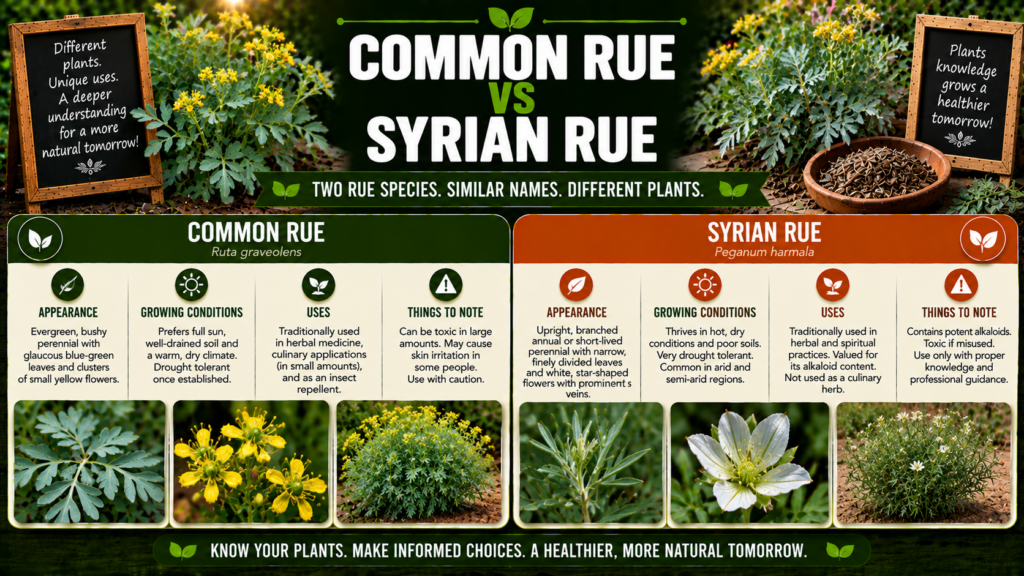
If you are beginning to explore medicinal plants, you will quickly discover that common plant names can sometimes be confusing.
Common Rue and Syrian Rue are a good example.
Although both plants are called “rue”, they belong to completely different plant families and are not simply two varieties of the same plant.
Common Rue is Ruta graveolens, while Syrian Rue is Peganum harmala.
They have different appearances, different botanical classifications and different traditional histories.
Understanding the difference is particularly important because Syrian Rue contains powerful naturally occurring compounds and has important safety considerations.
This article looks at the two plants from a botanical, historical and educational perspective, helping beginners understand why correct plant identification matters.
What Is Common Rue?
Common Rue, Ruta graveolens, is a perennial herb traditionally associated with Mediterranean and European herbal practices.
It belongs to the Rutaceae family, the same botanical family that includes citrus plants.
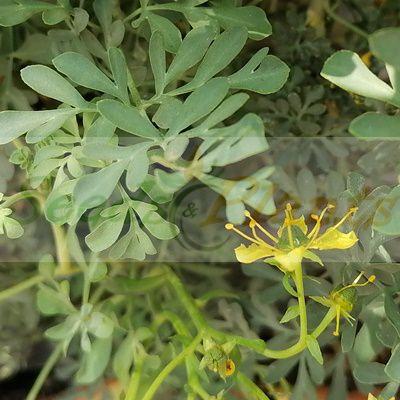
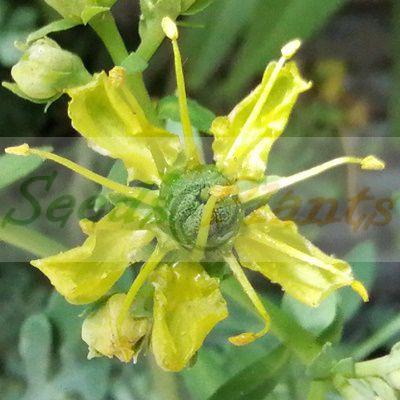
Common Rue is an evergreen or semi-evergreen plant in suitable climates and is valued by gardeners for its distinctive blue-green foliage and small yellow flowers.
The leaves have a strong, characteristic smell, which makes the plant relatively easy to recognise once you become familiar with it.
Common Rue has a long history of traditional use and was also grown historically as an ornamental and aromatic garden plant.
What Is Syrian Rue?
Syrian Rue, Peganum harmala, is a completely different plant.
It belongs to the Nitrariaceae family and is native to parts of North Africa, the Middle East and Central Asia.
Despite its common name, Syrian Rue is not a species of Ruta.
It is a different genus and a different botanical family from Common Rue.
Syrian Rue is a hardy herbaceous perennial that can survive in dry conditions and is often associated with arid and semi-arid regions.
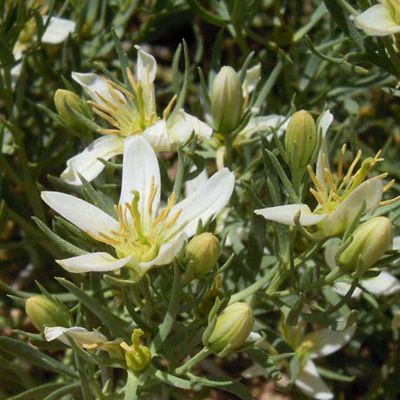
Its white flowers and distinctive seed capsules make it quite different in appearance from Common Rue.
Why Are They Both Called “Rue”?
This is where the confusion starts.
Common names are often based on historical associations, appearance, smell or traditional use.
A common name can also travel between languages and cultures over many generations.
In the case of Syrian Rue, the word “rue” does not indicate that the plant belongs to the Ruta genus.
This is why botanical names are so valuable.
When someone says “rue”, you need to know which plant they mean.
Common Rue vs Syrian Rue at a Glance
| Feature | Common Rue | Syrian Rue |
|---|---|---|
| Botanical name | Ruta graveolens | Peganum harmala |
| Plant family | Rutaceae | Nitrariaceae |
| Genus | Ruta | Peganum |
| General origin | Mediterranean and southern Europe | North Africa, Middle East and Central Asia |
| Flowers | Usually yellow | Usually white |
| Foliage | Blue-green, finely divided | Narrow, elongated foliage |
| General habitat | Mediterranean-type conditions | Dry and semi-arid regions |
| Traditional history | European and Mediterranean herbal traditions | Middle Eastern, Central Asian and North African traditions |
| Important identification point | A true Ruta species | Not a true Ruta species |
The two plants should therefore not be treated as interchangeable.
What Does Common Rue Look Like?
Common Rue is an attractive plant that can have a distinctive appearance in the garden.
It generally forms a compact, bushy plant with finely divided blue-green leaves.
Small yellow flowers appear during the flowering season.
The foliage has a strong aromatic smell, which is one of the plant’s most noticeable characteristics.
Mature plants can become somewhat woody towards the base.
Common Rue is often grown as an ornamental plant as well as for its historical association with herbal traditions.
What Does Syrian Rue Look Like?
Syrian Rue has a very different appearance.
It tends to have narrow, divided leaves and white flowers.
The plant produces distinctive seed capsules containing numerous seeds.
It is adapted to dry environments and is often found in regions where water availability is limited.
The overall appearance is quite different from the compact, blue-green appearance of Common Rue.
Where Does Common Rue Grow?
Common Rue originates from Mediterranean regions and has been cultivated in many other parts of the world.
It generally prefers:
- Well-drained soil
- Plenty of sunlight
- Relatively dry conditions
- Moderate watering
- Protection from excessive waterlogging
Once established, Common Rue can tolerate relatively dry conditions.
This makes it an interesting plant for gardeners who enjoy Mediterranean-style herbs and ornamental plants.
Where Does Syrian Rue Grow?
Syrian Rue is adapted to much drier conditions.
It is associated with:
- Dry grasslands
- Semi-desert regions
- Desert margins
- Sandy or disturbed soils
- Areas with relatively low rainfall
Its ability to tolerate dry environments has contributed to its widespread distribution in arid and semi-arid parts of its native range.
Are Common Rue and Syrian Rue Medicinally the Same?
No.
This is one of the most important points for beginners.
Although both plants have histories of traditional use, they contain different chemical constituents and have different traditional applications.
Information about one plant should therefore not automatically be applied to the other.
If you are reading an old herbal book or an online article that simply refers to “rue”, first establish which plant is actually being discussed.
Traditional Uses of Common Rue
Common Rue has a long history in European and Mediterranean folk medicine.
Historically, various parts of the plant were associated with a wide range of traditional uses.
However, many historical uses involved practices that would not meet modern safety standards.
Common Rue is therefore better approached today as a plant of botanical and historical interest, rather than assuming that traditional use means it is suitable for home medicinal use.
The plant can cause skin irritation, particularly when the skin is exposed to its sap and then exposed to sunlight.
Traditional Uses of Syrian Rue
Syrian Rue has a long history in traditional practices across parts of the Middle East and Central Asia.
It has been used historically for various cultural and traditional purposes.
However, Syrian Rue contains naturally occurring beta-carboline alkaloids, including harmine, harmaline and tetrahydroharmine.
These compounds can affect enzymes involved in the metabolism of certain substances and medicines.
As a result, Syrian Rue has important safety considerations and should not be treated as an ordinary herbal tea or casual household herb.
Why Syrian Rue Requires Particular Caution
The chemistry of Syrian Rue is an important reason why correct identification matters.
The plant contains compounds with monoamine oxidase-inhibiting activity.
This means that Syrian Rue can interact with certain medicines and other substances.
These interactions can potentially be serious.
For this reason, Syrian Rue should not be experimented with medicinally, particularly alongside prescription medicines.
This is a good example of why “natural” does not automatically mean “harmless”.
Common Rue Also Requires Care
Although Common Rue does not have the same chemical profile as Syrian Rue, it should not be treated as a completely harmless herb.
The plant can cause skin reactions, particularly after contact with the plant followed by exposure to sunlight.
Medicinal use of Common Rue also has important safety concerns.
Historically, rue was sometimes used in ways that could have serious consequences, particularly during pregnancy.
It is therefore not an herb that beginners should experiment with medicinally.
Common Rue and Pregnancy
Common Rue deserves particular caution during pregnancy.
The plant has a long history of traditional use in connection with menstruation and reproductive practices, but this does not make it safe during pregnancy.
Because of its potential effects and safety concerns, Common Rue should not be used medicinally during pregnancy without appropriate professional guidance.
This is an important example of why traditional herbal information needs to be interpreted carefully.
Syrian Rue and Medicines
Syrian Rue deserves particular caution when medicines are involved.
Because its constituents can inhibit monoamine oxidase enzymes, it may interact with medicines that affect serotonin, noradrenaline or other neurotransmitter systems.
Potential interactions can include certain antidepressants and other medicines.
This is one reason Syrian Rue should not be treated as an ordinary culinary herb.
Anyone taking prescription or other regular medicines should speak with a qualified healthcare professional before considering any medicinal herbal product, especially one known to contain biologically active alkaloids.
Why Botanical Names Matter
The difference between these two plants demonstrates exactly why botanical names are so important.
If an article simply says:
“Rue has traditionally been used for…”
you should immediately ask:
“Which rue?”
The botanical name provides the answer.
Ruta graveolens means Common Rue.
Peganum harmala means Syrian Rue.
Once you learn to recognise botanical names, researching medicinal plants becomes considerably safer and more accurate.
Common Names Can Be Misleading
Common names are useful because they are easier to remember, but they can create confusion.
The same common name can sometimes refer to different plants in different countries or cultures.
Likewise, two unrelated plants may share part of a common name because of similarities in appearance, history or traditional use.
For a website about medicinal plants, it is therefore particularly useful to provide the botanical name alongside the common name.
Are They Related to Each Other?
No.
This is perhaps the simplest way to settle the question.
Common Rue belongs to:
Family: Rutaceae
Genus: Ruta
Species: Ruta graveolens
Syrian Rue belongs to:
Family: Nitrariaceae
Genus: Peganum
Species: Peganum harmala
They are botanically distinct plants.
The shared word “rue” in their common names does not indicate a close botanical relationship.
Can They Be Grown in South Africa?
Common Rue can be grown as an ornamental or traditional garden plant in suitable parts of South Africa.
It generally appreciates plenty of sunlight and well-drained soil.
Syrian Rue is also adapted to dry conditions, but its cultivation should be approached with greater awareness of the plant’s potential invasiveness and safety considerations.
Before growing unfamiliar plants, it is sensible to check whether they are suitable for your local area and whether there are any restrictions concerning their cultivation.
Identification Tips for Beginners
If you are trying to distinguish the two plants, start with the overall appearance.
Common Rue
Look for:
- Blue-green foliage
- Finely divided leaves
- Yellow flowers
- Compact, bushy growth
- Strong aromatic smell
Syrian Rue
Look for:
- Narrow, divided foliage
- White flowers
- Distinctive seed capsules
- More open growth
- Adaptation to dry environments
However, photographs alone are not always sufficient for reliable plant identification.
When in doubt, use a reputable botanical reference or consult someone with appropriate plant-identification expertise.
Why Correct Identification Is Especially Important With Medicinal Plants
Misidentifying an ordinary garden plant can be disappointing.
Misidentifying a medicinal plant can be much more serious.
Different species can contain completely different chemical compounds.
A preparation that is considered appropriate for one plant may be inappropriate or unsafe for another.
This is why responsible herbal learning starts with botany before medicine.
First identify the plant.
Then learn which part is traditionally used.
Then investigate its constituents, traditional history, evidence and safety.
Traditional Use vs Modern Evidence
Both Common Rue and Syrian Rue have long histories of traditional use.
That historical information is valuable when studying medicinal plants and the cultures that used them.
However, traditional use is not the same thing as modern scientific evidence.
A plant can have been used for hundreds of years without modern research establishing that it is effective or safe for a particular condition.
The safest approach is to treat historical herbal information as part of the plant’s history rather than as automatic medical advice.
A Simple Comparison for Beginners
| Question | Common Rue | Syrian Rue |
|---|---|---|
| Same plant? | No | No |
| Botanical name | Ruta graveolens | Peganum harmala |
| Same family? | No | No |
| Flower colour | Yellow | White |
| Traditional history | Mediterranean and European | Middle Eastern, Central Asian and North African |
| Notable safety concern | Skin reactions and medicinal-use risks | Potent alkaloids and medicine interactions |
| Suitable for casual medicinal experimentation? | No | No |
Final Thoughts
Common Rue and Syrian Rue demonstrate why learning botanical names is so important when exploring herbal medicine.
Despite sharing the word “rue”, Ruta graveolens and Peganum harmala are completely different plants.
Common Rue is a Mediterranean plant with blue-green foliage and yellow flowers, while Syrian Rue is a dry-region plant with white flowers and a very different chemical profile.
Both have fascinating traditional histories, but neither should be treated casually as a medicinal herb.
For beginners, the most important lesson is simple:
Never rely on a common name alone when identifying a medicinal plant.
Check the botanical name, learn the plant’s characteristics and research its safety before considering any medicinal use.
The world of herbal medicine is full of plants with similar names, different regional names and sometimes surprising chemical properties. Taking the time to understand the botany first will make your herbal studies both more interesting and considerably safer.
Our Rue Varieties
Related Articles
Basil versus Holy Basil
Read MoreEnglish, French and German Thyme
Read MoreThe differences between Klip Dagga and Wild Dagga
Read MoreWinter Savory vs Summer Savory
Read MoreGerman Chamomile versus Roman Chamomile
Read More