
Pests & Plant Diseases
Powdery Mildew vs Downy Mildew
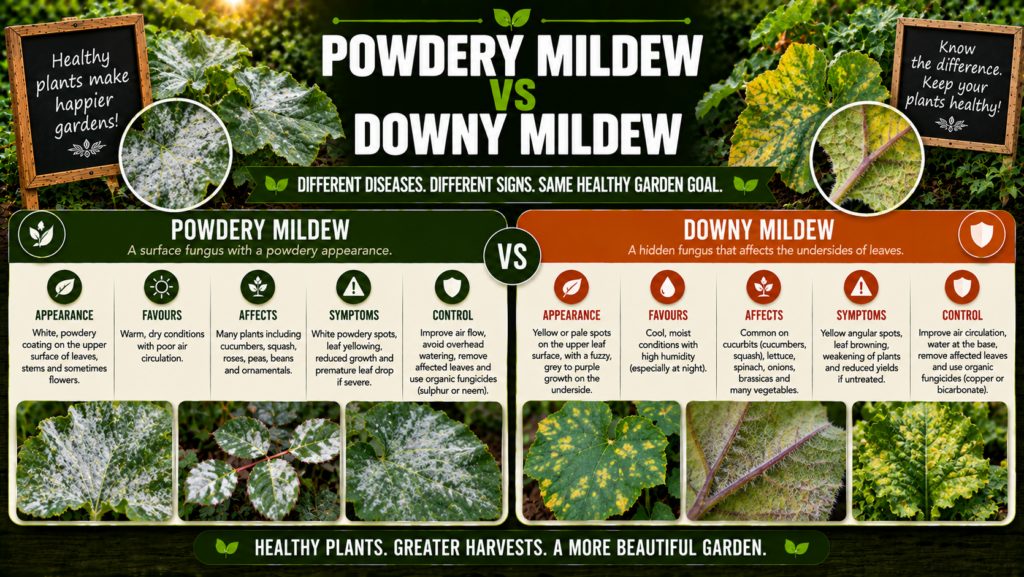
If you have ever noticed a white coating on the leaves of one of your plants, you may have immediately thought, “powdery mildew”.
That is often a reasonable first thought, but not every mildew-like problem is the same.
Powdery mildew and downy mildew are two different groups of plant diseases, and learning to tell them apart can make it much easier to understand what is happening in your garden.
Both can affect leaves and reduce the health and appearance of plants, but they generally develop under different environmental conditions and produce different symptoms.
For a beginner gardener, the easiest place to start is with what you can actually see.
Powdery Mildew vs Downy Mildew at a Glance
| Feature | Powdery Mildew | Downy Mildew |
|---|---|---|
| Appearance | White or grey powdery growth | Yellow, pale or brown patches with growth often appearing underneath leaves |
| Common location | Often visible on upper leaf surfaces | Often more noticeable on the underside of leaves |
| Leaf surface | Powdery coating may be obvious | Upper surface may show yellow or pale patches |
| Moisture preference | Can develop without leaves remaining wet | Generally favours humid, moist conditions |
| Typical spread | Spores spread through the air | Often favoured by moisture and humid conditions |
| Main prevention | Airflow, sunlight and avoiding overcrowding | Reducing leaf wetness and improving airflow |
| Plant group | True fungi | Mainly fungus-like organisms called oomycetes |
One of the most important differences is that downy mildew is not actually a true fungus, even though it is commonly discussed alongside fungal diseases.
What Is Powdery Mildew?
Powdery mildew is a group of fungal diseases that affects many different plants.
It is easy to recognise because it often produces a distinctive white, powdery coating on leaves, stems or other plant parts.
It can look almost as though someone has dusted the plant with flour.
Different powdery mildew fungi are associated with different host plants, so the powdery mildew affecting a rose is not necessarily the same species affecting a vegetable.
What Does Powdery Mildew Look Like?
The most recognisable symptom is a white or grey powdery growth.
It may initially appear as:
- Small white spots
- Powdery patches
- White areas on the upper surface of leaves
- Powdery growth on young shoots
- Coating on stems or flowers
As the infection progresses, affected leaves may become distorted, yellow or brown and eventually drop.
The disease can be particularly noticeable because the white growth contrasts strongly against green foliage.
Where Does Powdery Mildew Usually Appear?
Powdery mildew can appear on:
- The upper surface of leaves
- The underside of leaves
- Young stems
- Flower buds
- Flowers
- Developing fruit in some plants
It does not always cover the entire leaf.
A plant may initially have only a few small patches.
Does Powdery Mildew Need Wet Leaves?
This is an important difference between the two diseases.
Powdery mildew generally does not require prolonged periods of free water on the leaf surface in the same way that many other plant pathogens do.
In fact, powdery mildew can become a problem under conditions that seem surprisingly dry.
Warm days combined with suitable humidity and poor airflow can create favourable conditions.
This is one reason why simply reducing watering does not necessarily solve a powdery mildew problem.
What Is Downy Mildew?
Downy mildew refers to a group of plant diseases caused by oomycetes, which are fungus-like organisms rather than true fungi.
Different downy mildews affect different groups of plants.
Examples include downy mildew diseases affecting:
- Cucumbers
- Squash
- Melons
- Grapes
- Lettuce
- Spinach
- Onions
- Other vegetables and ornamental plants
The symptoms vary depending on the plant and the particular downy mildew pathogen involved.
What Does Downy Mildew Look Like?
Downy mildew often begins as pale green, yellow or yellowish-brown areas on the upper surface of leaves.
These patches may eventually become larger and turn brown.
Under humid conditions, you may see a fuzzy or downy growth on the underside of the leaf, particularly directly beneath affected areas.
The growth may appear white, grey, purple or brown depending on the particular disease.
This is quite different from the obvious flour-like coating commonly associated with powdery mildew.
Powdery Mildew vs Downy Mildew: The Underside Test
One simple observation can sometimes help.
Turn the affected leaf over.
With powdery mildew, the white powder is often clearly visible on the surface where the infection occurs.
With downy mildew, the upper surface may show yellow or pale patches while the underside may develop a fuzzy growth under humid conditions.
However, this is not a perfect identification test.
Plant diseases can vary considerably, so unusual symptoms should be investigated rather than diagnosed solely from one characteristic.
What Causes Powdery Mildew?
Powdery mildew is caused by specialised fungal pathogens.
The exact species depends on the plant being affected.
Powdery mildew tends to spread through spores carried by air currents.
Conditions that can encourage disease development include:
- Poor airflow
- Crowded plants
- Shaded conditions
- Warm temperatures
- Suitable humidity
- Dense foliage
Different powdery mildew species have different environmental preferences, so conditions can vary.
What Causes Downy Mildew?
Downy mildew is caused by oomycetes.
These organisms are biologically different from true fungi, even though they produce diseases that can look fungal.
Downy mildew generally favours:
- High humidity
- Moist conditions
- Leaf wetness
- Poor air circulation
- Cool to moderate temperatures in many cases
The exact conditions depend on the particular pathogen.
Why Does Airflow Matter?
Good airflow is helpful for managing many plant diseases.
When plants are packed closely together, moisture can remain trapped between leaves.
This creates a more favourable environment for some pathogens.
Providing adequate spacing allows air to move around the foliage and can help leaves dry more quickly.
This is one reason why planting according to the recommended spacing is important.
Does Overwatering Cause Mildew?
Overwatering does not directly cause either disease, but poor watering practices can contribute to conditions that favour certain plant diseases.
With downy mildew, prolonged leaf wetness and high humidity can be particularly important.
With powdery mildew, simply watering less is unlikely to solve the problem.
Instead, focus on the entire growing environment.
Watering Plants Correctly
Where practical, water the soil rather than regularly wetting the foliage.
Morning watering can give leaves time to dry during the day.
Avoid repeatedly splashing water over the leaves, particularly when plants are already showing signs of disease.
However, remember that some plants naturally prefer more humid conditions, so watering practices should always be appropriate for the particular crop.
South African Weather and Mildew
South African gardeners experience a wide range of climates.
A garden in the Western Cape can experience very different conditions from one in KwaZulu-Natal, Gauteng or Limpopo.
Humidity, rainfall, temperature and seasonal changes can all affect plant diseases.
During periods of humid weather, gardeners should pay particular attention to dense foliage and poor airflow.
In drier areas, powdery mildew can still occur, particularly where there is suitable humidity around plant foliage.
Plants Commonly Affected by Powdery Mildew
Powdery mildew can affect a very wide range of plants.
Common examples include:
- Roses
- Cucumbers
- Squash
- Pumpkins
- Zucchini
- Grapes
- Peas
- Beans
- Some fruit trees
- Many ornamental plants
- Various herbs
Different powdery mildew fungi usually have specific or preferred hosts.
Plants Commonly Affected by Downy Mildew
Downy mildew also affects many plants.
Examples include:
- Cucumbers
- Melons
- Squash
- Grapes
- Lettuce
- Spinach
- Onions
- Basil
- Other vegetables and ornamentals
Again, the particular pathogen matters.
A downy mildew affecting grapes is not necessarily the same organism affecting lettuce.
Can Powdery Mildew Kill Plants?
Powdery mildew does not always kill a plant.
In many cases, an established plant can tolerate some infection.
However, serious or repeated infections can:
- Reduce photosynthesis
- Distort leaves
- Cause premature leaf loss
- Reduce plant vigour
- Affect flowers or fruit
- Reduce yields
Young plants may be more vulnerable to severe damage.
Can Downy Mildew Kill Plants?
Downy mildew can also range from relatively mild to severe.
Under favourable conditions, disease can spread rapidly through susceptible crops.
Severe infections can cause extensive leaf damage and reduce the plant’s ability to photosynthesise.
In vegetable crops, this can have a significant effect on growth and harvest.
How to Prevent Powdery Mildew
Prevention is often easier than dealing with a severe disease outbreak.
Useful gardening practices include:
Provide Good Spacing
Don’t overcrowd plants.
Follow the recommended spacing for the particular crop.
Encourage Airflow
Prune or thin plants appropriately to prevent excessively dense growth.
Provide Suitable Sunlight
Where appropriate for the plant, adequate sunlight can help reduce overly damp and shaded conditions.
Avoid Excessive Nitrogen
Very lush, soft growth can sometimes be more susceptible to powdery mildew.
Avoid applying excessive nitrogen fertiliser.
Remove Seriously Affected Leaves
Removing badly affected leaves can reduce the amount of infected material in the garden.
Do not place diseased material into a compost pile unless you are confident your composting system reaches conditions capable of destroying the pathogen.
How to Prevent Downy Mildew
Many of the same basic gardening principles apply.
Improve Air Circulation
Give plants enough space.
Avoid Prolonged Leaf Wetness
Where practical, water the soil rather than repeatedly wetting the foliage.
Water in the Morning
Morning watering gives foliage more opportunity to dry.
Remove Infected Material
Remove severely affected leaves where appropriate.
Avoid Working With Wet Plants
Handling wet plants can potentially spread pathogens between plants.
If you need to work among plants, wait until foliage is dry where practical.
Should You Remove Infected Leaves?
It depends on the severity of the infection.
If only a small number of leaves are affected, removing them can help reduce infected material.
Use clean tools where cutting is required.
Do not strip a plant of most of its leaves simply because you see a few diseased areas.
Plants need healthy foliage to produce energy.
What About Infected Plant Debris?
At the end of the growing season, remove diseased plant material where appropriate.
Some plant pathogens can survive in infected debris and contribute to disease problems in subsequent seasons.
Good garden hygiene can therefore form an important part of disease management.
Can You Compost Diseased Leaves?
This depends on the composting system.
A properly managed hot composting process can destroy many pathogens, but a cool household compost pile may not reliably eliminate all plant diseases.
If you are uncertain, it is safer to follow your local waste-management recommendations for diseased plant material rather than adding it to a basic home compost pile.
Organic Gardening and Mildew
Gardeners who prefer organic approaches have several cultural management options.
The first line of defence should generally be:
- Correct plant spacing
- Good airflow
- Suitable sunlight
- Proper watering
- Garden hygiene
- Choosing resistant varieties where available
Some products are marketed as organic or natural disease treatments, but “natural” does not automatically mean safe or effective.
Always identify the disease as accurately as possible and follow the product label if using a registered plant-protection product.
What About Homemade Sprays?
You may come across recipes for homemade sprays containing ingredients such as bicarbonate of soda, milk or other household products.
Some have been investigated or used by gardeners for managing powdery mildew, but results can vary.
Applying homemade mixtures at the wrong concentration can also damage leaves.
If you decide to experiment with any home remedy, research it carefully and test a small area first.
Avoid assuming that something is safe for every plant simply because it is a household ingredient.
Fungicides and Plant Disease Products
Fungicides and other plant-protection products can sometimes be useful, particularly when a disease is severe or recurring.
However, the correct product depends on:
- The plant
- The disease
- The stage of infection
- Local regulations
- Product registration
- Application instructions
Always read and follow the label.
More product does not mean better disease control and can increase the risk of plant damage.
Resistant Varieties
One of the most effective ways of reducing disease problems is to choose varieties with known resistance where available.
Seed packets and nursery labels may mention resistance to particular diseases.
For example, some vegetable varieties have been bred to be less susceptible to particular powdery or downy mildew diseases.
This can be especially useful in areas where a disease occurs regularly.
Powdery Mildew vs Downy Mildew: A Beginner’s Identification Guide
When you first notice unusual marks on a plant, ask yourself:
Is there a white powdery coating?
If yes, powdery mildew is one possibility.
Are there yellow or pale patches on the upper leaf surface?
Downy mildew is one possibility, particularly if there is corresponding growth underneath the leaf.
Is there fuzzy growth on the underside of leaves during humid conditions?
This can be associated with downy mildew.
Are the leaves crowded and airflow poor?
This can increase the risk of several plant diseases.
Has the disease spread rapidly after wet weather?
Downy mildew becomes particularly important to consider.
These clues can help narrow down the possibilities, but they are not a substitute for accurate diagnosis.
Don’t Confuse Mildew With Other Problems
Not every white mark on a leaf is mildew.
Other possibilities include:
- Insect eggs
- Insect residue
- Dust
- Mineral deposits
- Natural leaf hairs
- Other fungal diseases
- Sap or plant exudates
Likewise, yellow patches are not automatically downy mildew.
Nutrient deficiencies, watering problems, viruses, pests and other diseases can cause similar symptoms.
Always look at the whole plant.
A Simple Mildew Prevention Checklist
For beginner gardeners, prevention can be kept relatively simple.
Choose suitable plant varieties.
Give plants enough space.
Avoid unnecessarily wetting foliage.
Water appropriately for the plant and local conditions.
Encourage good airflow.
Remove seriously diseased material.
Keep pruning and gardening tools clean.
Check plants regularly.
Act early when symptoms first appear.
Final Thoughts
Powdery mildew and downy mildew may sound similar, but they are not the same disease.
Powdery mildew is caused by fungi and is often recognised by its distinctive white, powder-like growth on plant surfaces.
Downy mildew is caused by fungus-like oomycetes and often produces yellow or pale patches on the upper surfaces of leaves, with fuzzy growth potentially appearing underneath under suitable humid conditions.
The best approach is not simply to reach for a treatment as soon as you see a suspicious mark.
First, look carefully at the symptoms.
Consider the weather, the plant species, the location of the affected areas and how quickly the problem is spreading.
Good plant spacing, airflow, appropriate watering and garden hygiene can go a long way towards reducing disease problems.
And if you are unsure whether you are dealing with powdery mildew, downy mildew or something completely different, accurate identification should come before treatment.
Learning to recognise common plant diseases is one of those gardening skills that becomes easier with experience. Once you know what to look for, you can spot problems earlier and give your plants a much better chance of staying healthy.
Related Articles
Beneficial Insects vs Harmful Insects
Read MoreCommon Seedling Diseases
Read MoreNatural Ways to Control Aphids
Read More