
Gardening Tips, Pests & Plant Diseases, Seed Starting
Common Seedling Diseases
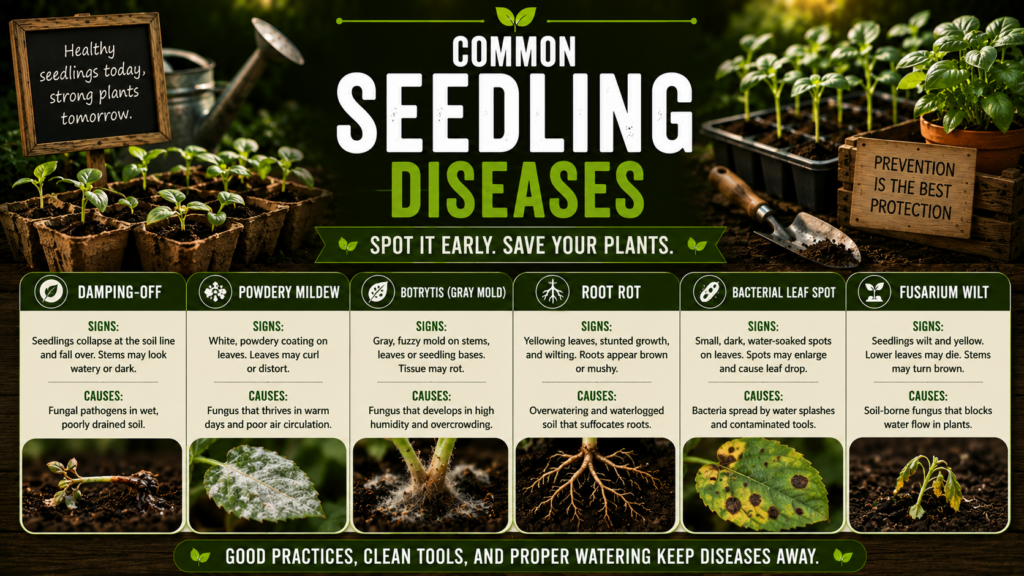
Few things are more frustrating than watching a tray of seeds germinate successfully, only to see the young seedlings weaken, collapse or develop suspicious marks a few days later.
Seedlings are particularly vulnerable to disease. Their stems are soft, their root systems are still small, and they are often grown close together in warm, moist conditions. Unfortunately, those same conditions can also favour fungi and other disease-causing organisms.
Some seedling diseases move quickly. A tray that looked healthy yesterday may show obvious losses today. Others develop more slowly, beginning with a few spots, patches of discolouration or seedlings that simply stop growing well.
The difficult part is that disease is not always easy to identify. Overwatering, underwatering, nutrient problems, cold damage, heat stress and sun scorch can all produce symptoms that resemble infection.
Learning to recognise the common patterns can help you respond sooner and, just as importantly, avoid treating a problem that is not actually a disease.
Why Are Young Seedlings So Vulnerable?
A mature plant can often tolerate a certain amount of stress or minor damage. A newly emerged seedling has far fewer reserves.
Its first root system may consist of little more than a delicate root and a handful of fine root hairs. The stem is thin and soft. The first leaves are small, and the plant has very little stored energy to fall back on if growth is interrupted.
Seedlings are also commonly raised in conditions where disease can spread easily:
- several plants growing close together
- constantly damp growing medium
- poor air movement
- high humidity
- contaminated trays or tools
- reused growing medium
- splashing water
- plant debris left around the growing area
Disease is rarely caused by one mistake alone. More often, a susceptible seedling, a disease-causing organism and favourable environmental conditions come together at the same time.
Damping Off
Damping off is probably the best-known seedling disease problem, and for good reason. It can destroy young seedlings very quickly.
The term does not refer to one single disease. Several soil-borne fungi and fungus-like organisms can be involved, including species of Pythium, Rhizoctonia and Fusarium.
Damping off may occur before or after seedlings emerge.
Pre-Emergence Damping Off
With pre-emergence damping off, seeds may germinate but decay before the shoots reach the surface.
From the gardener’s point of view, it may simply look as though the seed failed to germinate.
This is one reason poor emergence should not automatically be blamed on old or low-quality seed. If conditions are excessively wet and disease pressure is high, germinating seeds and very young shoots may be lost below the soil surface.
Post-Emergence Damping Off
Post-emergence damping off is easier to recognise.
A seedling may appear healthy at first, then develop a thin, discoloured or water-soaked area near the soil line. The stem weakens at this point and the seedling falls over.
Once the stem has been severely damaged, the seedling generally does not recover.
A classic warning sign is a patch of collapsed seedlings in an otherwise healthy tray, particularly where the growing medium has remained very wet.
Conditions That Encourage Damping Off
Damping off is strongly associated with conditions such as:
- overly wet growing medium
- poor drainage
- overcrowding
- poor air circulation
- contaminated trays
- contaminated growing medium
- excessive humidity
- cool, stagnant conditions for some pathogens
The exact conditions preferred by different organisms vary, but persistently wet, poorly ventilated seedling environments are a common theme.
What to Do
Remove badly affected seedlings promptly, along with obviously infected material around them.
Then review the growing conditions. Allow the surface of the growing medium to dry appropriately between waterings, improve air movement and avoid leaving trays standing in water.
If losses are spreading rapidly through a densely planted tray, saving every seedling may not be realistic. Sometimes restarting with clean equipment and fresh seedling mix is more successful than trying to rescue a heavily affected batch.
Root Rot in Seedlings
Root rot can be difficult to diagnose because the most important damage is happening below the surface.
Affected seedlings may:
- grow slowly
- wilt despite moist soil
- become pale or yellow
- fail to develop properly
- collapse as the disease progresses
Healthy young roots are generally firm and light in colour. Diseased roots may become brown, darkened, soft or decayed.
One of the most confusing signs is wilting in wet soil. A gardener sees a wilted seedling and assumes it needs more water. More water is added, but the plant continues to decline.
The problem is that damaged roots can no longer function properly. The growing medium may contain plenty of moisture, but the root system is unable to supply the plant effectively.
What Encourages Root Rot?
Common contributing conditions include:
- prolonged waterlogging
- containers without adequate drainage
- dense, compacted growing medium
- overwatering
- contaminated potting or seedling mix
- trays left standing in water
The best response depends on how advanced the problem is. A mildly stressed seedling may improve if conditions are corrected early. A seedling with a severely decayed root system is unlikely to recover.
Fusarium Diseases
Fusarium is a large group of soil-borne fungi, and different species can affect many kinds of plants.
In seedlings, Fusarium may be involved in damping off, root rot, crown rot or wilt symptoms. This is one reason diagnosis based on appearance alone can be difficult.
Possible signs include:
- poor emergence
- stunted growth
- yellowing
- wilting
- root discolouration
- stem or crown damage
- gradual collapse
A key difficulty is that Fusarium symptoms can resemble several other problems. A wilted seedling may be suffering from root damage, water stress, heat stress or another disease entirely.
If the same type of seedling repeatedly fails in the same contaminated medium or reused container, disease should be considered as a possibility.
Reducing the Risk
Good hygiene is important. Avoid reusing infected growing medium, clean trays before reuse and remove diseased plant material.
In garden beds where a particular soil-borne disease has been confirmed, crop rotation may help reduce repeated exposure, although some Fusarium organisms can persist in soil for long periods.
Rhizoctonia Disease
Rhizoctonia is another common soil-borne fungal problem associated with damping off, root disease and stem damage.
Young seedlings may develop sunken or discoloured lesions near the soil line. Roots may also be affected, and plants can become stunted or collapse.
Warm, moist soil can favour some Rhizoctonia problems, particularly where seedlings are crowded or stressed.
As with many soil-borne diseases, prevention is far easier than trying to save a badly infected seedling.
Clean containers, suitable growing medium, sensible watering and adequate spacing all reduce the conditions that allow disease to gain an advantage.
Botrytis or Grey Mould
Botrytis is often called grey mould because affected tissue may develop a characteristic grey, fuzzy growth under favourable conditions.
It thrives where humidity is high and air movement is poor.
Seedlings growing in crowded trays can be especially vulnerable because leaves remain close together and moisture dries slowly. Dead leaves and damaged tissue provide additional opportunities for infection.
Possible signs include:
- brown or decaying leaf tissue
- soft damaged areas
- grey fuzzy mould
- infected leaves that collapse
- disease spreading through crowded growth
What to Do
Remove affected plant material carefully and improve ventilation around the remaining seedlings.
Avoid leaving dead leaves on the surface of the growing medium. Increase spacing if plants are crowded, and review watering practices so foliage does not remain wet unnecessarily.
Botrytis is a good example of why seedling hygiene matters. A single dead leaf trapped in a humid, crowded tray can become a starting point for further problems.
Powdery Mildew
Powdery mildew is more commonly associated with established plants, but young plants and older seedlings can also be affected.
It usually appears as pale, powdery patches on leaves and sometimes stems. The patches may begin small and become more extensive.
Unlike many diseases associated with constantly wet leaves, powdery mildew does not require standing water on the leaf surface to develop. It is often favoured by conditions that combine suitable temperatures, humidity and poor air circulation.
Affected seedlings may continue growing if infection is mild, but severe disease can reduce photosynthesis and weaken young plants.
Management
Improve spacing and air circulation, remove heavily affected tissue where practical and avoid allowing susceptible plants to become excessively crowded.
If powdery mildew repeatedly affects a particular crop, resistant varieties may be worth considering where available.
Downy Mildew
Downy mildew is not the same disease as powdery mildew, despite the similar name.
Symptoms vary between crops, but gardeners may notice yellow, pale or angular patches on the upper leaf surface. Under humid conditions, a greyish, purplish or downy growth may appear on the underside of affected leaves.
Downy mildew is generally favoured by moist, humid conditions.
Because symptoms differ between plant species, identification can be difficult. Yellow leaf patches are not automatically downy mildew, and nutrient problems can sometimes create similar discolouration.
If suspicious patches are appearing, examine both sides of the leaf rather than looking only from above.
Leaf Spot Diseases
“Leaf spot” is a broad description rather than one single disease.
Both fungi and bacteria can cause spots on seedling leaves. The appearance varies depending on the plant and the organism involved.
Possible symptoms include:
- small brown spots
- dark lesions
- pale centres with darker margins
- water-soaked spots
- yellow halos
- spots that merge into larger dead areas
A few marks on a leaf do not automatically indicate an infectious disease. Physical damage, fertiliser splash, sun scorch and insect feeding can all create spots.
The pattern matters.
Disease becomes more likely when spots are increasing in number, appearing on multiple plants, spreading through a tray or developing under conditions favourable to infection.
Reducing Spread
Avoid unnecessary overhead watering, particularly where foliage remains wet for long periods.
Remove badly affected leaves or seedlings, improve spacing and avoid handling healthy plants immediately after touching diseased tissue.
Tools used around infected plants should be cleaned before being used elsewhere.
Bacterial Seedling Diseases
Bacterial diseases can affect young plants as spots, blights, rots or wilting problems.
Symptoms may include:
- water-soaked lesions
- dark leaf spots
- yellow halos around spots
- soft decay
- rapid tissue collapse
- stunting
Bacteria can spread through contaminated seed, splashing water, infected plant debris, hands and tools.
Warm, wet conditions often encourage bacterial disease development, although the exact conditions vary between pathogens.
One practical difficulty is that bacterial and fungal leaf diseases can look similar without laboratory testing. Home gardeners should therefore be cautious about making a definite diagnosis from one photograph or one symptom.
The immediate management principles are often similar: isolate affected plants where possible, reduce splashing, remove badly diseased material and improve hygiene.
Crown and Stem Rots
The crown is the area where the stem meets the roots, usually close to the soil surface.
When this area becomes infected, seedlings may develop:
- darkened tissue
- soft decay
- constricted stems
- wilting
- sudden collapse
Crown and stem rots may be caused by different organisms, so the visible symptom does not always identify the exact pathogen.
Persistent moisture around the stem base can increase risk. Planting seedlings too deeply may also create problems for species that are sensitive to having their stems buried.
If the crown is badly rotted, recovery is unlikely.
How Disease Spreads Through Seedling Trays
Seedling diseases often seem to appear suddenly, but the conditions for spread may have been developing for days.
Splashing Water
Water droplets can move contaminated soil and disease-causing organisms from one plant to another.
Aggressive overhead watering is particularly risky in crowded trays.
Contaminated Containers
Old trays can carry plant debris and contaminated growing medium from previous crops.
A tray may look empty while still holding material in corners, drainage holes and cracks.
Reused Growing Medium
Reusing seedling mix from a diseased batch can expose the next sowing to the same problem.
Seed-starting medium is not simply a physical support for roots. Its drainage, cleanliness and structure all matter.
Hands and Tools
Transplanting tools, labels, scissors and hands can move disease organisms between plants.
This is especially relevant when diseased seedlings are handled and healthy plants are touched immediately afterwards.
Crowding
Dense seedlings create a humid microclimate with poor air movement.
Leaves touch one another, water evaporates more slowly and disease can move easily from plant to plant.
Disease or Watering Problem?
This is one of the most important questions a home gardener can ask.
A seedling that wilts is not necessarily diseased.
Underwatered seedlings may wilt because the roots cannot access enough moisture. Overwatered seedlings may wilt because roots are damaged or deprived of oxygen. Diseased seedlings may wilt because pathogens have damaged roots or water-conducting tissues.
Look at the whole situation.
Ask:
- Is the growing medium wet or dry?
- Are all seedlings affected or only a few?
- Is the problem spreading?
- Are there visible stem lesions?
- Are roots healthy?
- Are there spots on the leaves?
- Is there fuzzy or powdery growth?
- Did symptoms appear after a sudden weather change?
- Has the tray been standing in water?
The more clues you gather, the less likely you are to react to one symptom in isolation.
Disease or Sun Scorch?
Seedlings moved suddenly from protected conditions into strong direct sunlight may develop pale, bleached or damaged patches.
This can be mistaken for disease.
Sun scorch often appears on the most exposed leaf surfaces after a sudden increase in light intensity. It does not usually spread from plant to plant in the way an infectious disease may.
Hardening off seedlings gradually before transplanting outdoors helps reduce this type of damage.
Disease or Nutrient Problem?
Nutrient deficiencies can cause yellowing, poor growth and unusual leaf colour.
Disease can do the same.
A useful clue is the pattern of symptoms. Nutrient problems often affect plants in a more consistent way, particularly where they share the same growing medium. Infectious disease may begin with individual plants or patches and spread unevenly.
This is not a perfect rule, but it can help guide further investigation.
Avoid adding fertiliser simply because a seedling looks pale. If the real problem is root disease, extra fertiliser will not repair the damaged root system and may create additional stress.
Should Diseased Seedlings Be Saved?
Sometimes yes. Often no.
A seedling with one suspicious leaf spot may recover perfectly well once conditions improve. A slightly affected plant may continue growing after damaged tissue is removed.
But a seedling with a rotted stem base, severely decayed roots or advanced collapse is unlikely to become a strong plant.
There is also a practical question: is saving one badly diseased seedling worth risking the rest of the tray?
In many cases, prompt removal is the better choice.
This can feel wasteful, especially when the seed is rare or slow to germinate. However, keeping a severely diseased plant among healthy seedlings may allow the problem to spread.
How to Prevent Seedling Diseases
Prevention is far more effective than trying to rescue seedlings after serious disease has developed.
Start With Clean Containers
Wash away old growing medium and plant debris before reusing trays and pots.
If a previous batch suffered from disease, take extra care before using the same equipment again.
Use Suitable Growing Medium
A seedling mix should hold enough moisture for germination while still allowing drainage and air around developing roots.
Heavy, compacted garden soil in small containers often creates poor conditions for young seedlings.
Do Not Keep the Mix Constantly Saturated
Seeds need moisture to germinate, but that does not mean the growing medium should remain waterlogged.
Once seedlings emerge, watering should respond to actual conditions rather than a rigid timetable.
Provide Air Movement
Good air circulation helps foliage and the surface of the growing medium dry appropriately.
This does not mean exposing delicate seedlings to harsh wind. The goal is to avoid stagnant, humid conditions.
Avoid Overcrowding
Thin seedlings where necessary and transplant them before they become a dense, tangled mass.
Crowding increases competition as well as disease risk.
Water With Care
Water in a way that minimises unnecessary splashing and prolonged leaf wetness.
Bottom watering can be useful in some seedling systems, but trays should not be left standing in water indefinitely.
Remove Dead Plant Material
Dead leaves, failed seedlings and decaying debris should not be left in humid propagation areas.
Inspect Seedlings Regularly
Early problems are easier to manage.
A quick daily look can reveal a collapsed seedling, suspicious spot or patch of mould before the issue spreads widely.
Be Careful With Home Remedies
Seedling disease advice often includes long lists of household treatments.
Cinnamon, bicarbonate mixtures, chamomile tea, hydrogen peroxide solutions and many other remedies are frequently recommended online as though they are guaranteed cures.
The evidence and effectiveness vary considerably, and some mixtures can damage delicate seedlings if used at unsuitable concentrations.
More importantly, no household spray can compensate for a waterlogged, overcrowded and poorly ventilated growing environment.
Before reaching for a treatment, correct the conditions that are encouraging the problem.
When Starting Again Is the Better Option
There are times when a seedling batch is too badly affected to justify continued rescue attempts.
Consider restarting when:
- damping off is spreading rapidly
- most seedlings have damaged stems
- roots are extensively rotted
- mould is widespread through the tray
- the growing medium is clearly unsuitable
- repeated losses continue despite intervention
If you do restart, do not simply repeat the same process.
Use clean containers, fresh growing medium and review watering, drainage, spacing, temperature and airflow.
Otherwise, the new batch may develop exactly the same problem.
Healthy Seedlings Begin With the Growing Environment
Seedling diseases can be frustrating because the first visible symptom often appears after infection has already begun.
The best defence is not one miracle treatment. It is a combination of sensible practices: clean containers, suitable growing medium, careful watering, adequate drainage, good air movement and enough space between plants.
It is equally important not to assume that every struggling seedling is diseased. Water stress, nutrient problems, temperature extremes and sudden exposure to strong sunlight can all produce similar symptoms.
Look for patterns. Check the roots and stem base. Examine both sides of the leaves. Consider whether the problem is spreading and whether the growing conditions favour disease.
The earlier you notice something unusual, the more options you have.
And when a seedling is clearly beyond recovery, removing it promptly may be the best way to protect everything still growing around it.
Related Articles
Powdery Mildew vs Downy Mildew
Read MoreBeneficial Insects vs Harmful Insects
Read MoreCommon Fruit Tree Problems
Read MoreUnderstanding Soil Types
Read MoreBenefits of Companion Planting
Read MoreSigns of Overwatering vs Underwatering
Read MoreSuccession Planting Explained
Read MoreNatural Ways to Control Aphids
Read More