
Gardening Tips, Vegetable & Herb Gardening
Succession Planting Explained
There is a familiar pattern in many vegetable gardens. For weeks, you wait patiently for the first harvest. Then suddenly everything is ready at once. You have more lettuce than you can eat, a mountain of radishes, and enough beans to fill every available container in the kitchen. A short while later, the harvest is over and the garden bed sits empty.
Succession planting is one of the simplest ways to avoid this cycle of feast and famine.
Rather than sowing or planting an entire crop at once, succession planting spreads production over a longer period. It can mean sowing small batches of the same vegetable seeds every few weeks, replacing a finished crop with another, or growing varieties that mature at different times.
The idea is simple: instead of treating planting as a once-off event, you keep the garden moving.
For home gardeners, this can mean steadier harvests, better use of limited space and fewer empty beds during the growing season. It is especially useful in small gardens, raised beds and container gardens, where every patch of productive space matters.
What Is Succession Planting?
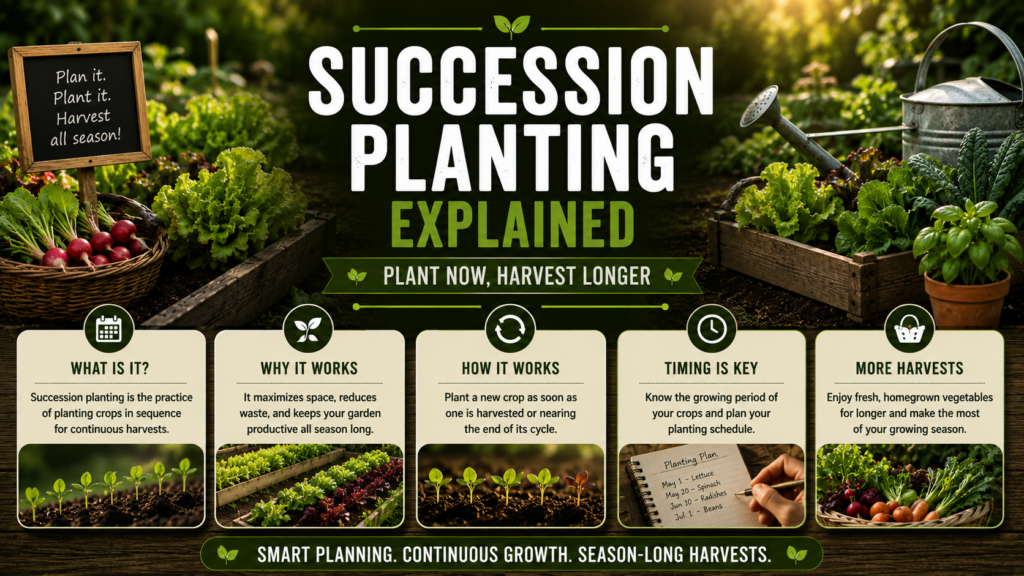
Succession planting is a method of planning crops so that one harvest follows another.
There is no single way to do it. Depending on the crop, the season and the space available, succession planting may involve:
- sowing the same crop at regular intervals
- planting a new crop as soon as an old one finishes
- growing early, mid-season and late varieties
- following a quick-growing crop with a slower one
- filling temporary gaps before larger plants need the space
All of these approaches have the same basic purpose: to make better use of the growing season and spread harvests over time.
A gardener who sows 40 radish seeds on one day may end up with far more radishes than the household can use at once. A gardener who sows 10 seeds, then another 10 a week or two later, is more likely to enjoy a manageable harvest over a longer period.
That is succession planting in its simplest form.
Why Succession Planting Works So Well in a Home Garden
Commercial growers often need large quantities of a crop ready at the same time. Home gardeners usually need the opposite.
Most households do not need 20 heads of lettuce in one week. They would rather harvest one or two regularly. The same applies to radishes, beetroot, carrots, spring onions, bush beans and many leafy vegetables.
Succession planting helps match the garden’s production more closely to what can actually be eaten.
It also reduces wasted space. A vegetable bed does not need to remain empty simply because an earlier crop has finished. With some forward planning, another crop can take its place.
Over a full growing season, this can make a surprisingly large difference to how much food a small garden produces.
The Main Types of Succession Planting
Succession planting is often discussed as though it is one fixed technique, but there are several useful ways to approach it.
1. Sow the Same Crop at Regular Intervals
This is the method most gardeners think of first.
Instead of sowing the whole seed packet at once, sow a smaller quantity and repeat the sowing later. The interval might be one, two, three or even four weeks, depending on the crop and growing conditions.
This works particularly well for vegetables that are harvested relatively young or have a short ideal harvesting window.
Good candidates include:
- radishes
- lettuce
- rocket
- spinach and other leafy greens
- spring onions
- beetroot
- carrots
- bush beans
- coriander
For example, instead of sowing an entire row of radishes in one afternoon, sow a short section of the row. A week or two later, sow the next section. Continue for as long as conditions remain suitable.
The result is a series of plantings at different stages of growth rather than one large crop reaching maturity together.
2. Replace a Finished Crop With Another
The second method is to plant a new crop as soon as an earlier one has been harvested.
A quick-growing crop may occupy a bed early in the season, followed by a longer-season crop later. Alternatively, a summer crop may be removed and replaced with vegetables suited to cooler conditions.
For example:
- radishes may be followed by bush beans
- peas may be followed by leafy greens
- early lettuce may be followed by tomatoes or peppers
- finished beans may be followed by beetroot
- summer crops may be followed by cool-season vegetables
The exact combinations depend heavily on local climate and planting season. A sequence that works well in a cool region may not suit a hot, frost-free area.
The important principle is to think ahead. Before one crop is finished, decide what will take its place.
3. Grow Varieties With Different Maturity Times
Another form of succession planting is to grow varieties of the same vegetable that mature at different rates.
An early-maturing variety may produce first, followed by a mid-season variety and then a later one. This spreads the harvest without requiring repeated sowing of exactly the same seed.
This method can be useful with crops such as:
- tomatoes
- cabbage
- broccoli
- carrots
- maize
- peas
Always check the variety description and expected days to maturity, but treat these figures as a guide rather than a promise. Temperature, soil conditions, water, sunlight and other factors can all affect how quickly plants develop.
4. Use Fast Crops to Fill Temporary Gaps
Some vegetables take a long time to reach full size. While they are still young, there may be unused space around them.
Quick-growing crops can sometimes be planted in these temporary gaps and harvested before the main crop needs the room.
For example, radishes or baby leafy greens may be grown in open spaces while slower vegetables are still establishing. By the time the larger plants begin to spread, the quick crop has already been harvested.
This can work very well, but timing matters. If the temporary crop stays too long, it may begin competing for light, water and nutrients.
Which Vegetables Are Best for Succession Planting?
Not every vegetable responds equally well to repeated sowing.
The easiest crops are generally those that grow quickly, have a relatively short harvest period, or are best eaten young.
Radishes
Radishes are classic succession crops because many varieties mature quickly. Small sowings made at intervals can provide a steady supply rather than one oversized harvest.
There is little benefit in sowing a huge quantity if most will become oversized or poor in quality before they can be eaten.
Lettuce
Lettuce is another excellent choice, particularly for gardeners who use it regularly.
Rather than planting an entire bed at once, start smaller batches. This is especially helpful with heading lettuce, where mature plants can quickly overwhelm a household.
Leaf lettuce can also be harvested gradually, but repeated sowings still help maintain a supply of younger plants.
Carrots
Carrots can be succession sown, although the timing is usually less frequent than with very fast crops such as radishes.
A few smaller sowings can spread the harvest and reduce the risk of having a large quantity reach peak size together.
Germination conditions matter. Carrot seed is small and the upper layer of soil can dry quickly, particularly during warm or windy weather.
Beetroot
Beetroot is useful because both roots and young leaves can be harvested. Small repeated sowings can provide a longer harvest period.
Remember that what appears to be a single beetroot seed is often a seed cluster in many traditional varieties, so thinning may still be necessary.
Bush Beans
Bush beans often produce a concentrated flush of pods. Sowing another small batch a few weeks after the first can extend the bean harvest.
This approach is often more manageable than planting a very large number at once.
Leafy Greens
Many leafy vegetables are well suited to succession planting, particularly when grown for young leaves.
The main limitation is temperature. Some greens perform poorly in intense heat, while others are damaged by severe cold. Repeated sowing only works while conditions remain suitable for the crop.
Coriander
Coriander deserves special mention because it can move from leafy growth to flowering surprisingly quickly, especially under warm or stressful conditions.
Repeated small sowings are often far more useful than one large planting if fresh leaves are the goal.
How Often Should You Sow?
This is where many succession planting guides become too rigid.
You may see advice such as “sow every two weeks”, but there is no universal interval that works for every crop, garden or season.
A better approach is to consider:
- how quickly the crop grows
- how much your household uses
- how long the crop remains at good eating quality
- current temperatures
- expected seasonal changes
- how much space is available
Fast crops may be sown every one to two weeks. Slower crops may only need another sowing after three or four weeks.
You also do not have to follow a strict calendar.
One practical method is to watch the previous sowing. When the first batch has germinated and is growing well, start the next. This creates a natural gap between plantings and can be easier than trying to remember fixed dates.
Do Not Ignore the Weather
Succession planting is not simply a matter of sowing seed every fortnight regardless of conditions.
Plants respond to temperature, day length, rainfall and heat. A crop that performed beautifully from one sowing may struggle a month later because the season has changed.
This is particularly important in South African gardens, where growing conditions vary enormously between regions. Winter rainfall areas, summer rainfall areas, frost-prone inland gardens and warm subtropical regions do not share one universal planting calendar.
Even within the same garden, conditions can change quickly.
A lettuce sowing may germinate well during mild weather but struggle during a sudden hot spell. Coriander may produce plenty of leaves in cool conditions and rush towards flowering as temperatures rise. Peas may thrive during the cooler part of the season but decline when sustained heat arrives.
Before repeating a sowing, ask whether the next few weeks are still likely to suit that crop.
Succession Planting in Hot Weather
Hot weather can complicate succession planting.
Some seeds germinate poorly when soil temperatures become too high. Young seedlings may also struggle if a new sowing coincides with a heatwave.
During hot periods, it may help to:
- sow during a more suitable weather window
- keep the seedbed consistently moist during germination
- use temporary light shade where appropriate
- choose heat-tolerant crops and varieties
- stop sowing cool-season crops when conditions are no longer suitable
The answer is not always to keep planting. Sometimes good succession planning means knowing when to stop one crop and move on to another.
Succession Planting in Containers
You do not need a large vegetable garden to use succession planting.
The method works very well in pots, troughs and other suitable containers.
A container of radishes can be resown after harvest. A pot used for leafy greens can be refreshed and replanted. Several containers can also be started at different times, creating a rotating harvest.
For example, three containers of lettuce do not need to be planted on the same day. Start one, wait a while, then start the second and third at intervals.
Container gardeners do need to pay close attention to the growing medium. Repeated crops remove nutrients, and old potting mix may become compacted or depleted. Simply pulling out one crop and immediately sowing another, over and over again, is unlikely to give good results indefinitely.
Refresh the growing medium where necessary and maintain appropriate fertility for the crop being grown.
Plan for the Next Crop Before the Current One Is Finished
One of the most common mistakes is waiting until a bed is empty before deciding what to plant next.
By then, valuable growing time may already have been lost.
If seedlings need to be raised before transplanting, start them while the current crop is still in the ground. They can then be ready to move into the bed soon after it becomes available.
For direct-sown crops, make sure seed is on hand before the space opens.
This small amount of planning makes succession planting much easier.
A simple garden notebook can help.
Record:
- what was sown
- the sowing date
- where it was planted
- when harvesting started
- when the crop finished
- what followed it
Over time, these notes become far more useful than a generic planting calendar because they reflect the conditions in your own garden.
Prepare the Soil Between Crops
Succession planting does not mean pulling out one crop and pushing another into tired soil without a second thought.
Repeated cropping can place considerable demand on a garden bed.
Once a crop is removed:
- Clear away unhealthy plant material.
- Remove weeds before they set seed.
- Check the soil condition.
- Add compost or other appropriate organic matter where needed.
- Replace nutrients according to the needs of the next crop.
- Water the bed if the soil is too dry for planting.
Avoid automatically adding large amounts of fertiliser every time. Different crops have different requirements, and excessive feeding can create its own problems.
The next crop should determine how the bed is prepared.
Think About Crop Families Too
When planning a sequence, it is worth considering plant families, especially where pests or soil-borne diseases have been a problem.
Repeatedly growing closely related crops in the same space can allow certain problems to build up.
For example, cabbage, broccoli, cauliflower, kale and radish all belong to the brassica family. Tomatoes, peppers and aubergines are also closely related.
This does not mean a small home garden needs an elaborate rotation chart worthy of a commercial farm. In a limited space, perfect crop rotation may not even be possible.
However, avoiding the constant repetition of the same crop family in the same bed is a sensible habit where practical.
Common Succession Planting Mistakes
Succession planting is simple in principle, but a few mistakes can reduce its benefits.
Sowing Too Much Each Time
Four succession sowings are not particularly helpful if every sowing is still far larger than the household needs.
The aim is not simply to plant more often. It is to divide the total crop into useful quantities.
Following a Fixed Schedule Blindly
“Sow every two weeks” is a guideline, not a rule.
If extreme heat is approaching, if the previous crop has barely grown, or if the season is ending, another sowing may make little sense.
Forgetting Days to Maturity
A crop needs enough suitable growing time to finish.
Late sowings may fail because the gardener counts the days on the seed packet but forgets that growth often slows under less favourable conditions.
Running Out of Space
It is easy to plan repeated sowings on paper without considering where all the plants will grow.
The first crop may still be occupying the bed when the second and third batches need space.
Exhausting the Soil
Continuous production can be demanding. Beds that are repeatedly replanted need attention to soil structure, organic matter and appropriate fertility.
Keeping Unproductive Plants Too Long
Home gardeners are often reluctant to remove a crop that still looks alive.
But a few tired lettuce plants, exhausted beans or declining vegetables can occupy valuable space while producing very little. Once a crop is genuinely finished, clearing it promptly allows the next planting to begin.
A Simple Example of Succession Planting
Imagine a small home garden with one raised bed.
Instead of filling the entire bed with lettuce, the gardener plants only a section. Another small section is sown with radishes, while the remaining space holds a slower-growing crop.
Two weeks later, a second small batch of lettuce is started.
The first radishes are harvested, and that space becomes available for another crop. Meanwhile, seedlings intended for the next open section are already growing in trays.
As the season changes, heat-sensitive crops are no longer resown. They are replaced with plants better suited to the conditions ahead.
Nothing about this system is complicated. The garden is simply being treated as a changing space rather than a once-off planting project.
Start Small
It is tempting to create a detailed succession plan for every bed, pot and vegetable in the garden. For most home gardeners, that quickly becomes more work than necessary.
Start with one or two crops you regularly eat.
Radishes, lettuce, beetroot, leafy greens, bush beans or coriander are all useful possibilities, depending on your climate and season.
Sow a small amount. Make a note of the date. Then sow another small batch after a suitable interval.
Watch what happens.
You may discover that two weeks is too short for your needs, or that three weeks creates a better gap. You may find that a particular crop grows much faster during one part of the season than another.
That observation is the real key to successful succession planting.
A More Productive Garden Without More Space
Succession planting is sometimes presented as an advanced gardening technique, but the basic idea is remarkably straightforward: do not assume everything has to be planted at once.
Spread sowings out. Replace finished crops. Use quick-growing vegetables where temporary space is available. Choose varieties with different maturity times. Plan the next crop before the current one is finished.
The result is not necessarily a garden that produces more every single week. Weather, pests and changing seasons will always affect what happens.
What succession planting can do is help you use your available space more thoughtfully and spread harvests over a longer period.
For a home gardener, that often means fewer overwhelming surplus, fewer empty beds and a steadier supply of fresh produce from the space you already have.
Related Articles
Intercropping Vegetables
Read MoreBeneficial Insects vs Harmful Insects
Read MoreCommon Fruit Tree Problems
Read MoreUnderstanding Soil Types
Read MoreSoil Depth for Common Vegetables
Read MoreBenefits of Companion Planting
Read MoreSigns of Overwatering vs Underwatering
Read MoreCommon Seedling Diseases
Read More