
Vegetable & Herb Gardening
Soil Depth for Common Vegetables
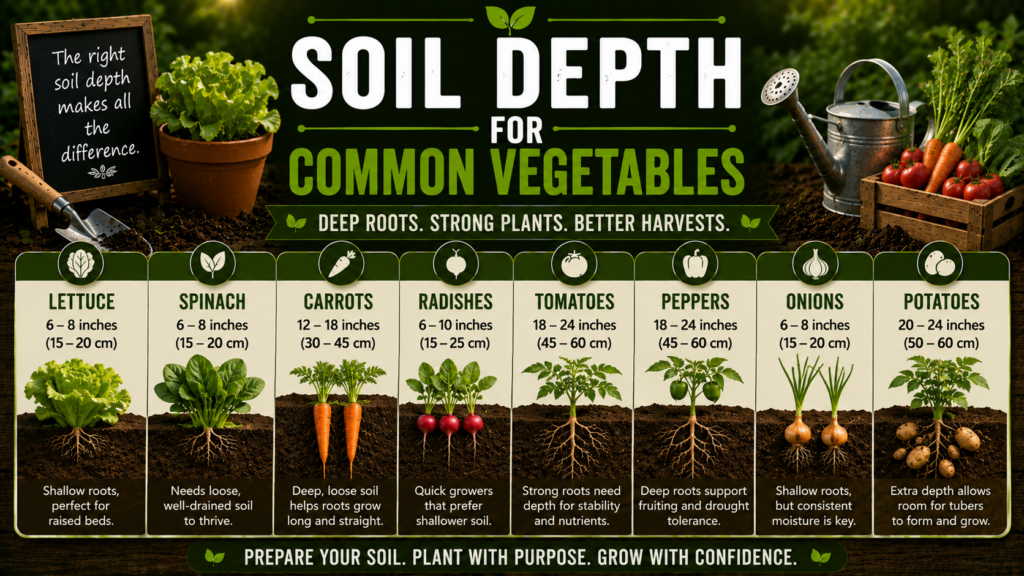
When planning a vegetable garden, most beginners think about sunlight, watering, seeds and fertiliser. One important detail that is sometimes overlooked, however, is soil depth.
Plants need enough room for their roots to develop properly. Some vegetables have relatively shallow root systems and can grow successfully in a modest depth of soil, while others need considerably more space below the surface.
Understanding soil depth can help you decide where to plant your vegetables and can be particularly useful if you are gardening in raised beds, containers, troughs or other areas where the depth of growing medium is limited.
The good news is that you do not need to know exactly how every root grows underground. A basic understanding of shallow, medium and deep-rooted vegetables is enough to get started.
Why Does Soil Depth Matter?
A plant’s roots anchor it in the soil and take up water and nutrients.
If there is not enough room for the roots to develop, the plant may struggle to reach its full potential.
Limited soil depth can result in:
- Restricted root growth
- Faster drying of the growing medium
- Reduced access to nutrients and water
- Smaller root crops
- Poor plant stability
- Increased stress during hot or dry weather
This is particularly important in containers and raised beds.
A vegetable growing in a deep garden bed may have plenty of room for its roots, while the same vegetable grown in a shallow container may quickly run out of space.
Shallow-, Medium- and Deep-Rooted Vegetables
For practical gardening purposes, it can be helpful to divide vegetables into three broad groups.
Shallow-rooted vegetables
These generally need less soil depth and can often be grown successfully in smaller containers.
Examples include:
- Lettuce
- Radishes
- Some salad greens
- Spinach
- Many herbs
- Spring onions
Medium-rooted vegetables
These need more room than shallow-rooted crops but do not usually require very deep soil.
Examples include:
- Beans
- Peas
- Beetroot
- Chard
- Bush-type vegetables
- Some brassicas
Deep-rooted vegetables
These need greater depth for their roots or the edible part of the plant to develop properly.
Examples include:
- Carrots
- Parsnips
- Some larger beetroot varieties
- Potatoes
- Sweet potatoes
- Some larger-rooted crops
The exact requirements vary between varieties, so the information on your seed packet is always worth checking.
Approximate Soil Depths for Common Vegetables
The following depths are useful general guidelines for home gardeners. They are not strict rules, and plants can sometimes grow successfully in slightly different conditions.
| Vegetable | Approximate Minimum Soil Depth |
|---|---|
| Lettuce | 15–20 cm |
| Radishes | 15–20 cm |
| Spring onions | 15–20 cm |
| Spinach | 15–20 cm |
| Peas | 20–30 cm |
| Beans | 20–30 cm |
| Beetroot | 20–30 cm |
| Chard | 20–30 cm |
| Broccoli | 30–45 cm |
| Cabbage | 30–45 cm |
| Cauliflower | 30–45 cm |
| Cucumbers | 30–45 cm |
| Peppers | 30–45 cm |
| Tomatoes | 30–45 cm or more |
| Carrots | 30 cm or more |
| Potatoes | 30–45 cm or more |
| Sweet potatoes | 30 cm or more |
These figures are intended as practical starting points rather than precise scientific measurements. Soil quality, variety, drainage, climate and available space all affect how well a vegetable will grow.
Lettuce
Lettuce is a good vegetable for beginners because it generally has a relatively shallow root system.
A soil depth of around 15–20 cm can be suitable for many varieties.
This makes lettuce a useful choice for:
- Shallow raised beds
- Window boxes
- Troughs
- Smaller containers
Because lettuce has relatively shallow roots, it can dry out quickly during hot weather.
Keep an eye on the moisture level, particularly during warm South African summers.
Radishes
Radishes are another excellent choice for gardeners with limited soil depth.
Many common radishes can grow successfully with around 15–20 cm of soil.
However, the required depth depends on the variety. Some larger or elongated radishes need more space.
If the soil is compacted or contains stones, the roots may become misshapen.
For the best results, provide loose, reasonably fertile soil with enough depth for the particular variety.
Spring Onions
Spring onions generally have relatively shallow roots and can be grown in containers with modest soil depth.
Around 15–20 cm can be sufficient for many varieties.
They are therefore useful for small gardens, balconies and container growing.
Spinach
Spinach generally does not require extremely deep soil.
Around 15–20 cm of suitable growing medium can work for many home-growing situations.
However, good moisture management is important because shallow-rooted plants can dry out more quickly.
Peas
Peas generally benefit from more root space than lettuce and radishes.
Around 20–30 cm of soil can provide a useful growing depth.
Remember that peas also need support as they grow, depending on the variety.
Providing a trellis or other suitable support can help keep climbing varieties upright.
Beans
Beans can grow well in containers and raised beds, although their root requirements vary according to the type of bean.
A soil depth of around 20–30 cm is a useful starting point for many varieties.
Bush beans are often easier to grow in smaller spaces than climbing varieties, although climbing beans can make excellent use of vertical space when provided with suitable support.
Beetroot
Beetroot develops an edible swollen root, so adequate soil depth is important.
Around 20–30 cm can be suitable for many varieties.
Loose soil is particularly useful because compacted soil can restrict root development and lead to poorly shaped roots.
Chard
Chard, also known as Swiss chard or silverbeet, generally has a reasonably manageable root system.
Around 20–30 cm of soil can be suitable for many home-growing situations.
It can also perform well in containers, making it a useful crop for gardeners with limited ground space.
Broccoli
Broccoli develops a larger plant and needs more root space than many salad crops.
Around 30–45 cm of soil is a useful general guideline.
Good fertility is also important because broccoli is a relatively hungry crop.
Provide adequate space between plants as well so that the mature plants do not become overcrowded.
Cabbage
Cabbages need enough root space to support their relatively large above-ground growth.
Around 30–45 cm of soil can be suitable for many varieties.
As with broccoli, spacing is also important.
A container that is technically deep enough may still be too small if several cabbage plants are crowded together.
Cauliflower
Cauliflower has similar soil-depth requirements to other larger brassicas.
Around 30–45 cm is a useful starting point.
Healthy soil, adequate moisture and sufficient nutrients are important because cauliflower can be more demanding than some simpler crops.
Cucumbers
Cucumbers can develop a substantial root system and appreciate plenty of room.
Around 30–45 cm of soil can provide a useful depth for container or raised-bed growing.
Cucumbers also need plenty of water during active growth, so deeper soil alone does not eliminate the need for regular moisture checks.
Vertical growing can be an excellent option where space is limited.
Peppers
Peppers generally benefit from a reasonable amount of root space.
Around 30–45 cm can be suitable for many varieties.
A container that is deep enough but too narrow may still restrict the plant, so consider both depth and overall volume.
Tomatoes
Tomatoes can develop extensive root systems and benefit from plenty of soil volume.
Around 30–45 cm or more of suitable growing medium is a useful starting point for many home-growing situations.
The exact requirements depend on the variety and whether the plant is grown in the ground or in a container.
Determinate or compact varieties can be easier to manage in containers than very vigorous types.
Carrots
Carrots are a particularly good example of why soil depth matters.
The edible part of the plant grows underground, so the soil needs to be deep enough for the roots to develop.
Around 30 cm or more is a useful starting point for many carrot varieties.
Longer carrot varieties may need considerably more depth.
If your garden soil is shallow, rocky or heavy with stones, consider growing shorter carrot varieties in a deep container or raised bed.
Potatoes
Potatoes need sufficient depth and growing volume for the underground tubers to develop.
Around 30–45 cm or more can be suitable, depending on the growing method and variety.
Potatoes can be grown in:
- Large containers
- Bags designed for growing
- Raised beds
- Garden soil
Rather than thinking only about depth, consider the total volume of growing space available to the plant.
Sweet Potatoes
Sweet potatoes can develop a spreading root system and need room to grow.
Around 30 cm or more of loose soil can provide a useful starting point.
They also need sufficient horizontal space, so a narrow container may not be ideal even if it is deep enough.
Soil Depth Is Not the Only Consideration
It is important not to become too focused on the number of centimetres.
A deep container filled with poor, compacted soil is not necessarily better than a shallower space containing healthy, well-structured growing medium.
Plants need:
- Good drainage
- Adequate nutrients
- Moisture
- Air around the roots
- Suitable soil structure
- Enough space to spread
- Appropriate sunlight
Soil depth is one part of the growing environment.
Soil Depth and Containers
When growing vegetables in containers, think about both depth and volume.
A narrow pot may be deep enough but not provide enough overall space for the plant.
Likewise, a wide but shallow container may be suitable for lettuce but not for carrots or larger vegetables.
Before buying a container, check the growing requirements of the crop you want to plant.
Remember that the roots of different plants develop differently.
Raised Beds and Soil Depth
Raised beds are an excellent way to create suitable growing conditions, particularly if the existing garden soil is poor or shallow.
One advantage is that you can control the depth and quality of the growing medium.
However, you do not necessarily need a very tall raised bed for every crop.
A shallow raised bed can work well for lettuce, radishes and other shallow-rooted vegetables, while deeper beds are more suitable for carrots, potatoes and larger crops.
What Happens If the Soil Is Too Shallow?
If the growing space is too shallow, roots may become restricted.
The plant may then struggle to obtain enough water and nutrients, particularly during hot weather.
Root crops can also develop poorly shaped or undersized edible roots.
A shallow container can dry out much faster than a deeper one because it contains less growing medium.
This means plants may require more frequent checking and watering.
What Happens If the Soil Is Too Deep?
More soil is not always better.
If a container is excessively large for a small plant, the growing medium may remain wet for too long after watering.
This can create an unsuitable environment for roots.
A container should therefore be appropriately sized for the plant rather than simply being as large as possible.
How to Prepare Soil for Vegetables
Whatever depth you provide, make sure the growing medium is suitable.
A good vegetable-growing soil should be reasonably loose, well structured and able to hold moisture without becoming waterlogged.
Adding suitable compost can help improve soil structure and organic matter.
Avoid repeatedly working wet soil, particularly heavy clay, as this can cause compaction.
Before planting, remove large stones and other obstacles from the growing area if you are growing root vegetables.
Soil Depth and Hot Weather
South African gardeners need to pay particular attention to moisture during hot weather.
A shallow soil layer can dry out quickly, particularly in a sunny container.
Mulching the soil surface can help reduce moisture loss.
It is also useful to check containers regularly rather than assuming that yesterday’s watering is enough for today.
During periods of extreme heat, plants may require more frequent attention.
Can You Grow Deep-Rooted Vegetables in Shallow Soil?
Sometimes, but the results may be disappointing.
For example, carrots can still grow in shallow soil, but the roots may be short or misshapen.
If you only have a shallow growing area, choose varieties specifically suited to limited depth.
Short carrot varieties are a good example.
Choosing the right variety can sometimes be easier than trying to force a crop into unsuitable conditions.
Common Beginner Mistakes
Choosing a container based only on its width
A wide container is not necessarily suitable for deep-rooted crops.
Ignoring the mature size of the plant
A seedling may look tiny, but the mature plant may need considerably more root space.
Filling containers with garden soil
Heavy garden soil can become compacted in containers.
Forgetting drainage
Adequate soil depth does not help if excess water cannot drain away.
Planting too many vegetables together
Even a deep bed can become overcrowded if too many plants are grown in the same space.
Assuming every variety has the same root requirements
Different varieties of the same vegetable can have different growth habits.
A Simple Guide for Beginners
If you are unsure about soil depth, start by checking the seed packet or growing instructions for the particular variety.
Then ask yourself:
- Is the crop shallow-, medium- or deep-rooted?
- Will the edible part grow above or below the soil?
- Am I growing it in the ground, a raised bed or a container?
- Does the container provide enough overall volume?
- Is the growing medium loose and well drained?
- Will the plant have enough sunlight?
- Can I keep the soil appropriately moist?
These simple questions can help you choose a suitable growing space.
Final Thoughts
Understanding soil depth is one of those small gardening details that can make a surprisingly big difference.
Shallow-rooted crops such as lettuce and radishes can make good choices for smaller containers, while crops such as carrots, potatoes and larger vegetables generally need more room.
The figures given in this guide are useful starting points rather than rigid rules. Always consider the particular plant, variety and growing conditions.
If you are new to vegetable gardening, start with a few easy crops and observe how they grow. Over time, you will develop a much better understanding of how much space your plants need both above and below the soil.
Healthy roots are the foundation of healthy plants, so giving them enough room to grow is one of the simplest ways to give your vegetable garden a good start.
Related Articles
Intercropping Vegetables
Read MoreSuccession Planting Explained
Read MoreWhich Onion Variety to Grow?
Read MoreGrowing Rosemary from a cutting
Read MoreLambs Quarters Edible Weed
Read MoreCrop Rotation
Read More