
Vegetable & Herb Gardening
Intercropping Vegetables
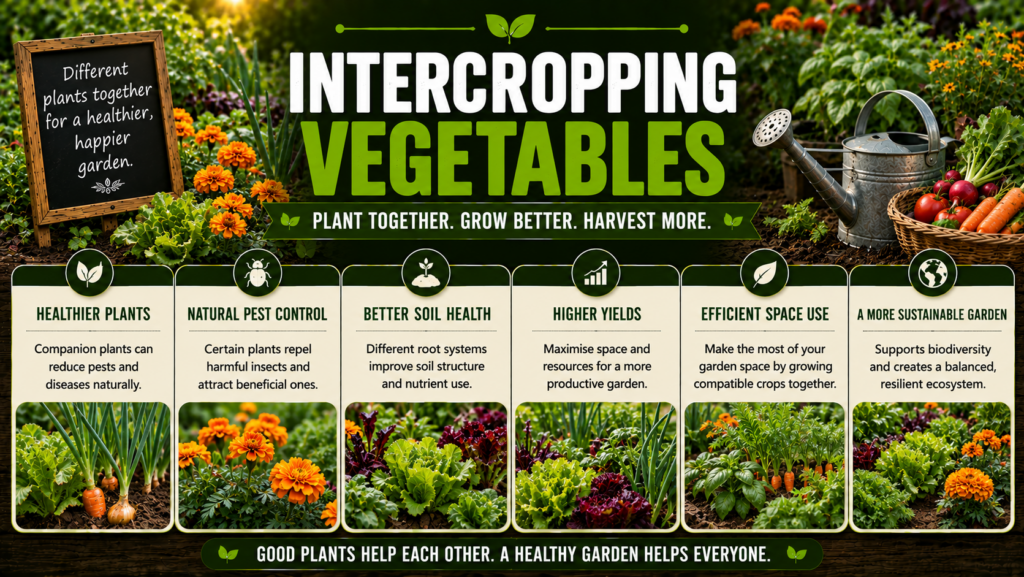
If you have ever looked at a vegetable garden and wondered whether you could grow several different crops together instead of planting each one in its own section, the answer is yes.
This approach is known as intercropping.
Intercropping involves growing two or more crops together in the same growing area during at least part of their growing period.
For the home gardener, it can be a useful way of making better use of available space while creating a more varied and productive vegetable garden.
It can be particularly useful for smaller gardens, raised beds and urban gardens where every bit of space counts.
However, successful intercropping isn’t simply a matter of putting lots of different vegetables next to one another.
The plants still need enough sunlight, water, nutrients and room to grow.
Understanding how different crops grow is the key to making intercropping work.
What Is Intercropping?
Intercropping is the practice of growing two or more different crops together in the same area.
Instead of having one bed containing only tomatoes and another containing only lettuce, for example, you might grow suitable combinations of crops together.
The crops may be planted:
- At the same time
- At different times
- In alternating rows
- In groups
- At different spacings
- At different heights
The particular arrangement depends on the crops being grown and the available space.
Intercropping vs Companion Planting
The terms intercropping and companion planting are sometimes used interchangeably, but they are not exactly the same.
Intercropping is primarily concerned with growing different crops together to make efficient use of space, time and resources.
Companion planting is often discussed in relation to the possible effects that one plant may have on another, such as attracting beneficial insects or helping with pest management.
The two approaches can overlap.
A garden can use intercropping principles while also incorporating companion planting ideas.
Why Do Gardeners Intercrop Vegetables?
There are several reasons why gardeners may choose to intercrop.
These include:
- Making better use of space
- Growing more than one crop in an area
- Making use of vertical space
- Staggering harvests
- Providing ground cover
- Reducing bare soil
- Increasing garden diversity
- Making use of different growing seasons
Intercropping can also make a vegetable garden more interesting because there is always something different happening in the beds.
Making Better Use of Garden Space
One of the biggest advantages of intercropping is efficient use of space.
Plants don’t all grow in the same way.
Some grow tall.
Some stay low.
Some develop underground roots.
Others spread across the soil surface.
By combining plants with different growth habits, you can sometimes use the same growing area more efficiently.
Think in Three Dimensions
A useful way to understand intercropping is to think about your garden vertically.
Imagine a garden bed containing:
- A tall crop
- A medium-sized crop
- A low-growing crop
The tall plant occupies the upper space.
The medium plant occupies the middle layer.
The low-growing plant covers the lower part of the bed.
This can be more efficient than growing every crop in separate blocks.
Examples of Vegetable Combinations
There are many possible combinations, but some simple examples include:
- Tomatoes with lettuce
- Maize with beans
- Carrots with radishes
- Onions with carrots
- Lettuce with radishes
- Tall crops with low-growing leafy vegetables
The suitability of a combination depends on the varieties, spacing and growing conditions.
Don’t assume that two plants are compatible simply because they are commonly mentioned together.
Intercropping Tomatoes
Tomatoes are relatively tall plants, particularly indeterminate varieties.
This creates an opportunity to grow lower-growing crops around them.
Suitable possibilities may include:
- Lettuce
- Radishes
- Certain herbs
- Low-growing leafy vegetables
However, avoid overcrowding the tomato plants.
Tomatoes need good airflow, sunlight and adequate root space.
Intercropping Maize
Maize is another crop that naturally provides vertical growth.
In some traditional agricultural systems, maize has been grown together with climbing beans and other crops.
The maize provides a structure that climbing plants can use, while the different crops occupy different areas of the growing space.
This type of combination needs careful planning because vigorous crops can compete for water, nutrients and sunlight.
Intercropping Carrots
Carrots are root vegetables, so much of their development takes place underground.
They can sometimes be combined with vegetables that occupy different parts of the growing space.
For example, radishes mature quickly and can be harvested before slower-growing carrots need all the available space.
This is an example of time-based intercropping.
What Is Time-Based Intercropping?
Not all intercropping involves plants growing together for the entire season.
You can also use differences in maturity times.
For example:
- Plant a fast-growing crop.
- Plant a slower-growing crop alongside it.
- Harvest the fast crop.
- Allow the slower crop to continue developing.
This makes use of space that would otherwise be empty.
Radishes are particularly useful in this type of system because they mature relatively quickly.
Intercropping Leafy Vegetables
Leafy vegetables can be useful in an intercrop because many are relatively compact.
Examples include:
- Lettuce
- Spinach
- Swiss chard
- Asian greens
- Rocket
However, leafy vegetables still need enough sunlight and moisture.
If planted underneath tall crops, make sure they are not placed in excessively deep shade.
Intercropping Onions
Onions have a relatively upright growth habit and can sometimes be combined with lower-growing vegetables.
Their narrow leaves occupy less horizontal space than spreading crops.
They can therefore be useful in carefully planned mixed beds.
As with any combination, consider the mature size of every plant rather than its size when you first plant it.
Intercropping with Herbs
Some herbs can also be incorporated into vegetable gardens.
Herbs can add diversity and attract pollinators when they flower.
Examples include:
- Basil
- Parsley
- Coriander
- Thyme
- Chives
However, avoid assuming that every herb benefits every vegetable.
Choose plants according to their actual growing requirements.
The Importance of Sunlight
Sunlight is one of the most important considerations when planning an intercrop.
A combination may look good on paper but fail if one plant eventually shades another too heavily.
Before planting, ask:
Which plant will become tallest?
Which plants need full sun?
Will the taller crop cast shade over a sun-loving vegetable?
Can the plants tolerate partial shade?
This is particularly important during winter when the sun sits lower in the sky.
Managing Shade
Shade isn’t always a bad thing.
Some leafy vegetables can tolerate less direct sunlight than fruiting crops.
You can use this to your advantage.
For example, a tall crop may provide some afternoon shade for a vegetable that is more comfortable with slightly cooler conditions.
However, excessive shade can reduce growth and harvests.
The goal is to use shade strategically rather than accidentally.
Root Competition
Plants growing together also share the same soil.
Their roots may compete for:
- Water
- Nutrients
- Space
This doesn’t mean that all plants need to be separated.
It simply means you should avoid combining several extremely vigorous crops in a small area without planning for their mature root systems.
Different Root Depths Can Help
One way to plan an intercrop is to combine plants with different root structures.
For example, a shallow-rooted leafy vegetable and a deeper-rooted crop may make better use of the soil profile than two shallow-rooted crops competing in exactly the same area.
This isn’t a guarantee of success, but it is a useful principle when planning your beds.
Water Requirements Matter
Try to group plants with reasonably similar watering requirements.
A vegetable that prefers consistently moist soil may not be the best partner for one that prefers drier conditions.
If you combine plants with very different water needs, it can become difficult to keep both healthy.
This is especially important in South Africa, where water availability and summer temperatures can vary considerably between regions.
Nutrient Requirements
Plants also differ in their nutrient requirements.
Heavy-feeding crops such as tomatoes, maize and pumpkins can use substantial amounts of nutrients.
Combining several heavy feeders in a small area can place considerable demand on the soil.
Adding compost and maintaining healthy soil can help, but don’t assume that organic matter alone will solve every nutrient problem.
Intercropping and Soil Fertility
Healthy soil is the foundation of a productive vegetable garden.
Before starting an intercrop, consider:
- Soil structure
- Drainage
- Organic matter
- Nutrient availability
- Soil pH
Adding well-made compost can improve soil structure and contribute organic matter.
However, compost should be used as part of an overall soil management approach rather than as a replacement for understanding your soil.
What About Legumes?
Legumes such as beans and peas are particularly interesting in mixed cropping systems.
Legumes form relationships with soil bacteria that can help them obtain nitrogen from the atmosphere.
This does not mean that growing beans automatically fertilises all neighbouring plants.
The benefits depend on the crop, soil conditions and what happens to the plant residues after harvesting.
Still, legumes can be valuable members of a diverse vegetable garden.
Intercropping for Small Gardens
Intercropping can be particularly useful if you have limited garden space.
Instead of needing separate beds for every vegetable, you can carefully combine crops.
For example, a small bed might contain:
- A few tomato plants
- Lettuce between the larger plants
- Radishes harvested early
- Herbs around the edges
The exact arrangement depends on the mature size of the plants.
Intercropping in Raised Beds
Raised beds are well suited to planned intercropping.
Because the growing area is clearly defined, you can map out where each crop will go.
However, avoid the temptation to plant too closely simply because the bed looks empty.
Young plants are small.
Mature plants may be several times larger.
Always plan for the final size.
Intercropping in Containers
Intercropping can also be used in larger containers.
A large container might contain a main crop with one or two smaller plants around it.
However, containers provide a limited amount of soil.
Competition for water and nutrients can therefore become more significant.
For containers, it is often better to use fewer plants and give each one enough room.
Succession Planting and Intercropping
Intercropping can work particularly well alongside succession planting.
Succession planting means sowing or planting crops at different times so that harvests are spread out.
For example, you could sow lettuce at intervals rather than planting the entire supply at once.
Combining succession planting with intercropping can help keep the garden productive throughout the season.
Intercropping and Pest Management
A diverse garden can make it more difficult for a single crop pest to spread rapidly through an entire bed.
If a bed contains several different vegetables rather than one continuous crop, the plants are less uniform.
However, intercropping should not be presented as a guaranteed pest-control method.
You still need to inspect plants regularly for:
- Aphids
- Caterpillars
- Whiteflies
- Snails and slugs
- Beetles
- Other local pests
Attracting Beneficial Insects
A diverse garden can also provide more opportunities for beneficial insects.
Allowing some suitable flowering herbs and plants to bloom can provide nectar and pollen for insects such as bees and hoverflies.
Some beneficial insects also prey on garden pests.
This is one reason why biodiversity can be valuable in a home garden.
Intercropping Does Not Mean Crowding
This is one of the most important lessons for beginners.
More plants do not automatically mean more vegetables.
If plants are crowded together:
- Airflow can be reduced
- Disease may spread more easily
- Plants compete for water
- Plants compete for nutrients
- Harvesting becomes difficult
- Plants may shade one another
Good intercropping is about efficient spacing, not maximum planting density.
Common Intercropping Mistakes
Beginners often make a few predictable mistakes.
Planting Too Closely
The bed looks beautifully full at first, but becomes overcrowded later.
Ignoring Mature Size
A tiny tomato seedling eventually becomes a much larger plant.
Combining Plants with Different Water Needs
This makes irrigation difficult.
Ignoring Sunlight
A tall crop can unintentionally shade smaller vegetables.
Combining Too Many Heavy Feeders
Several vigorous crops can place substantial demands on the soil.
Forgetting Access
If plants completely cover a bed, harvesting and maintenance become difficult.
Plan for Access
A productive garden should still be easy to maintain.
Leave enough room to:
- Water plants
- Harvest vegetables
- Inspect leaves
- Remove weeds
- Apply mulch
- Deal with pests
A garden that looks full but cannot be comfortably accessed can quickly become frustrating.
How to Plan an Intercropping Bed
Before planting, make a simple sketch.
Mark:
- The tallest crops
- Medium-sized crops
- Low-growing crops
- Root vegetables
- Fast-growing crops
- Slow-growing crops
- Walking or access areas
Then consider sunlight, water and mature plant size.
You don’t need a complicated garden design.
Even a simple drawing on paper can help.
A Simple Example
Imagine a small vegetable bed.
You could place:
Back of the bed: Tall tomatoes supported on stakes.
Middle: Smaller leafy vegetables.
Between young plants: Radishes that will be harvested quickly.
Edges: Compact herbs.
As the season progresses, the radishes are harvested, creating more space.
The tomatoes continue growing upwards while the lower-growing crops occupy the remaining space.
This is a simple example of using both space and time efficiently.
Intercropping for South African Gardens
South Africa has many different climate zones, so there is no single intercropping calendar that works everywhere.
A planting combination suitable for the Western Cape may not have the same timing in Gauteng or KwaZulu-Natal.
Consider:
- Local frost dates
- Summer temperatures
- Rainfall
- Water availability
- Soil type
- Length of the growing season
Use local planting calendars and the sowing instructions for each vegetable as your starting point.
Intercropping During Hot Weather
During very hot weather, soil can lose moisture quickly.
Mulching around plants can help reduce evaporation and protect the soil surface.
However, don’t place thick mulch directly against plant stems.
Monitor plants regularly, particularly when several crops are sharing the same growing area.
Intercropping During Cooler Weather
Cooler conditions can change the balance between crops.
Some vegetables slow down considerably during cold weather, while others thrive.
This creates opportunities for seasonal combinations.
Again, choose crops according to your local growing conditions rather than following a generic calendar.
Should Beginners Try Intercropping?
Yes, but start simply.
You don’t need to fill an entire vegetable bed with ten different crops.
Start with two or three vegetables that have compatible:
- Sunlight requirements
- Water requirements
- Growing periods
- Mature sizes
Observe how they perform.
Once you understand how your garden behaves, you can experiment with more combinations.
Keep Notes
A gardening notebook can be extremely useful.
Record:
- What you planted
- Where you planted it
- Planting date
- Harvest date
- Weather conditions
- Pest problems
- Which combinations worked well
- Which combinations became overcrowded
This information becomes increasingly valuable each season.
Your own garden observations are often more useful than a generic planting chart because they reflect your particular soil and climate.
Final Thoughts
Intercropping vegetables is a practical way to make better use of your garden space while growing a greater variety of crops.
The basic idea is simple: grow different crops together while making thoughtful use of space, sunlight, water and time.
Tall crops can make use of vertical space.
Low-growing vegetables can occupy areas closer to the soil surface.
Fast-growing crops can be harvested before slower crops reach full size.
However, successful intercropping requires planning.
Don’t simply plant vegetables as close together as possible.
Consider their mature size, root systems, sunlight requirements, water needs and nutrient demands.
For South African gardeners, local climate is particularly important. What works well in one region may need to be adjusted in another.
Start with a simple combination, observe how the plants grow and make notes.
With a little practice, intercropping can become a natural part of planning your vegetable garden — helping you make the most of the space you have while keeping your garden varied, productive and enjoyable.
Related Articles
Soil Depth for Common Vegetables
Read MoreSuccession Planting Explained
Read MoreWhich Onion Variety to Grow?
Read MoreGrowing Rosemary from a cutting
Read MoreLambs Quarters Edible Weed
Read MoreCrop Rotation
Read More