
Gardening Basics, Gardening Tips, Vegetable & Herb Gardening
Crop Rotation
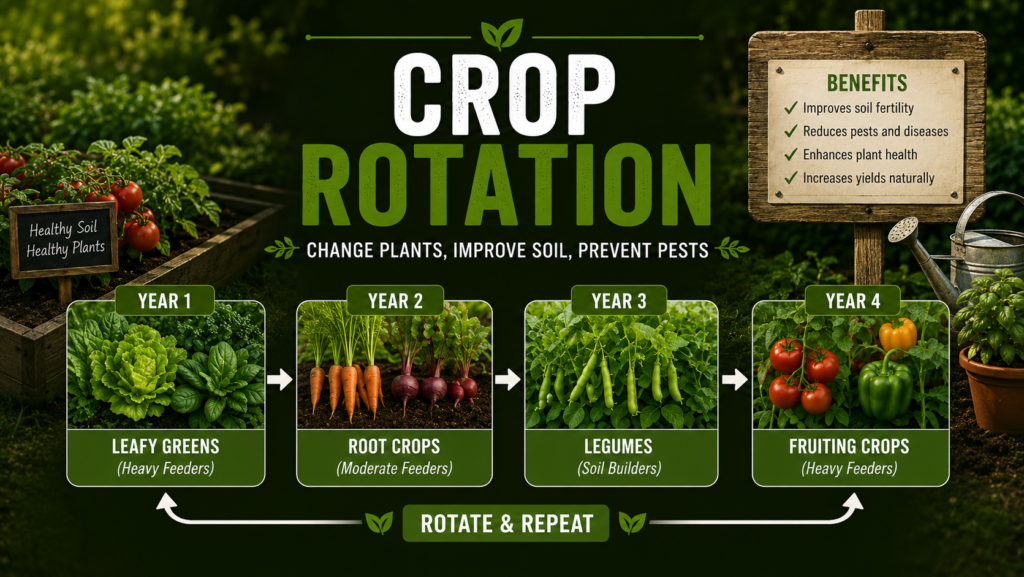
If you grow vegetables in garden beds, raised beds or containers, you may eventually notice that planting the same type of crop in the same soil year after year can create problems.
Certain pests and diseases become more established, nutrients can become unbalanced and some crops may simply stop performing as well as they did when the soil was fresh.
This is where crop rotation can help.
Crop rotation means changing the types of crops grown in a particular area from one growing season to the next.
Instead of planting tomatoes in the same bed every year, for example, you might follow them with legumes, then onions or other crops, before eventually returning to tomatoes.
It is a simple gardening practice that can help support healthier soil and reduce the build-up of some crop-specific pests and diseases.
What Is Crop Rotation?
Crop rotation is the planned movement of different crop groups between growing areas over successive seasons.
The idea is quite simple.
Rather than growing the same family of vegetables repeatedly in exactly the same soil, you alternate between different groups of plants.
For example:
Legumes → Alliums → Brassicas → Fruit and Root Crops → Legumes
The exact rotation can vary depending on the vegetables you grow, your soil and the length of your growing season.
You don’t need a complicated agricultural system to benefit from crop rotation.
Even a small home vegetable garden can make use of the basic principle.
Why Is Crop Rotation Important?
One of the main reasons gardeners use crop rotation is to avoid repeatedly giving the same pests and diseases the same host plants.
Many plant pathogens and pests are associated with particular plant families.
If the same family is planted in the same soil year after year, some problems can become easier to maintain from one season to the next.
Changing the crop family can interrupt that cycle.
Crop rotation can also help you make better use of soil nutrients because different crops have different nutrient requirements and root systems.
Crop Rotation Can Help With Soil Health
Healthy soil is more than simply having enough fertiliser.
Soil contains:
- Organic matter
- Minerals
- Microorganisms
- Air spaces
- Water
- Plant roots
- Decomposing organic material
Different crops interact with the soil in different ways.
Some are heavy feeders, while others require fewer nutrients.
Some have shallow roots, while others explore deeper layers.
Rotating crops helps prevent one particular type of plant from placing exactly the same demands on the soil season after season.
Crop Rotation and Plant Diseases
Some plant diseases can survive in soil or infected plant debris.
If you repeatedly grow the same susceptible crop in the same location, the pathogen may have an opportunity to continue its life cycle.
Moving that crop to another area can reduce the opportunity for the disease to build up.
This does not eliminate plant diseases, but it can form part of an overall disease-management strategy.
Crop Rotation and Pests
The same principle applies to some pests.
Certain insects specialise in particular crops or plant families.
If their preferred host is continuously available in the same location, they may have an easier time establishing themselves.
Rotating crop families can make it more difficult for some crop-specific pests to remain established.
However, crop rotation is not a complete pest-control solution.
Regular plant inspection, good garden hygiene, appropriate spacing and other pest-management methods are still important.
How Long Should You Rotate Crops?
There is no single rotation period that works for every garden.
Traditional crop rotations can last two, three or more years.
Longer rotations can be particularly useful for crops affected by persistent soil-borne diseases.
For a home vegetable garden, however, even a simple annual rotation can be a useful improvement over repeatedly planting the same crop family in exactly the same location.
The most important thing is to avoid thinking of rotation as an all-or-nothing practice.
Even a basic system is better than continually planting the same susceptible crop in the same soil.
Annual Crop Rotation
For a home garden, rotating crop families each year is relatively straightforward.
For example, you might have four raised beds and use a four-year rotation:
Year 1: Legumes
Year 2: Alliums
Year 3: Brassicas
Year 4: Fruiting and root crops
Then the cycle begins again.
If you have four beds, each group can move into the next bed each year.
This gives you a simple system that is easy to remember.
A Simple Four-Group Rotation
There are many ways to organise a crop rotation.
For beginners, one practical approach is to divide your vegetables into broad groups:
Group 1: Legumes
Examples include:
- Beans
- Peas
- Broad beans
- Runner beans
Group 2: Alliums
Examples include:
- Onions
- Garlic
- Leeks
- Shallots
- Spring onions
- Scallions
Group 3: Brassicas
Examples include:
- Cabbage
- Broccoli
- Cauliflower
- Kale
- Brussels sprouts
- Turnips
- Kohlrabi
- Mizuna
- Mustard greens
- Bok choy
- Chinese cabbage
Group 4: Fruiting and Root Crops
This group can include a mixture of crops such as:
- Tomatoes
- Eggplant
- Sweet peppers
- Potatoes
- Carrots
- Beetroot
- Parsnips
- Sweet potatoes
- Celery
- Lettuce
- Spinach
However, this final group is quite broad, so gardeners with space for a more detailed rotation may benefit from separating fruiting crops and root crops into different groups.
Why Plant Families Matter
When planning crop rotation, it is often more useful to think in terms of plant families rather than simply the name of the vegetable.
For example, tomatoes, peppers and eggplants all belong to the Solanaceae family.
If you plant tomatoes one year and peppers in exactly the same spot the following year, you haven’t really changed the crop family.
The same principle applies to brassicas.
Cabbage, broccoli, cauliflower, kale and Brussels sprouts are all members of the Brassicaceae family.
For crop rotation, these crops should generally be treated as one group.
What About Root Crops?
Root vegetables can be useful in a rotation because they have different growth patterns from many leafy and fruiting vegetables.
Examples include:
- Carrots
- Beetroot
- Parsnips
- Radishes
- Turnips
However, not all root crops belong to the same plant family.
This means you don’t necessarily have to keep every root crop together in one rotation group.
Instead, consider the plant family and the pests and diseases associated with the particular crop.
What About Tomatoes?
Tomatoes are particularly worth considering when planning crop rotation.
They belong to the nightshade family, Solanaceae, along with:
- Eggplant
- Peppers
- Potatoes
If you have had problems with soil-borne diseases affecting tomatoes, repeatedly following tomatoes with another Solanaceae crop may not provide the break you are looking for.
For rotation purposes, think of the whole plant family rather than just the individual vegetable.
What About Potatoes?
Potatoes are also members of the Solanaceae family.
This means they should generally be considered alongside tomatoes, peppers and eggplants when planning a family-based rotation.
If you grow potatoes in one bed, avoid immediately following them with another crop from the same family if disease pressure is a concern.
Legumes in Crop Rotation
Beans and peas are popular rotation crops.
Legumes have a special relationship with certain soil bacteria that allows them to obtain nitrogen from the atmosphere.
This makes legumes particularly interesting in crop rotation.
However, it is important not to assume that simply growing beans automatically adds large amounts of usable nitrogen to the soil for the next crop.
Much depends on what happens to the plants and their roots after harvest.
Leaving healthy root systems and incorporating suitable organic matter can contribute to soil health.
Should You Remove Legume Roots?
If your beans or peas have finished producing, cutting the plants at soil level and leaving the roots in the soil can be useful.
The roots can decompose and contribute organic matter.
Avoid pulling everything out unnecessarily unless there is a particular reason to do so.
If the plants were diseased, however, follow appropriate garden-hygiene practices rather than leaving infected material in the soil.
Crop Rotation in Raised Beds
Raised beds are ideal for crop rotation because each bed provides a clearly defined growing area.
For example, imagine four raised beds:
Bed 1: Legumes
Bed 2: Alliums
Bed 3: Brassicas
Bed 4: Fruiting and root crops
The following year, move each group one bed along.
This gives you a simple rotation without having to redesign the garden every season.
Crop Rotation in Small Gardens
You don’t need a large vegetable garden to use crop rotation.
If you only have one or two beds, simply keep a record of what was planted there each season.
Even moving a crop family to another section of the garden can help.
If space is extremely limited, prioritise rotating crops that are particularly susceptible to recurring soil-borne pests and diseases.
Crop Rotation in Containers
Crop rotation can also be useful in container gardening.
This is particularly important if you regularly reuse the same growing medium.
Container soil is a limited environment.
Repeatedly growing the same crop in the same container can allow certain pests and diseases to persist, while the growing medium can gradually become depleted or unbalanced.
Where practical, rotate the type of crop grown in each container.
Do You Need to Replace Container Soil?
Not necessarily.
Good-quality container growing media can often be reused, provided it is still in good condition and has not been affected by serious disease.
Before reusing it, consider:
- What was previously grown in the container?
- Was the plant healthy?
- Does the growing medium still drain well?
- Has it become compacted?
- Does it contain enough organic matter?
- Has it been heavily depleted?
Adding suitable fresh growing medium or compost can help rejuvenate an established container mix.
However, if a serious soil-borne disease has affected a plant, reusing the same growing medium may not be advisable.
Crop Rotation Does Not Replace Good Soil Management
Crop rotation works best as part of a broader soil-management plan.
Healthy vegetable gardens also benefit from:
- Adding mature compost
- Maintaining organic matter
- Avoiding unnecessary soil disturbance
- Using suitable mulch
- Preventing compaction
- Managing watering correctly
- Removing seriously diseased plant material
Think of crop rotation as one tool in your gardening toolbox rather than a complete solution to every soil problem.
Crop Rotation and Compost
Adding mature compost between growing seasons can help replenish organic matter.
Compost also supports soil structure and contributes nutrients.
However, compost does not make crop rotation unnecessary.
The two practices work well together.
A simple routine could be:
Harvest → remove unsuitable plant material → add mature compost → rotate the next crop family into the bed.
What About Organic Gardening?
Crop rotation is particularly compatible with organic gardening because it is a preventative cultural practice rather than relying entirely on chemical pest or disease control.
Organic gardeners often combine crop rotation with:
- Compost
- Mulching
- Beneficial insects
- Resistant varieties
- Good garden hygiene
- Appropriate watering
- Physical pest controls
The aim is to create a growing environment where plants are naturally better able to cope with problems.
Crop Rotation and Companion Planting
Crop rotation and companion planting are sometimes confused.
They are different techniques.
Crop rotation changes what is grown in a particular area over time.
Companion planting involves growing particular plants together.
You can use both approaches in the same garden.
For example, you might rotate your tomato crop between beds each year while also growing suitable companion plants around the tomatoes.
Crop Rotation and Succession Planting
Succession planting is another different technique.
It involves planting crops at different times so that you can harvest continuously.
For example, you might sow lettuce every few weeks rather than planting all your lettuce on one day.
Crop rotation operates over a longer period, while succession planting focuses mainly on timing within the growing season.
The two can easily be used together.
A Simple Rotation Example
Let’s imagine you have four raised beds.
Year 1
Bed 1: Beans and peas
Bed 2: Onions and garlic
Bed 3: Cabbage and broccoli
Bed 4: Tomatoes, carrots and beetroot
Year 2
Move each group along:
Bed 1: Onions and garlic
Bed 2: Cabbage and broccoli
Bed 3: Tomatoes and root crops
Bed 4: Beans and peas
Year 3
Move them again.
The important thing is to keep a record so you know what was planted where.
Keep a Crop Rotation Record
A notebook, spreadsheet or simple garden map can make crop rotation much easier.
Record:
- Bed or container
- Crop family
- Variety
- Planting date
- Harvest date
- Disease or pest problems
- Compost added
- Notes for the following season
You don’t need an elaborate system.
Even a simple yearly sketch can prevent you from accidentally planting the same crop family in the same place.
What If You Don’t Have Enough Beds?
Don’t worry.
Perfect crop rotation is not always possible in a small home garden.
If you only have one raised bed, you can still avoid repeatedly planting the same crop by changing what you grow each season.
If you have several containers, rotate crops between containers.
If space is very limited, focus particularly on avoiding repeated planting of the same plant families where pests or diseases have previously been a problem.
Common Crop Rotation Mistakes
Treating Different Varieties as Different Crops
Growing two tomato varieties in consecutive seasons doesn’t count as rotating away from tomatoes.
They are still both Solanaceae.
Rotating Individual Vegetables Instead of Families
Following tomatoes with peppers may look like a rotation, but both belong to the same family.
Forgetting Potatoes
Potatoes are also members of the nightshade family.
Having No Record
After a year or two, it can be surprisingly difficult to remember exactly what grew where.
Expecting Rotation to Solve Everything
Crop rotation helps, but pests, diseases, poor soil and watering problems can still occur.
How Long Before Planting the Same Crop Again?
The ideal interval depends on the crop and the problem you are trying to prevent.
For general home gardening, rotating crop families annually is a useful starting point.
For crops affected by persistent diseases, a longer break may be advisable.
If you have a recurring disease problem, research the specific pathogen rather than relying on a general rotation rule.
South African Crop Rotation
South African gardeners have the advantage of growing vegetables across a wide range of climates.
However, this also means that planting schedules differ considerably.
Your rotation plan should take into account:
- Your local climate
- Frost
- Rainfall
- Summer heat
- Irrigation
- Growing season length
- The crops suited to your region
A rotation plan is most useful when it fits the way you actually garden.
There is no need to copy a rotation designed for another country if it doesn’t suit your local growing conditions.
A Simple Beginner’s Rotation
If you are completely new to crop rotation, don’t make it complicated.
Start with four broad groups:
1. Legumes
Beans and peas
2. Alliums
Onions, garlic and leeks
3. Brassicas
Cabbage, broccoli, cauliflower and related crops
4. Fruiting and root crops
Tomatoes, peppers, eggplant, carrots, beetroot and similar vegetables
Rotate these groups between your available beds or containers.
As you gain experience, you can refine the system according to plant families and the specific crops you grow.
Final Thoughts
Crop rotation is one of those gardening practices that sounds more complicated than it really is.
The basic principle is simply to avoid growing the same crop family in the same soil repeatedly.
Moving your vegetables around can help reduce the build-up of some crop-specific pests and diseases, while different crops make different demands on the soil.
For raised beds, an annual rotation is a practical place to start.
For container gardeners, rotating the crops grown in each container can also be useful, particularly when the growing medium is reused.
You don’t need a large farm or an elaborate gardening system.
A few raised beds, a handful of containers and a simple notebook are enough to get started.
Pay attention to plant families rather than just vegetable names, keep track of what you plant and combine crop rotation with good soil care, composting, sensible watering and regular pest and disease monitoring.
Over time, you’ll begin to notice which crops perform particularly well after others and which combinations work best in your own garden.
And that is one of the most useful parts of gardening — learning from your soil, your plants and your own growing conditions each season.
Related Articles
Intercropping Vegetables
Read MoreContainer Gardening Basics
Read MoreComposting for Beginners
Read MoreBeneficial Insects vs Harmful Insects
Read MoreCommon Fruit Tree Problems
Read MoreHow Soil pH Affects Plants
Read MoreUnderstanding Soil Types
Read MoreSoil Depth for Common Vegetables
Read More