
Gardening Basics, Organic Gardening
Composting for Beginners
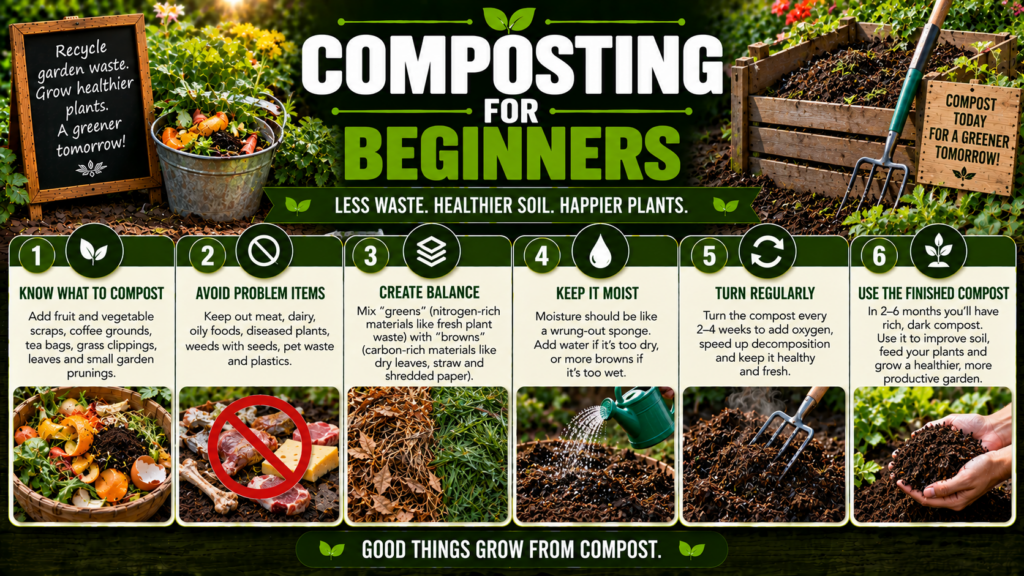
If you have ever looked at a pile of vegetable peels, fallen leaves and garden cuttings and wondered whether they could be put to better use, the answer is yes.
Instead of sending all those organic materials to the rubbish bin, you can turn many of them into compost.
Composting is one of the simplest ways for a gardener to recycle organic material and create a useful soil amendment for the garden. You don’t need an expensive setup or a large garden to get started. Even a small compost bin can make a difference.
For beginners, composting may seem a little complicated at first. You might hear terms such as “green materials”, “brown materials”, “carbon”, “nitrogen” and “aeration”.
Don’t let the terminology put you off.
Once you understand a few basic principles, composting becomes much easier.
What Is Compost?
Compost is decomposed organic material.
It is created when microorganisms and other decomposers break down plant and other suitable organic materials over time.
A finished compost is usually dark, crumbly and earthy-smelling. It can be mixed into garden soil or used around plants to add organic matter.
Compost is not simply “rotting rubbish”. A healthy compost pile is an active ecosystem containing microorganisms, fungi and other decomposers working together to break down organic material.
Why Should Gardeners Make Compost?
There are several good reasons to compost at home.
It Recycles Garden and Kitchen Waste
Many materials that would otherwise end up in the rubbish bin can be composted.
Examples include:
- Vegetable peelings
- Fruit scraps
- Fallen leaves
- Grass clippings
- Small amounts of untreated garden trimmings
- Used coffee grounds
- Tea leaves
- Crushed eggshells
Instead of throwing these materials away, you can return their nutrients and organic matter to the garden.
It Adds Organic Matter to Soil
Compost adds organic matter to the soil.
Organic matter can help improve soil structure and contribute to the soil’s ability to hold moisture and nutrients.
This can be particularly useful in gardens where the soil is sandy, compacted or otherwise lacking in organic matter.
It Encourages Soil Life
Healthy soil contains a huge variety of living organisms.
Adding mature compost provides organic material that supports the soil ecosystem.
Earthworms and microorganisms can all play important roles in breaking down organic matter and cycling nutrients.
It Can Save Money
Once you have a composting system in place, much of the material comes from things you already have at home or in the garden.
Instead of continually buying bags of organic soil amendments, you can produce some of your own.
Compost won’t replace every soil amendment or fertiliser, but it can become a valuable part of a home gardener’s routine.
What Do You Need to Start Composting?
The good news is that you don’t need much.
A basic composting system needs:
- Organic material
- Air
- Moisture
- Microorganisms
- Time
You can compost in a purpose-made bin, a simple enclosed container or a suitable open pile, depending on your garden and local conditions.
Choose a location that is convenient to reach and has good drainage.
A shaded or partially shaded area can help prevent the compost from becoming excessively hot and drying out, particularly during the warmer months.
Understanding Green and Brown Materials
One of the easiest ways to understand composting is to divide materials into green and brown categories.
Green Materials
Green materials are generally rich in nitrogen.
Examples include:
- Fresh grass clippings
- Vegetable scraps
- Fruit scraps
- Fresh weeds before they have gone to seed
- Fresh green plant material
- Coffee grounds
Green materials help provide nitrogen for the microorganisms breaking down the compost.
Brown Materials
Brown materials are generally richer in carbon.
Examples include:
- Dry leaves
- Dry grass
- Straw
- Small twigs
- Shredded plain cardboard
- Untreated paper
- Dried plant material
Brown materials provide carbon and help create the structure needed for good airflow.
You Need Both
A compost pile made entirely from fresh green material can become wet, compacted and unpleasant-smelling.
A pile made mostly from dry brown material may break down very slowly.
A mixture of the two creates a better balance for decomposition.
You don’t need to measure every ingredient precisely.
Think of it as creating a varied mixture rather than following a complicated recipe.
What Can You Put in a Compost Pile?
Many common household and garden materials can be composted.
Good beginner materials include:
Kitchen scraps
- Vegetable peelings
- Fruit scraps
- Coffee grounds
- Tea leaves
- Crushed eggshells
Garden materials
- Fallen leaves
- Grass clippings
- Small garden trimmings
- Dead annual plants
- Non-invasive weeds that have not gone to seed
Other materials
- Shredded untreated cardboard
- Plain paper
- Small amounts of untreated sawdust
The smaller the pieces, generally the quicker they can break down because microorganisms have more surface area to work on.
What Should You Avoid Composting?
Not everything organic belongs in a home compost pile.
For a simple beginner system, avoid adding:
- Meat
- Fish
- Bones
- Dairy products
- Oils and greasy foods
- Pet faeces
- Diseased plants
- Weeds containing mature seeds
- Chemically treated materials
- Large amounts of glossy or heavily printed paper
These materials can attract unwanted animals, create unpleasant smells or introduce problems into the compost.
Commercial composting systems can handle some materials that are unsuitable for a simple home pile, but beginners are generally better off keeping things straightforward.
What About Citrus Peels?
Citrus peels can be composted.
They may take longer to break down than some softer kitchen scraps, particularly when added in large pieces.
Chopping them into smaller pieces can help.
There is also no need to believe the common gardening myth that citrus automatically “kills” a compost pile. A balanced compost pile can handle reasonable amounts of citrus material.
What About Onion and Garlic Scraps?
Onion and garlic scraps can also be composted.
As with other kitchen scraps, adding them as part of a varied mixture is preferable to adding large quantities of one particular material.
Cutting larger pieces into smaller pieces can help them break down more quickly.
Can You Compost Grass Clippings?
Yes.
Grass clippings are a useful green compost material.
However, adding a very thick layer of fresh grass all at once can cause the material to become compacted and wet.
Instead, mix grass clippings with dry leaves, shredded cardboard or other brown material.
This helps maintain airflow and reduces the chance of the grass forming a dense, smelly layer.
Can You Compost Fallen Leaves?
Absolutely.
Fallen leaves are one of the best brown materials for a home compost pile.
If you have lots of leaves in autumn or after seasonal tree shedding, don’t automatically throw them away.
They can provide valuable carbon-rich material for your compost.
Running over them with a lawn mower or shredding them before adding them can help them break down more quickly.
What About Weeds?
Weeds can be composted, but beginners should be selective.
Avoid adding weeds that have already produced mature seeds, as some seeds may survive a poorly managed compost pile.
Also be cautious with invasive plants or weeds that spread easily from roots or other plant parts.
If you are unsure whether a particular weed is suitable for your compost, leave it out.
Do You Need to Turn Your Compost?
Turning compost means mixing the materials so that air can reach different parts of the pile.
Oxygen is important for the microorganisms involved in aerobic decomposition.
Turning can therefore help the pile break down more evenly and may speed up the process.
You don’t need to turn it constantly.
A garden fork or compost aerator can be used to mix the pile periodically.
If your compost is already well-aerated and breaking down nicely, there is no need to disturb it every day.
How Wet Should Compost Be?
Compost should be moist but not waterlogged.
A useful comparison is the moisture level of a wrung-out sponge.
If the compost is extremely dry, decomposition can slow down.
If it is soaking wet, there may not be enough air between the materials, which can lead to unpleasant smells and slower decomposition.
During hot, dry South African weather, you may need to check the moisture level more regularly.
If necessary, add a little water when building or turning the pile.
Does Compost Need Sun?
Compost does not need full sun.
In fact, placing a compost bin in a partially shaded location can help prevent it from drying out too quickly.
A convenient location with good drainage is usually more important than choosing the sunniest part of the garden.
How Long Does Compost Take?
There is no fixed timetable.
Depending on the materials, moisture, temperature, airflow and how often the pile is turned, compost can take several months or longer to mature.
A well-managed active compost pile can break down considerably faster than a neglected pile.
Don’t worry if your first batch takes longer than expected.
Composting is a natural process, not a race.
How Do You Know When Compost Is Ready?
Finished compost should generally:
- Look dark and crumbly
- Have an earthy smell
- Be relatively uniform in appearance
- No longer resemble most of the original food scraps and plant material
You may still find a few pieces of twigs or tougher material. These can simply be removed and returned to the compost pile.
If the compost smells strongly unpleasant or contains lots of recognisable fresh material, it may need more time.
Can You Use Immature Compost?
It is better to allow compost to mature before using large amounts around plants.
Partially decomposed material can continue breaking down after being added to the soil and may temporarily affect nutrient availability.
For most beginners, the simplest approach is to wait until the compost has become dark, crumbly and earthy-smelling.
How to Use Finished Compost
There are several ways to use mature compost in the garden.
Mix It Into Garden Beds
Compost can be incorporated into the soil before planting.
This adds organic matter and helps improve the growing environment for plants.
Add It Around Established Plants
A layer of mature compost can be placed around established plants.
Avoid piling it directly against stems or trunks.
Use It When Planting
A small amount of mature compost can be incorporated into the soil when preparing a planting area.
The exact amount depends on the soil and the plants being grown.
Add It to Potting Mixes
Compost can form part of a homemade potting mixture, but it should not necessarily make up the entire mixture.
Container plants need a growing medium that provides suitable drainage and aeration as well as organic matter.
Compost and South African Gardens
Composting can be particularly useful for South African gardeners because growing conditions vary enormously from one region to another.
Some gardens have sandy soils that drain very quickly, while others have heavy clay soils that can become compacted.
Adding organic matter can help improve soil structure, although compost is not a magic solution for every soil problem.
Your local climate also affects how quickly compost breaks down.
Warm weather can encourage decomposition, while very dry conditions can slow the process if the pile does not have enough moisture.
Common Composting Problems
Even a simple compost pile can occasionally develop problems.
The Compost Smells Bad
A strong rotten or unpleasant smell often indicates that the pile is too wet, too compacted or lacking enough airflow.
Try adding dry brown material and turning the pile to introduce more air.
The Compost Is Not Breaking Down
Possible causes include:
- Too little moisture
- Too much dry material
- Large pieces of material
- Cold conditions
- Poor mixture of materials
Adding some fresh green material, moisture and smaller pieces can help.
The Compost Is Too Wet
Add dry brown material such as:
- Dry leaves
- Shredded cardboard
- Dry garden material
Then turn the pile to improve airflow.
The Compost Is Full of Flies
A few small insects around compost are normal.
However, large numbers of flies can indicate that fresh kitchen scraps are exposed.
Cover fresh food scraps with a layer of brown material.
A well-balanced compost pile should not smell like a rubbish bin.
Do You Need Compost Activators?
You may see products advertised as compost activators or compost starters.
They are not usually essential for a basic home compost pile.
The microorganisms needed to decompose organic material are naturally present in soil, plant material and the environment.
Providing a suitable balance of organic materials, moisture and oxygen is generally more important than buying a special product.
Can You Have Too Much Compost?
Yes.
Compost is useful, but more is not always better.
Adding extremely large quantities can change soil characteristics and may create nutrient or salt-related problems depending on the compost’s composition.
Use mature compost sensibly as part of an overall soil-management approach.
Composting Does Not Have to Be Perfect
One of the biggest mistakes beginners make is worrying about getting every detail exactly right.
You don’t need to create a scientifically perfect pile on your first attempt.
Start with a mixture of:
Green materials + brown materials + moisture + air + time
Observe what happens and make adjustments.
If the pile is too wet, add brown material.
If it is too dry, add a little moisture.
If it is compacted, turn it.
If it smells unpleasant, look at the balance of materials and airflow.
With experience, you will quickly learn what works in your particular garden.
A Simple Beginner Compost Recipe
If you want an easy starting point, try building your pile in layers or mixing materials as they become available.
For example:
Brown layer: Dry leaves or shredded cardboard.
Green layer: Vegetable scraps and fresh garden material.
Brown layer: More dry leaves or other dry material.
Green layer: Grass clippings or fresh plant material.
Continue adding materials while keeping the mixture reasonably balanced.
There is no need to create perfectly equal layers.
The goal is simply to avoid having the pile dominated by either very wet green material or very dry brown material.
Composting in Small Gardens
You don’t need a large property to make compost.
A small compost bin, tumbler or enclosed container can work well where space is limited.
If you live in a townhouse, complex or home with a small garden, consider a compact composting system that suits the amount of organic waste you produce.
The important thing is to choose a system that you will actually use.
What About Worm Composting?
Worm composting, also called vermicomposting, is another option.
Instead of relying primarily on a large outdoor compost pile, worms are used to help process suitable organic material in a contained system.
Worm bins can be useful where garden space is limited.
However, worm composting has slightly different requirements from ordinary composting, so beginners may prefer to learn the basics of traditional composting first.
Final Thoughts
Composting is a simple way to turn many everyday kitchen and garden materials into something useful for your garden.
You don’t need expensive equipment or specialist knowledge to get started.
Remember the basic principles:
Add a mixture of green and brown materials.
Keep the pile moist but not waterlogged.
Allow air to circulate.
Avoid unsuitable materials.
Give the compost time to mature.
Your first compost pile may not be perfect, and that’s completely fine.
Like gardening itself, composting is something you learn by doing.
Once you get into the habit of saving suitable kitchen scraps and garden materials, composting can become a natural part of your gardening routine—and instead of throwing valuable organic material away, you can return it to the soil where it can become part of the next growing season.
Related Articles
Container Gardening Basics
Read MoreHow Soil pH Affects Plants
Read MoreUnderstanding Soil Types
Read MoreBenefits of Organic Gardening
Read MoreBenefits of Companion Planting
Read More10 Common Beginner Gardening Mistakes
Read MoreThe Difference Between Trees and Shrubs
Read MoreSeed Types Explained
Read More