
Gardening Basics
Container Gardening Basics
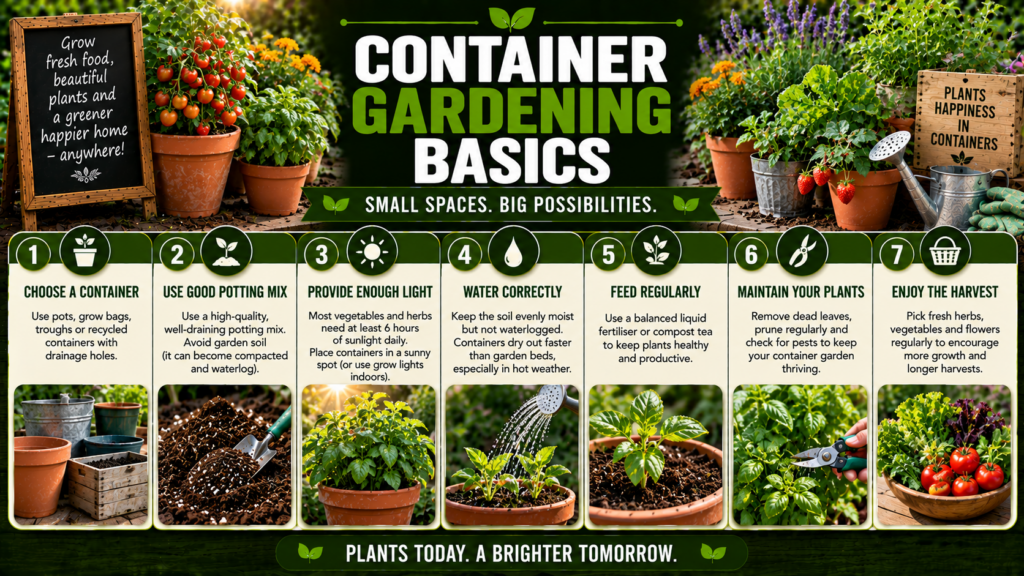
You don’t need a large garden to grow plants.
A sunny balcony, patio, courtyard, veranda or even a small outdoor area can provide enough space to grow herbs, vegetables, flowers and some fruit trees in containers.
Container gardening is simply the practice of growing plants in pots, tubs, planters or other suitable containers instead of planting them directly into the ground.
For beginners, container gardening can be a particularly rewarding way to start growing plants because you have much more control over the growing environment.
You can choose the soil, move plants when necessary, control watering and select containers that suit the space available.
However, plants grown in containers have different needs from plants growing in the ground.
Once you understand a few basic principles, container gardening becomes much easier.
Why Try Container Gardening?
There are many reasons to grow plants in containers.
It Works in Small Spaces
Containers make it possible to garden where traditional garden beds aren’t practical.
You can grow plants on:
- Balconies
- Patios
- Verandas
- Courtyards
- Small gardens
- Rooftops
- Windowsills
- Entrances
Even a few containers can provide fresh herbs or vegetables.
You Can Move Your Plants
One of the biggest advantages of container gardening is mobility.
If a plant is receiving too much sun, you may be able to move it to a more sheltered position.
Likewise, you can move a container to a sunnier location when needed.
This can be especially useful in areas where summer temperatures become very high.
You Control the Growing Medium
When growing directly in the garden, you have to work with the soil already present.
With containers, you can choose a suitable growing medium from the beginning.
This makes it easier to create good drainage and provide the type of growing environment a particular plant prefers.
It Can Be Easier to Manage
Containers can make certain gardening jobs more manageable.
You can keep herbs close to the kitchen, grow vegetables at a comfortable height and isolate individual plants if necessary.
Choosing the Right Container
Almost any suitable container can potentially be used for growing plants, provided it is safe for the intended purpose and has adequate drainage.
Common choices include:
- Plastic pots
- Terracotta pots
- Ceramic planters
- Wooden containers
- Fabric grow bags
- Repurposed containers
- Large tubs and troughs
The important thing is not necessarily how attractive the container is.
The plant’s needs should come first.
Does Container Size Matter?
Yes.
The container needs to provide enough space for the plant’s roots.
A small herb such as thyme can be perfectly happy in a relatively small pot, while a tomato plant or fruit tree needs considerably more space.
If the container is too small:
- Roots may become crowded
- The growing medium can dry out quickly
- Plants may become unstable
- Nutrients can become depleted more quickly
- Growth may be restricted
Research the mature size and root requirements of the plant before choosing a container.
Always Provide Drainage
One of the most important rules of container gardening is:
The container must have drainage holes.
Excess water needs somewhere to escape.
Without adequate drainage, water can accumulate around the roots and create conditions that encourage root problems.
If a decorative pot has no drainage hole, consider using it as a cover pot with a suitable plant container placed inside.
Don’t Rely on a Layer of Stones for Drainage
A common gardening suggestion is to place a thick layer of gravel or stones at the bottom of a pot to improve drainage.
This is generally not necessary.
What matters most is having drainage holes and using a suitable growing medium.
A thick layer of stones can actually reduce the amount of usable growing space for roots without solving the underlying drainage problem.
Choosing a Growing Medium
Garden soil from the ground is not always the best choice for containers.
It can become compacted and may not provide the balance of drainage and aeration that container-grown plants need.
Instead, use a suitable commercial potting mix or a properly prepared container-growing medium.
A good growing medium should generally provide:
- Drainage
- Air space around the roots
- Moisture retention
- Nutrient-holding capacity
- Support for the plant
Different plants may require different mixes.
What About Compost?
Compost can be very useful in container gardening.
It adds organic matter and nutrients and can form part of a suitable potting mix.
However, compost should not necessarily make up the entire growing medium.
Container plants need good drainage and aeration as well as organic matter.
A balanced container mix is generally more suitable than filling a pot entirely with compost.
Choosing Plants for Containers
Many plants can be grown successfully in containers.
Good beginner choices include:
Herbs
- Basil
- Parsley
- Coriander
- Thyme
- Rosemary
- Mint
- Chives
Vegetables
- Lettuce
- Radishes
- Spinach
- Spring onions
- Carrots
- Bush beans
- Tomatoes
- Chillies
Flowers
Many annual flowers perform well in containers and can add colour to patios and balconies.
Fruit
Some fruit plants can also be grown in containers, particularly naturally compact varieties or plants grown on suitable dwarfing rootstocks.
Examples include:
- Strawberries
- Dwarf citrus
- Some figs
- Certain compact peaches
- Some other naturally smaller fruit varieties
Always check the mature size before planting.
Think About the Amount of Sunlight
Before choosing plants, observe how much sunlight your container area receives.
A balcony that receives several hours of direct sunlight will offer a very different growing environment from a shaded courtyard.
Plants can generally be grouped according to their light preferences.
Some need plenty of direct sunlight, while others prefer partial shade.
Don’t choose a plant simply because you like it.
Choose a plant that matches the conditions you can provide.
South African Sun Can Be Strong
South African gardeners should pay particular attention to sunlight and heat.
A container standing against a hot wall or on a paved surface can become considerably hotter than the surrounding garden.
The container itself can also heat up, potentially increasing moisture loss from the growing medium.
During particularly hot weather, plants may need more frequent attention.
Moving containers to a more suitable position or providing some afternoon protection can help, depending on the plant.
Watering Container Plants
Container plants generally need more frequent watering than plants growing in the ground.
There is simply less growing medium available to hold moisture.
However, watering every container on a fixed schedule is not always the best approach.
Instead, check the growing medium.
If the surface is dry, push a finger gently into the soil to check the moisture level below the surface.
Then water according to the plant’s requirements and the conditions.
Water Thoroughly
When watering a container, apply enough water to moisten the growing medium throughout.
Water should eventually drain from the bottom.
This helps ensure that the root zone receives moisture rather than only wetting the very top layer.
Don’t allow containers to sit permanently in saucers filled with water.
Empty excess water where appropriate.
Avoid Overwatering
More water does not necessarily mean healthier plants.
Overwatering can deprive roots of oxygen and contribute to root problems.
Signs of watering problems can include:
- Yellowing leaves
- Wilting despite wet soil
- Slow growth
- Poor plant health
- Fungal or root-related problems
Remember that wilting does not always mean a plant needs more water.
Check the growing medium first.
Containers Dry Out Quickly in Summer
This is particularly important in South Africa.
During hot weather, containers can dry out much faster than garden beds.
Small pots can dry out especially quickly.
Plants on exposed balconies or patios may require more frequent checking than plants in sheltered areas.
Large containers generally hold moisture for longer than very small containers.
What About Watering in Winter?
Water requirements usually decrease when temperatures are lower and plant growth slows.
However, winter watering depends on the plant, container, rainfall and local climate.
Don’t continue watering on a summer schedule simply because that is what you have always done.
Check the growing medium first.
Feeding Container Plants
Plants growing in containers have access to a limited amount of nutrients.
Over time, nutrients can be used by the plant or washed out through watering.
Container plants may therefore benefit from regular feeding during active growth.
Use a fertiliser appropriate for the plant you are growing and follow the product’s instructions.
More fertiliser is not necessarily better.
Excessive fertiliser can damage roots and contribute to salt accumulation in the growing medium.
Organic Options
Gardeners who prefer organic gardening can use suitable organic fertilisers and compost as part of their container-growing approach.
Examples include:
- Mature compost
- Worm castings
- Well-made compost-based amendments
- Suitable organic fertilisers
Always make sure that any manure or compost used is properly matured.
Fresh manure is generally not suitable for direct use around container plants.
Repotting Container Plants
Plants eventually outgrow their containers.
Signs that a plant may need repotting include:
- Roots growing from drainage holes
- Roots tightly circling the root ball
- The plant drying out unusually quickly
- Stunted growth
- The plant becoming unstable
- The container becoming obviously too small
Repotting into a slightly larger container gives the roots more room.
There is usually no need to move a plant from a small pot into an enormous container all at once.
Choosing a New Pot
When repotting, choose a container that is appropriately larger than the current one.
The new pot should:
- Have drainage holes
- Provide enough room for continued root growth
- Be stable enough for the plant
- Suit the plant’s eventual size
Very large containers can hold a lot of wet growing medium, which can create drainage and watering challenges if the plant has a relatively small root system.
Container Material Matters
Different materials have different characteristics.
Terracotta
Terracotta pots are attractive and porous.
They can allow moisture to evaporate through the sides, which can mean plants dry out faster.
Plastic
Plastic containers are lightweight and generally retain moisture better.
They can be useful where frequent watering is difficult.
Ceramic
Ceramic pots can be decorative and heavy, making them stable.
However, they can be difficult to move once filled.
Fabric Grow Bags
Fabric grow bags provide good airflow around the root area and are available in many sizes.
They can be particularly useful for vegetables and larger plants.
Dark Containers in Hot Areas
Dark-coloured containers can absorb considerable heat when placed in direct sunlight.
This can make the root zone hotter, particularly during very hot weather.
In exposed areas, consider the position of the container as well as the container material and colour.
A little afternoon protection can make a significant difference for plants that struggle with extreme heat.
Container Gardening and Wind
Wind can be a problem for container plants.
Balconies, rooftops and exposed patios can experience strong gusts.
Tall plants can become unstable, while foliage may lose moisture quickly.
Use sturdy containers and place them somewhere appropriately sheltered.
Support tall plants such as tomatoes where necessary.
Growing Vegetables in Containers
Container gardening is particularly useful for growing fresh vegetables in small spaces.
Some beginner-friendly choices include lettuce, radishes, spring onions, spinach and herbs.
Larger vegetables such as tomatoes require more space and support.
When growing root vegetables, remember that the container needs to be deep enough for the edible root to develop properly.
Growing Herbs in Containers
Herbs are among the easiest plants for beginners to grow in containers.
They are also convenient because you can keep them close to the kitchen.
However, different herbs have different requirements.
For example, rosemary and thyme generally prefer well-drained conditions, while mint prefers more consistent moisture.
It is often better to give vigorous herbs such as mint their own container rather than allowing them to spread through a shared planter.
Growing Fruit Trees in Containers
Some fruit trees can be grown successfully in containers.
This is particularly useful for gardeners with limited space.
However, fruit trees require substantially larger containers than most herbs or vegetables.
They also need appropriate pruning, feeding, watering and sunlight.
If you are interested in growing fruit trees this way, choose a variety and rootstock suitable for container cultivation.
Common Container Gardening Problems
Yellow Leaves
Yellow leaves can have many causes, including watering problems, nutrient deficiencies, poor drainage or natural ageing.
Don’t immediately assume the plant needs fertiliser.
Check the growing conditions first.
Wilting
Wilting may be caused by underwatering, excessive heat, root damage or even overwatering.
Check the growing medium before adding more water.
Slow Growth
Slow growth may be related to:
- Insufficient sunlight
- Poor nutrition
- Small containers
- Root problems
- Incorrect watering
- Temperature stress
Look at the whole growing environment rather than focusing on one possible cause.
Pests
Container plants can still attract pests.
Check leaves and stems regularly for signs of:
- Aphids
- Whiteflies
- Caterpillars
- Scale insects
- Spider mites
Early detection usually makes pest management easier.
Can Containers Reduce Garden Pests?
Containers can sometimes make pest management easier because individual plants are separated from one another.
If one plant develops a pest problem, it can potentially be moved away from other plants.
However, container gardening does not eliminate pests.
Regular inspection is still important.
Reusing Containers
Reusing containers can be a practical and environmentally friendly option.
Before using a repurposed container, make sure it is:
- Clean
- Strong enough
- Safe for growing plants
- Able to provide drainage
Avoid containers that may have held toxic chemicals or other substances that could contaminate the growing medium.
Drainage Holes Can Be Added
If you are using a suitable repurposed container without drainage holes, you may be able to add them.
The number and size of holes will depend on the container.
The aim is simply to ensure that excess water can escape.
Always handle drilling equipment safely and wear suitable protective equipment when necessary.
Container Gardening for Beginners: A Simple Routine
A simple routine can keep container plants healthy.
Every Few Days
Check:
- Moisture
- Plant appearance
- Signs of pests
- Wilting
- New growth
Regularly
Remove:
- Dead leaves
- Spent flowers
- Damaged growth
Check that drainage holes remain clear.
During Active Growth
Monitor whether plants need feeding or additional support.
Seasonally
Consider whether plants need:
- Repotting
- Pruning
- A change of position
- Protection from extreme weather
- Replacement if they have completed their growing cycle
A Beginner’s Container Checklist
Before planting, ask yourself:
Does the container have drainage holes?
Is it large enough for the mature plant?
Is the growing medium suitable?
Does the plant receive enough sunlight?
Can I provide enough water without overwatering?
Will the location become excessively hot?
Is the container protected from strong wind?
Will the plant need support?
If you can answer these questions, you are already well on your way to successful container gardening.
Final Thoughts
Container gardening is a wonderful way to grow plants when you don’t have a large garden.
Whether you want a few pots of herbs outside the kitchen, vegetables on a patio or even a fruit tree on a sunny terrace, containers can make gardening accessible to almost anyone.
The most important things to remember are container size, drainage, suitable growing medium, sunlight, watering and feeding.
Pay particular attention to your local conditions. A container on an exposed balcony in the South African summer may need very different care from one sitting in a sheltered courtyard.
Start with a few easy plants rather than filling every available space at once.
As you gain experience, you will learn how quickly your containers dry out, which plants perform well in your particular area and how much care each one needs.
And that is one of the nicest things about container gardening: you can start small, learn as you go and gradually build a productive little garden wherever you have the space.
Related Articles
Composting for Beginners
Read MoreHow Soil pH Affects Plants
Read MoreUnderstanding Soil Types
Read More10 Common Beginner Gardening Mistakes
Read MoreThe Difference Between Trees and Shrubs
Read MoreSeed Types Explained
Read MoreBulbs, Corms, Tubers and Rhizomes
Read MoreCrop Rotation
Read More