
Gardening Tips, Pests & Plant Diseases
Beneficial Insects vs Harmful Insects
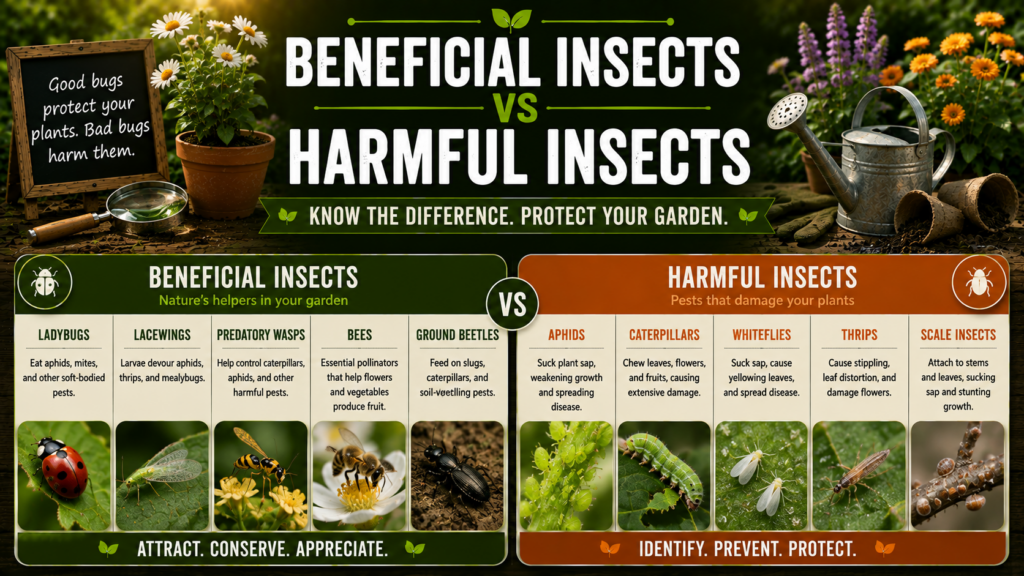
The first time you discover insects crawling over your plants, your instinct may be to reach for the insecticide.
But before you do, take a closer look.
Not every insect in the garden is a pest. In fact, many insects are valuable garden helpers. Some pollinate flowers, while others feed on insects that damage your plants.
Learning to tell the difference between beneficial and harmful insects can help you protect your plants without accidentally harming the creatures that are helping your garden.
It is also worth remembering that an insect can be harmless on one plant but troublesome in large numbers on another. The goal is not to remove every insect from the garden. A healthy garden should contain insects.
The trick is learning which ones need your attention and which ones should be welcomed.
Why Are Insects Important in the Garden?
Insects are an important part of a healthy garden ecosystem.
They perform several different jobs, including:
- Pollinating flowers
- Helping plants produce fruit and seeds
- Feeding on other insects
- Breaking down organic material
- Providing food for birds and other wildlife
- Contributing to the wider food chain
Without insects, many gardens would look very different.
Bees, butterflies and other pollinators are particularly important because they transfer pollen between flowers, helping many plants reproduce.
Other insects act as natural predators, feeding on pests such as aphids and other small plant-feeding insects.
What Makes an Insect a Garden Pest?
A garden insect becomes a pest when its feeding or other activity causes enough damage to negatively affect the plant.
This is an important distinction.
Finding one aphid on a plant does not necessarily mean that the plant has a serious pest problem.
A large population feeding heavily on young shoots, leaves or other parts of the plant may be a different matter.
Signs of significant insect damage can include:
- Large numbers of insects
- Curling or distorted leaves
- Holes in leaves
- Chewed leaf edges
- Sticky leaves
- Damaged flowers
- Damaged fruit
- Stunted new growth
- Visible insects on young shoots
Before treating a problem, try to identify the insect and understand what it is doing.
Common Beneficial Insects
There are many helpful insects found in gardens. Some of the most recognisable include ladybirds, lacewings, hoverflies and various predatory bugs.
Ladybirds
Ladybirds are among the best-known beneficial insects.
Both adult ladybirds and, in some species, their larvae feed on various small insects, including aphids.
The larvae may look quite different from adult ladybirds and are sometimes mistaken for pests.
If you see a small, unusual-looking insect with a longish body and tiny spines on your plant, do not automatically remove it. It may be a ladybird larva.
Lacewings
Adult lacewings are delicate insects with transparent-looking wings.
Their larvae are useful predators and can feed on aphids and other small insects.
Like ladybird larvae, lacewing larvae may not look particularly attractive to someone who is unfamiliar with them, but they can be valuable garden helpers.
Hoverflies
Hoverflies are often mistaken for bees or wasps because some species have similar markings.
Many adult hoverflies feed on nectar and pollen and can contribute to pollination.
The larvae of some hoverfly species feed on aphids and other soft-bodied pests.
If you see a hoverfly visiting your flowers, there is generally no reason to be concerned.
Bees
Bees are extremely important pollinators.
They visit flowers to collect nectar and pollen, and in doing so they transfer pollen between flowers.
If you grow fruit trees, vegetables or flowering plants, attracting pollinators can be particularly beneficial.
Provide a range of suitable flowering plants and avoid unnecessary insecticide use to help create a more welcoming environment for bees.
Butterflies and Moths
Butterflies can be beautiful visitors to the garden and are also pollinators.
However, there is an important distinction to make.
Adult butterflies generally feed on nectar, while their caterpillars need plant material to grow.
Some caterpillars can cause considerable damage to vegetable crops, while others may have little impact.
Therefore, seeing a butterfly does not mean that every caterpillar in the garden should automatically be protected—or that every caterpillar should be removed.
Identification matters.
Common Harmful Garden Insects
There are many insects that can damage plants, but a few are particularly common.
Aphids
Aphids are small, soft-bodied insects that often gather on young shoots, stems and the undersides of leaves.
They feed by sucking plant sap.
Heavy infestations can cause leaves to curl, become distorted or grow poorly.
Aphids may also produce honeydew, a sticky substance that can encourage the development of sooty mould.
The good news is that aphids are also food for several beneficial insects, including ladybird larvae and lacewing larvae.
This is a good example of why simply spraying at the first sign of aphids may not always be the best approach.
Whiteflies
Whiteflies are tiny flying insects that are often found on the undersides of leaves.
They feed on plant sap and can become troublesome when populations grow.
Gently disturbing an affected plant may cause clouds of tiny white insects to fly into the air.
Inspect the undersides of leaves regularly if you suspect whiteflies.
Scale Insects
Scale insects can look quite different from the typical insects people expect to find on plants.
They may appear as small bumps attached to leaves, stems or branches.
Some scale insects feed on plant sap and can weaken plants when present in large numbers.
Because they remain relatively still, they can easily be overlooked.
Thrips
Thrips are very small insects that can damage flowers, leaves and young plant growth.
Damage may appear as silvery patches, distorted growth or discolouration.
Because thrips are so small, they can be difficult for a beginner to identify without looking closely.
Caterpillars
Caterpillars can be either a minor garden visitor or a serious pest, depending on the species and the plant they are feeding on.
Some caterpillars chew holes in leaves or consume large sections of foliage.
Others belong to butterflies or moths that are valuable parts of the garden ecosystem.
If you find caterpillars on a crop, identify them where possible before deciding what to do.
Beetles
Some beetles feed on plant leaves, flowers, roots or fruit and can cause significant damage.
However, “beetle” does not automatically mean “pest”. There are also beneficial beetles that prey on other insects.
Again, identification is important.
Signs That Insects Are Damaging Your Plants
Sometimes you may notice the damage before you notice the insect.
Look for:
- Small holes in leaves
- Ragged leaf edges
- Curling leaves
- Yellowing or distorted new growth
- Sticky leaves
- Chewed flowers
- Damaged fruit
- Silvery marks
- Insects hiding under leaves
- Sudden changes in plant growth
If you find damage, inspect the plant carefully.
Check the tops and undersides of leaves, stems, flowers and even the soil around the base of the plant.
Some pests are very good at hiding.
Look Under the Leaves
One of the simplest habits a beginner gardener can develop is checking underneath leaves.
Many small plant pests spend much of their time there because the underside of a leaf offers protection.
Aphids, whiteflies, scale insects and other pests may be much easier to spot from underneath.
When inspecting a plant, gently turn over a few leaves and look closely.
A small hand magnifying glass can be useful if you are having difficulty seeing very tiny insects.
Don’t Forget About Insect Eggs and Larvae
Finding eggs or larvae can sometimes provide an earlier warning than finding adult insects.
However, not all eggs or larvae are harmful.
Some beneficial insects also lay eggs on plants because their young will feed on pests.
For example, a beginner might see a cluster of unusual eggs or an unfamiliar larva and assume it needs to be removed.
Before doing so, try to identify it.
Learning what beneficial insect eggs and larvae look like can help prevent accidental damage to your garden’s natural pest-control team.
Ants Can Sometimes Point to a Pest Problem
Ants are not necessarily plant pests, but their presence around a plant can sometimes provide a useful clue.
Ants may be attracted to the honeydew produced by sap-feeding insects such as aphids and scale insects.
If you suddenly notice many ants moving up and down a plant, inspect the leaves and stems for aphids or other sap-feeding pests.
The ants themselves may not be the underlying problem.
How to Encourage Beneficial Insects
You can make your garden more welcoming to beneficial insects without doing anything complicated.
Plant flowers
A variety of flowering plants can provide nectar and pollen for adult beneficial insects and pollinators.
Avoid unnecessary insecticide use
Broad-spectrum insecticides can affect beneficial insects as well as pests.
Provide shelter
A garden with different types of plants, ground cover and natural areas can provide shelter for insects.
Keep some diversity
A garden containing only one type of plant offers fewer resources than a garden with a variety of flowers, herbs, vegetables and other plants.
Let some plants flower
Allowing suitable herbs and other plants to flower can provide valuable food for visiting insects.
Natural Pest Control
One of the biggest advantages of encouraging beneficial insects is that they can provide a form of natural pest control.
For example, a garden containing ladybirds and lacewings may have more natural predators of aphids.
This does not mean that beneficial insects will completely eliminate every pest.
Rather, they become part of the garden’s natural balance.
A few pests are often perfectly normal. Problems arise when pest populations increase enough to cause significant damage.
Should You Remove Harmful Insects by Hand?
Sometimes, yes.
If you find a small number of easily identifiable pests on a plant, physically removing them may be a simple first step.
For example, a few larger insects or caterpillars may be easy to pick off and relocate or dispose of appropriately.
This can be especially useful in a small home garden where you can inspect plants regularly.
However, make sure you have identified the insect first.
When Should You Consider Treatment?
Treatment may be appropriate when a pest population is causing significant damage or is likely to threaten the health of the plant.
Before treating, consider:
- What insect is causing the damage?
- How serious is the damage?
- Are beneficial insects present?
- Can the pest be removed manually?
- Can the plant be protected physically?
- Is there a less disruptive treatment available?
If a treatment is necessary, follow the product instructions carefully and use only products suitable for the particular plant and pest.
Do not assume that a stronger concentration will work better.
Avoid Killing Beneficial Insects by Mistake
One of the biggest beginner mistakes is spraying everything that moves.
This can create an unfortunate cycle.
You spray to kill pests, but the treatment also kills beneficial insects. Without as many natural predators, pest populations may later increase again.
By learning to identify helpful insects, you can avoid disrupting this natural balance unnecessarily.
Beneficial vs Harmful: A Simple Guide
Here is a quick way to think about some common garden visitors:
| Insect | Usually helpful or harmful? | Why? |
|---|---|---|
| Ladybirds | Helpful | Many feed on plant pests |
| Lacewing larvae | Helpful | Predators of small pests |
| Hoverflies | Helpful | Adults can pollinate; some larvae eat aphids |
| Bees | Helpful | Important pollinators |
| Butterflies | Helpful | Pollinators as adults |
| Aphids | Can be harmful | Feed on plant sap |
| Whiteflies | Harmful | Feed on plant sap |
| Scale insects | Can be harmful | Feed on plant sap |
| Thrips | Harmful | Can damage leaves and flowers |
| Caterpillars | Depends on species | Some damage crops; others develop into butterflies or moths |
| Beetles | Depends on species | Some damage plants; others are predators |
The word “usually” is important here. There are many different insect species, and identification is more reliable than judging an insect by its general group.
Create a Balanced Garden
A healthy garden is not one without insects.
It is a garden where different organisms interact with one another.
You may have bees visiting flowers, ladybirds hunting aphids, butterflies moving between plants, spiders catching insects and earthworms working through the soil.
At the same time, there may be a few insects feeding on your plants.
This is normal.
The aim is to prevent serious damage while maintaining as much of the natural balance as possible.
Final Thoughts
Learning the difference between beneficial and harmful insects is an important step for any beginner gardener.
Instead of treating every insect as an enemy, take a moment to observe it.
Is it eating your plant? Is it pollinating a flower? Is it feeding on another insect? Is it simply passing through?
The more you learn to recognise the different creatures living in your garden, the easier it becomes to manage genuine pest problems without harming the insects that are helping you.
A garden full of insects is not necessarily a garden with a problem. Sometimes, it is a sign that you have created a living, active environment where nature is doing some of the gardening for you.
Related Articles
Powdery Mildew vs Downy Mildew
Read MoreCommon Fruit Tree Problems
Read MoreUnderstanding Soil Types
Read MoreBenefits of Companion Planting
Read MoreSigns of Overwatering vs Underwatering
Read MoreCommon Seedling Diseases
Read MoreSuccession Planting Explained
Read MoreNatural Ways to Control Aphids
Read More