
Gardening Tips, Organic Gardening
Benefits of Companion Planting
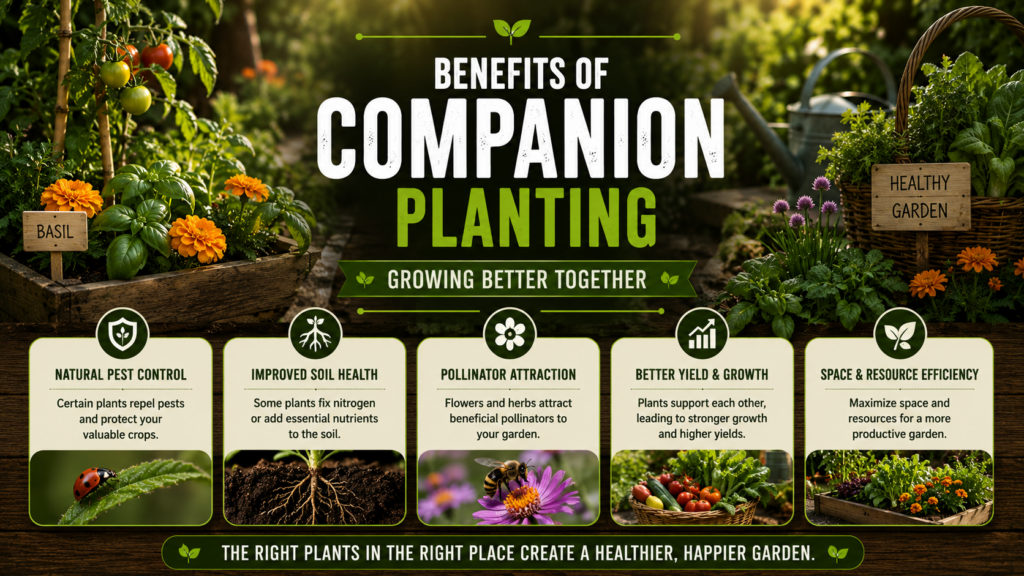
Benefits of Companion Planting
A vegetable garden does not have to be arranged in strict blocks, with tomatoes in one bed, herbs in another and flowers kept somewhere else entirely.
Companion planting takes a different approach. By growing carefully chosen plants together, home gardeners can create a more diverse garden where neighbouring plants may support one another in practical ways.
A flowering herb can attract pollinators and beneficial insects. A tall crop can provide light shade for a more delicate plant. A low-growing companion can cover exposed soil. Strongly aromatic plants may help make a crop less obvious to certain pests, while trap crops can draw pest activity towards plants that are easier to monitor and manage.
For the organic home gardener, companion planting is particularly appealing because it encourages us to work with diversity rather than relying on one solution for every garden problem.
It can also make a garden more productive and enjoyable. Vegetables, herbs and flowers can share the same growing space, creating beds that are useful, colourful and full of insect activity.
The key is knowing which plants are likely to grow comfortably together and what benefit you hope the combination will provide.
What Is Companion Planting?
Companion planting is the practice of growing different plants together because their growth habits or other characteristics may create a useful relationship.
Depending on the combination, companion plants may help by:
- attracting pollinators
- supporting beneficial insects
- making it more difficult for some pests to locate a crop
- acting as trap crops
- providing shade
- covering bare soil
- making use of vertical space
- offering physical support
- increasing biodiversity
- creating a longer flowering season
- filling temporary gaps between slower-growing crops
Some companion planting combinations have been used by gardeners for generations. Others are based on observations of plant growth, insect behaviour and the practical use of garden space.
Not every combination will perform identically in every garden. Climate, pest pressure, soil, spacing and season all influence the result. But that does not make companion planting any less useful. It simply means the best combinations are those that suit your own growing conditions.
Why Companion Planting Is Valuable in an Organic Garden
Organic gardening is about more than replacing a synthetic product with an organic one.
A healthy organic garden is a living system. Plants interact with insects, soil organisms, weather and one another. The more diverse that system becomes, the more opportunities there are for useful relationships to develop.
A garden filled with only one type of plant may offer very little food or habitat for beneficial insects. A mixed garden containing vegetables, flowering herbs and suitable flowers can provide nectar, pollen, shelter and a range of different growing environments.
Companion planting can therefore become part of a broader organic gardening strategy alongside:
- healthy soil
- compost and organic matter
- crop rotation
- mulching
- careful watering
- regular pest inspection
- encouraging beneficial insects
- choosing suitable plants for the season
It is not necessary to transform the whole garden at once. Even a few well-chosen companions can add useful diversity.
Good Companion Planting Combinations for Home Gardeners
For a beginner, long companion planting charts can quickly become confusing.
A more practical approach is to start with the main crop you want to grow, then choose companions that offer a clear potential benefit or fit comfortably into the same growing space.
The following combinations provide a useful starting point.
Tomatoes and Basil
Tomatoes and basil are probably the best-known companion planting pair.
They are convenient neighbours because both enjoy warm growing conditions and can fit naturally into the same productive garden area. Basil adds a different growth habit beneath or near taller tomato plants, and flowering basil is highly attractive to bees and other insects.
Basil is also widely grown as an aromatic companion around tomatoes. Its strongly scented foliage is one of the reasons gardeners value it in mixed plantings.
How to Grow Them Together
Plant basil near tomatoes while still allowing enough space for air to move around the tomato plants.
Avoid packing basil tightly against the tomato stems. Tomatoes can develop fungal disease problems when foliage becomes excessively dense and humid.
A few basil plants positioned around the sunnier edges of a tomato planting can work well.
If you grow several basil plants, consider harvesting some regularly for leaves while allowing one or two to flower for visiting insects.
Potential Benefits
- adds aromatic diversity around tomatoes
- flowers attract pollinators and other insects
- uses lower growing space around taller plants
- both crops enjoy warm-season conditions
- provides a useful kitchen harvest from the same bed
Tomatoes and Marigolds
Marigolds are among the most popular companion plants for tomatoes and other vegetables.
Their bright flowers add diversity to the garden and attract a range of visiting insects. Certain marigold species are also valued for their relationship with some soil-dwelling nematodes, although the effect depends on the type of marigold and the nematode involved.
For the home gardener, marigolds are easy to incorporate around the edges of tomato beds.
How to Grow Them Together
Plant marigolds between widely spaced tomatoes or around the bed edges.
Do not allow mature marigolds to crowd the tomato stems. Compact varieties are often easier to fit into a small vegetable garden.
Potential Benefits
- increases flowering diversity
- attracts visiting insects
- adds ground-level cover
- certain marigolds may be useful in managing some nematode problems
- provides long-lasting colour in the vegetable garden
Tomatoes and Nasturtiums
Nasturtiums can be useful around tomatoes where there is enough room for their spreading growth.
They are widely used in companion planting because they attract pollinators and may draw aphids and certain other pests. This can make them useful as plants to inspect regularly for early pest activity.
How to Grow Them Together
Allow nasturtiums to trail along the outer edge of a tomato bed rather than letting them grow densely through the tomato plants.
Check the leaves and young shoots regularly. If aphids gather heavily on the nasturtiums, manage the infestation before it spreads.
Potential Benefits
- flowers attract pollinators
- can act as a useful indicator or trap plant for some pests
- covers open ground
- leaves and flowers are edible
- adds diversity beneath taller crops
Carrots and Onions
Carrots and onions are a traditional companion planting combination.
The pairing is popular because the two crops have different growth habits and strong differences in scent. Onions and related plants are often used in mixed plantings where gardeners hope to make host crops less obvious to pests.
Carrots develop below ground while onions grow upright, so the combination can also make good use of bed space when planted with sensible spacing.
How to Grow Them Together
Rather than planting individual carrots and onions in a tight alternating pattern, consider growing short neighbouring rows or narrow bands.
This makes thinning, watering and harvesting easier.
Potential Benefits
- different growth habits use space efficiently
- aromatic diversity within the bed
- upright onion foliage creates relatively little shade
- both crops can fit comfortably into organised mixed rows
Carrots With Leeks or Spring Onions
Leeks and spring onions can be used in a similar way to onions.
Their upright growth allows light to reach lower-growing neighbouring crops, while their distinctive scent adds diversity to the planting.
Spring onions are particularly useful in small gardens because they occupy relatively little space and can often be harvested before slower crops reach full size.
Potential Benefits
- efficient use of narrow spaces
- aromatic diversity
- limited shading of carrots
- spring onions can provide an earlier harvest
Cabbage Family Crops and Aromatic Herbs
Cabbage, broccoli, cauliflower, kale and other brassicas are frequently targeted by caterpillars and other pests.
Aromatic herbs are popular companions in brassica beds because their foliage introduces different scents and plant forms around the crop.
Possible companions include:
- thyme
- sage
- rosemary
- dill
- mint grown in containers
- oregano
Not all of these herbs need to be planted directly between cabbages. In many cases, placing them around the edges of a bed is more practical.
How to Grow Them Together
Use compact herbs around bed margins and leave enough space for mature brassicas, which can become surprisingly large.
Rosemary and sage can develop into substantial shrubs, so position them where they will not compete heavily with vegetables.
Mint is best kept in a container because it can spread aggressively through open soil.
Potential Benefits
- increases aromatic diversity
- flowering herbs support visiting insects
- adds several plant forms to the bed
- perennial herbs can create longer-term habitat around productive areas
Brassicas and Dill
Dill deserves special attention as a companion in the vegetable garden.
When allowed to flower, its clusters of small flowers attract a wide range of insects. These can include hoverflies and small beneficial wasps.
This makes dill a useful addition near crops that frequently experience pest pressure.
How to Grow Them Together
Dill can become tall, so position it where it will not heavily shade smaller vegetables.
Allow selected plants to flower rather than harvesting every plant for leaves.
Potential Benefits
- flowers provide nectar and pollen
- attracts a range of visiting insects
- adds vertical diversity
- provides an edible herb harvest
Brassicas and Nasturtiums
Nasturtiums are frequently planted near cabbages, broccoli and related crops.
They may attract aphids and can also draw the attention of certain caterpillar pests, which is why they are sometimes used as trap crops.
The important part is observation. A trap plant should be checked regularly rather than planted and forgotten.
How to Grow Them Together
Grow nasturtiums around the outer edge of the brassica bed where they can spread without smothering young vegetables.
Inspect them frequently for pest build-up.
Potential Benefits
- can serve as a trap or monitoring plant for certain pests
- attracts pollinators
- covers open soil
- adds edible flowers and leaves
Cucumbers and Nasturtiums
Cucumbers and nasturtiums can make an attractive warm-season combination.
Cucumber flowers depend on pollinator activity for good fruit development, and nasturtium flowers attract many visiting insects.
If cucumbers are trained vertically, nasturtiums can occupy lower or outer spaces around the growing area.
Potential Benefits
- flowers encourage pollinator activity
- makes use of different growing levels
- nasturtiums can cover open ground
- creates a highly diverse planting area
Cucumbers and Dill
Dill is another useful companion near cucumbers.
Its flowers attract insects, while cucumbers benefit from good pollinator activity.
The combination is particularly useful when dill is allowed to reach flowering stage.
How to Grow Them Together
Position dill beside rather than directly beneath dense cucumber vines.
Both plants can become vigorous, so allow adequate space and airflow.
Potential Benefits
- supports insect diversity
- dill flowers provide nectar and pollen
- cucumber flowers benefit from active pollinator populations
- both provide an edible harvest
Cucumbers and Radishes
Radishes are often recommended as companions for cucumbers.
One of the practical advantages is timing. Radishes grow quickly and may be harvested while cucumber plants are still young and before the vines occupy their full space.
This makes the combination useful for gardeners trying to get more from a small bed.
Potential Benefits
- radishes provide a quick early harvest
- makes use of temporary open space
- combines well with succession planting
- different growth habits reduce direct competition when properly timed
Beans and Maize
Beans and maize are part of one of the oldest and best-known mixed planting systems.
Climbing beans can use sturdy maize plants as support, while the two crops occupy space differently.
Beans are legumes and can form relationships with nitrogen-fixing bacteria in their root nodules. This makes them valuable plants in diverse growing systems, although it is worth remembering that a growing bean plant uses much of that nitrogen itself.
How to Grow Them Together
Timing is important.
Allow maize to become established before climbing beans begin vigorous growth. If beans are planted too early, they may overwhelm young maize plants.
Choose sturdy maize varieties where the stalks are expected to act as supports.
Potential Benefits
- vertical use of space
- maize can provide physical support
- increased crop diversity
- combines a grass crop with a legume
The Three Sisters: Maize, Beans and Squash
The traditional Three Sisters planting system combines maize, climbing beans and squash.
Each crop occupies the space differently:
- maize grows upright
- beans climb vertically
- squash spreads across the soil surface
The broad squash leaves can shade the ground, while the maize provides structure for climbing beans.
This is one of the clearest examples of companion planting as a complete growing system rather than a simple two-plant pairing.
How to Try It at Home
Give the maize time to establish before sowing climbing beans.
Choose a squash or pumpkin variety suited to the available space. Large trailing varieties can spread far beyond a small bed.
Do not assume the system can be squeezed into a tiny area. All three crops can be vigorous.
Potential Benefits
- uses vertical and horizontal space
- provides living ground cover
- increases crop diversity
- combines plants with different growth habits
- produces several food crops from one area
Lettuce and Tomatoes
Lettuce can be a useful temporary companion for young tomatoes.
Early in the season, newly planted tomatoes leave considerable open space around them. Lettuce can use some of that space before the tomatoes develop a large canopy.
As temperatures rise, taller tomato plants may also provide some light shade.
How to Grow Them Together
Plant lettuce where it can be harvested before the tomato plants become too large and dense.
Avoid crowding the tomato stem or creating a thick mass of foliage that reduces airflow.
Potential Benefits
- makes use of temporary open space
- lettuce provides an earlier harvest
- taller tomatoes may offer light shade
- works well with succession planting
Lettuce and Radishes
This is one of the easiest combinations for a beginner.
Both crops can be grown during suitable cool to mild conditions, and radishes mature quickly.
Radishes can be harvested while lettuce plants are still developing.
Potential Benefits
- efficient use of small beds
- quick radish harvest
- simple combination for raised beds
- useful for succession planting
Lettuce and Spring Onions
Spring onions have narrow, upright leaves and occupy relatively little horizontal space.
This makes them easy to fit near leafy vegetables such as lettuce.
Potential Benefits
- contrasting growth habits
- efficient use of bed space
- limited shading
- both are useful kitchen crops
Peas and Leafy Greens
Peas can be grown vertically on a support while leafy greens occupy lower spaces nearby.
During cooler growing conditions, crops such as lettuce and suitable leafy greens can make good use of the area around a pea trellis.
How to Grow Them Together
Position the trellis carefully so mature peas do not completely shade the lower crop.
In warmer regions, some afternoon shade may be useful. In cool conditions, too much shade can slow growth.
Potential Benefits
- uses vertical and lower growing spaces
- creates several harvests from one area
- suitable for cool-season mixed beds
- leafy crops may benefit from light shade as temperatures rise
Aubergines and Marigolds
Aubergines are warm-season crops that can share beds with flowering companions such as marigolds.
Marigolds add colour and insect activity around the lower edges of the planting while aubergines occupy the taller space.
Potential Benefits
- attracts visiting insects
- adds flowering diversity
- makes use of lower bed edges
- both suit warm-season gardens
Peppers and Basil
Peppers and basil can be comfortable companions because both generally prefer warm conditions.
Basil can occupy spaces between widely planted peppers, provided the bed does not become overcrowded.
Potential Benefits
- similar seasonal growing conditions
- flowering basil attracts insects
- adds aromatic diversity
- produces two useful kitchen crops
Strawberries and Borage
Borage is frequently recommended as a companion for strawberries.
One of its clearest benefits is its flowers, which are highly attractive to bees and other pollinators.
Strawberries benefit from good pollinator activity, making flowering companions valuable around the growing area.
How to Grow Them Together
Borage can become much larger than expected, so give it space.
Rather than planting many borage plants directly among strawberries, one or two nearby may be sufficient for a small garden.
Potential Benefits
- attracts pollinators
- provides a long period of flowers
- increases diversity around strawberries
- flowers are edible
Roses and Aromatic Herbs
Companion planting is not limited to the vegetable garden.
Aromatic herbs such as thyme, lavender and certain other flowering herbs can be useful around roses where growing conditions are compatible.
The herbs add floral diversity and attract visiting insects.
Potential Benefits
- longer flowering interest
- supports insect diversity
- covers some lower spaces
- combines ornamental and useful plants
Flowers That Make Useful Companions in the Vegetable Garden
Flowers are among the easiest ways to introduce companion planting into an organic garden.
They can attract pollinators, provide nectar and pollen for beneficial insects and add diversity among food crops.
Marigolds
Useful around:
- tomatoes
- peppers
- aubergines
- brassicas
- beans
Benefits may include increased floral diversity, visiting insect activity and, with appropriate species and growing methods, effects on certain nematodes.
Nasturtiums
Useful around:
- tomatoes
- cucumbers
- squash
- brassicas
- beans
They attract pollinators, provide ground cover and may act as trap or monitoring plants for some pests.
Alyssum
Useful near:
- lettuce
- brassicas
- tomatoes
- peppers
- many vegetable beds
Its clusters of small flowers are valuable to a range of insects, including hoverflies.
Because alyssum stays relatively low, it can fit around bed edges without heavily shading vegetables.
Calendula
Useful throughout mixed vegetable and herb gardens.
Its bright flowers attract insects and add long-lasting colour to productive spaces.
Borage
Useful near:
- strawberries
- tomatoes
- cucumbers
- squash
Borage flowers are highly attractive to bees. The plant can become large, so spacing matters.
Cosmos
Useful near productive gardens where there is room for taller flowers.
Cosmos provides abundant flowers and attracts many visiting insects.
Sunflowers
Useful near:
- climbing crops
- squash
- cucumbers
- larger vegetable beds
Sunflowers attract pollinators and provide height and structure. They can also create shade, so position them carefully.
Zinnias
Useful around warm-season vegetable gardens.
Their flowers attract butterflies, bees and other insects and can provide colour over a long period.
Herbs That Make Useful Companion Plants
Herbs are particularly valuable because they provide both a harvest and ecological diversity.
Basil
Good near:
- tomatoes
- peppers
- aubergines
Allow selected plants to flower for visiting insects.
Dill
Good near:
- cucumbers
- brassicas
- lettuce and mixed vegetable beds
Its flowers are particularly valuable to beneficial insects.
Coriander
Good throughout:
- vegetable beds
- brassica plantings
- mixed herb gardens
When allowed to flower, coriander attracts many small insects, including hoverflies and beneficial wasps.
Thyme
Good near:
- brassicas
- tomatoes
- aubergines
- bed edges
Its low growth and flowers make it useful in mixed plantings where conditions are suitable.
Rosemary
Good near:
- brassica beds
- beans
- larger mixed gardens
Rosemary is a substantial perennial shrub, so it is usually better beside a vegetable bed than squeezed between annual crops.
Sage
Good near:
- brassicas
- carrots
- larger mixed herb and vegetable areas
Like rosemary, sage needs enough permanent space to develop.
Mint
Often grown near:
- brassicas
- vegetable beds
- outdoor seating and pathways
Mint is strongly aromatic and widely used in companion planting, but it spreads aggressively. Growing it in containers is usually the safest option.
Companion Planting to Attract Pollinators
Many home-grown vegetables depend on or benefit from insect pollination.
Cucumbers, pumpkins, squash and many fruiting crops produce better harvests when pollinator activity is strong.
A garden containing flowers throughout the season gives bees and other pollinators more reason to remain active in the area.
Useful flowering companions may include:
- alyssum
- borage
- calendula
- cosmos
- sunflowers
- zinnias
- flowering basil
- flowering coriander
- dill
- locally suitable indigenous flowering plants
Try to provide a sequence of flowers rather than one short burst.
When one species finishes flowering, another should ideally be starting.
Companion Planting to Support Beneficial Insects
Not every insect in the vegetable garden is a pest.
Ladybirds, lacewings, hoverflies, parasitic wasps and predatory insects can all contribute to keeping pest populations under control.
Many beneficial insects need nectar and pollen during part of their life cycle.
Small, accessible flowers are particularly useful.
Good choices include:
- alyssum
- coriander
- dill
- fennel
- parsley allowed to flower
- other small-flowered herbs and suitable flowering plants
A vegetable garden that contains these resources can become far more active and diverse than one containing crops alone.
Using Companion Plants as Trap Crops
A trap crop is grown because a particular pest may prefer it to the main crop.
Nasturtiums are one of the most familiar examples in home gardens. They are often used near brassicas and other vegetables because they can attract aphids and certain caterpillar pests.
The advantage is that pest activity may become concentrated on a plant that is easy to inspect.
But trap cropping requires management.
Check trap plants regularly. If pest numbers become excessive:
- remove heavily infested leaves
- manage the pest population
- remove the whole trap plant if necessary
The goal is to draw and manage pest activity, not create a permanent breeding site.
Using Tall Plants for Shade
In hot gardens, one plant can sometimes improve conditions for another simply by providing shade.
Possible shade-producing companions include:
- maize
- sunflowers
- trellised beans
- tomatoes
Lower-growing crops such as lettuce and some leafy greens may benefit from light shade during hot periods.
Placement matters.
Observe where morning and afternoon sun fall across the bed. In many hot gardens, protection from intense afternoon sun is more useful than heavy shade throughout the day.
Living Ground Covers
Low-growing companions can help cover exposed soil.
Potential benefits include:
- reduced evaporation
- moderated soil temperatures
- fewer open spaces for weeds
- increased habitat diversity
Possible living ground covers include:
- nasturtiums
- low-growing herbs
- spreading squash in larger spaces
- carefully managed leafy crops
Remember that living ground covers are still plants. They use water and nutrients, so allow enough space for the main crop.
Making Better Use of Small Gardens
Companion planting is especially valuable where space is limited.
Think of the garden in layers:
Vertical layer:
Climbing beans, peas, cucumbers and other trellised crops.
Tall layer:
Tomatoes, maize, sunflowers and tall herbs.
Middle layer:
Peppers, aubergines, brassicas and bush beans.
Low layer:
Lettuce, radishes, spring onions and compact herbs.
Trailing layer:
Nasturtiums, squash and other spreading plants.
Not every bed needs all these layers. The idea is simply to consider whether plants can occupy different spaces without overcrowding one another.
Combining Companion Planting With Succession Planting
Companion planting becomes even more useful when timing is included.
Imagine a bed of newly planted tomatoes.
The tomatoes are still small, leaving open ground between them. Lettuce or radishes can use some of this temporary space. The quick crop is harvested before the tomato plants develop a large canopy.
Basil grows near the tomatoes during warm weather, while marigolds or alyssum flower around the bed edges.
Later, as the season changes, finished crops are removed and replaced.
This combines companion planting with succession planting and allows the garden to change throughout the season.
Companion Planting in Containers
You do not need a large garden to use companion planting.
A sufficiently large container can hold plants with complementary growth habits.
Possible combinations include:
- tomato with basil
- pepper with basil
- strawberry with a compact flowering companion
- lettuce with spring onions
- cucumber on a trellis with nasturtiums trailing at the edge
The main limitation is root space.
All plants in a container share the same water and nutrients, so choose combinations with broadly compatible needs and use a container large enough for mature growth.
Companion Planting Mistakes to Avoid
Companion planting is flexible, but a few common mistakes can reduce its benefits.
Overcrowding
More diversity does not mean filling every centimetre of soil.
Plants still need light, water, nutrients and air movement.
Ignoring Mature Size
A tiny borage seedling can become a large plant. So can rosemary, fennel, squash and many varieties of nasturtium.
Plan for mature growth.
Combining Plants With Very Different Water Needs
Mediterranean herbs that prefer freely draining conditions may struggle beside crops requiring consistently moist soil.
This is particularly important in containers.
Creating Too Much Shade
A sunflower may provide useful afternoon shade or block most of the light from a smaller crop.
Position tall companions carefully.
Forgetting to Manage Trap Crops
A pest-covered trap plant needs attention.
Allowing Aggressive Plants to Spread
Mint is the classic example. Keep vigorous spreaders contained where necessary.
Assuming Companion Plants Replace Garden Care
Companion planting works best alongside good soil, sensible watering, crop observation and appropriate pest management.
A Simple Companion Planting Plan for Beginners
If you are new to companion planting, start with a few easy combinations rather than redesigning the whole garden.
For a warm-season vegetable garden, you might try:
- tomatoes with basil and marigolds
- cucumbers with dill and nasturtiums
- peppers with basil and alyssum
- aubergines with marigolds
- beans with nearby flowering plants
- squash with pollinator-friendly flowers
For cooler growing conditions, try:
- lettuce with radishes
- carrots with onions or spring onions
- brassicas with dill and flowering companions
- peas with lower-growing leafy vegetables
- beetroot with lettuce
- mixed leafy greens with alyssum around the bed edges
These combinations are easy to understand because each plant has a role.
The companion may provide flowers, aromatic diversity, ground cover, vertical growth, an early harvest or more efficient use of space.
Keep Records of What Works in Your Garden
Companion planting results vary between gardens, and that is part of what makes the practice interesting.
A combination that performs beautifully in one area may behave differently elsewhere because of:
- climate
- soil
- rainfall
- pest pressure
- planting density
- bed orientation
- variety choice
Keep simple notes.
Record which plants were grown together, whether pests were noticeable, how well the crops developed and whether the combination was easy to manage.
Photographs are particularly useful. A bed that looks spacious at planting time may be completely full six weeks later.
Over time, you will develop a companion planting system suited to your own garden.
A Practical Approach to Companion Planting
You do not need to memorise hundreds of plant combinations to benefit from companion planting.
Start with a few simple principles:
- grow flowers among or near vegetables
- allow selected herbs to flower
- provide nectar and pollen across the season
- combine plants with different growth habits
- use vertical space
- use quick crops before slower plants expand
- add aromatic diversity
- try manageable trap crops
- use shade deliberately
- avoid overcrowding
- observe which combinations perform well
Traditional companion planting suggestions can provide an excellent starting point. Try them, observe them and adapt them to your own conditions.
A pairing does not need to guarantee complete pest protection to be worthwhile. If it attracts more pollinators, supports beneficial insects, improves use of space, provides another harvest or simply increases diversity, it may already be contributing something valuable.
The Real Benefits of Companion Planting
The greatest benefit of companion planting is that it encourages us to see the garden as a connected growing space.
Tomatoes can share a bed with basil and flowering marigolds. Cucumbers can climb above nasturtiums. Dill can flower near brassicas and attract insect activity. Lettuce can use temporary spaces before larger plants expand. Sunflowers can bring height and pollinators into productive areas.
Each plant adds something different.
For the organic home gardener, this diversity is valuable. It creates more varied habitat, brings flowers into food-growing spaces and encourages closer observation of what is happening in the garden.
Start with a few well-known combinations. Give each plant enough room. Watch how insects respond. Notice which crops grow comfortably together and which combinations become too crowded.
Then adjust the planting next season.
Companion planting is not about finding one perfect chart and following it forever. It is about combining plants thoughtfully, learning from traditional pairings and discovering which relationships work best in your own garden.
A more diverse garden is not only productive. It is often more colourful, more active and far more interesting to grow.
Related Articles
Composting for Beginners
Read MoreBeneficial Insects vs Harmful Insects
Read MoreCommon Fruit Tree Problems
Read MoreUnderstanding Soil Types
Read MoreBenefits of Organic Gardening
Read MoreSigns of Overwatering vs Underwatering
Read MoreCommon Seedling Diseases
Read MoreSuccession Planting Explained
Read More